Our federal government is shut down, thousands are on work furlough, our president is spitting mad, pointing fingers and continuing to blatantly show how under qualified he is to run our nation.
My husband and I are about to sell our calves, which means we will be getting our single livestock related paycheck for the year - the one we pay all our annual bills with. Due to having young rancher loans, my husband has to have the signature of a government worker that has been ordered not to work on his check before he can deposit it. If we cannot deposit that check, we will be unable to make our land, insurance and operating loan payments, along with numerous other smaller payments that are coming due before the end of the year.
We are definitely affected, and I tell you this first so you understand that my opinion is not that of someone who is in no way impacted by this shutdown, but as someone whose home and business are completely in question if things are not rectified in a timely manner.
The thing that makes me maddest is the general public's cry for a fix by Congress, their outrage against the other party, and the general mindset that Congress is solely responsible for this mess and consequently for fixing it.
Who elected Congress? I did, and you did. Without the American voter they would not be in a position to make decisions, or refuse to make decisions. We as citizens are the only reason each and every elected official, at any level of government, has a job/position.
This is our problem. The people responsible for this mess we're in is you and I, for our ignorance, lack of research, and/or refusal to show up and vote. For the general, lazy mindset in this country today that someone should fix it and take care of it for you, and for making Congress the latest responsible party for fixing what we should have fixed as citizens before it ever got to this point.
Now, I'm not saying that every single member of Congress is against working for the people, reaching solid solutions, or that every single American citizen made poor voting decisions. Based on what I've heard and read so far, the members I voted for that were elected are acting in ways I support the majority of the time. I have met with them in person and communicated with them in other ways to let my opinion, as a voting constituent known, in an effort to provide them insight as to what myself and my family, friends and neighbors expect of them.
What this also means is that going forward, we this citizens are responsible for helping to rectify this current mess and prevent a similar one in the future. That is done by knowing the issues, forming an opinion based on facts, communicating with your elected officials on your opinion and reasons for it, following future campaigns, and showing up to vote for the person who will work best on behalf of your community, occupation, religious beliefs, money management viewpoints, etc...
It is not accomplished by whining, spouting opinions that are based on nothing, pointing fingers everywhere but at yourself, and electing government officials on their looks, race or social status instead of on their ability to effectively run our country in a way that will make you proud to be an American.
You better believe that as a citizen of a new state I fully intend to do my research and vote as a well informed citizen in the next election, and continue to do my part to bring a stop to the current nonsense happening daily in our nations capital. I hope you will as well.

Showing posts with label American Agriculture. Show all posts
Showing posts with label American Agriculture. Show all posts
Wednesday, October 2, 2013

Tuesday, February 12, 2013
Agriculture in Arizona

I am in the airport, on the way home from the the AFBF Young Farmer & Rancher Annual Leadership Conference, which was held in Phoenix, AZ over the last three days. If you ever get the chance to attend this event, I cannot recommend it enough. I've been two years in a row, and it has been one of my all-time favorites each time.
We had roughly two and a half days of meetings, speakers, networking meals and the collegiate discussion meet to keep us occupied. There will be more coverage of that in the publications I write for, and hopefully on here as well in upcoming weeks.
On the last day, we toured local agriculture operations. On my tour we went to a dairy that has 28,000 animals, 8,000-9,000 of which are milking cows (the rest are the calves and yearlings that aren't milking age yet). We also went to the place that provides places like Hobby Lobby and Pottery Barn with much of their plant based home decor items, like wheat wreathes. Our last stop was a college ag research center, where we saw a cotton gin built in the 1930's process cotton. Very cool!
Here is a quick rundown of some other things I learned about agriculture production and issues in AZ:
- They get 8-10 cuttings of alfalfa a year! Their major markets are local dairies, like the one I visited.
- One man said if he pulls out of his field and gets mud on the highway, there is a first-time fine of $10,000, and after that it goes to $20,000 per fine.
- Dust regulation is also a big deal, and when the wind blows the sand around (it is a desert...) they call the farmers to let them know they're creating too much dust based on what their daily allotments are.
- It costs $50 per acre foot of water, if you have a water right. People either have water rights or don't, depending on whether they farmed during specific years in the 1970's, or not.
- The area around Phoenix gets 8 inches of moisture a year, in about two storms most of the time. If you raise a crop, you irrigate it.
- Irrigation water comes from captured snow pack runoff and from collecting water during the major storms bringing the land it's annual precipitation.
- The first single row cotton picker could pick 9,000 lbs. of cotton a day. The best human worker could pick between 400 and 450 lbs.
- If you see illegal aliens in southern Arizona, and they're in a row walking along, that's called a mule pack. If they have little backpacks, they're probably alright. But, if they have big backpacks, they're likely each full of 100 pounds of marijuana or cocaine, and there will be people at the front and back with machine guns that will kill you.
- Our local Arizonan on our tour bus said these illegals coming through have completely destroyed the landscape in very southern Arizona, littering it with trash and making ranching dangerous and nearly impossible.
- One major reason for not putting up a more permanent fence (our local said its old, three-wire barbwire with no border markings in most rural areas) between us and Mexico is because a few herds of antelope and elk travel back and forth, and the government doesn't want to eliminate their connectivity. This also results in cattle between the two countries mixing regularly.
- On nights will full moons, cattle pots of illegals will be dropped at the border, and walking across. Don't go hunting or cow gathering when there's a full moon.
- If you get caught in Mexico with a gun, it's so many years in prison for each bullet in your gun. And their prisons are known for their "great hospitality." Hello America....
Thursday, October 11, 2012
Farmers and Ranchers: There is a difference
In the last year or two I have noticed the word "farmer" being used more and more as a general term for the face of agriculture From the media covering agriculturalists collectively as farmers, to being asked by other people in our industry if I'm a cattle farmer, I've seen this trend grow and gain popularity across the country.
It's not that I dislike being called a farmer, or feel they're somehow lesser than ranchers, not at all. It's that they have a different job description from mine. Equally important and similar in that both farmers and ranchers raise food, but still very different in what foods they raise and how they produce those foods.
Farmers raised crops, and hog, dairy and poultry producers are also frequently called farmers. They use a lot of machinery that I have never driven, can't tell you the name of, or what specific purpose it has. They are soil and fertilizer experts, seed variety gurus and plant growing geniuses. They maximize their land potential through the crops they grow, and are often located on the most productive lands in the country.
Ranchers raise cattle or sheep. We use horses and/or 4-wheelers, and a farmer would laugh hysterically at our "machinery." We manage our land to do its best job producing native grass species, and are often doing this on lands unsuitable for farming due to lack of topsoil, moisture, or rough topography. We maximize our lands potential through the pounds we put on our livestock. We are fence fixers, cattle genetic researchers, and we put our water in a tank instead of on the ground.
Farms are also smaller on average than ranches, but that doesn't mean their production is less or the workload is lighter. Farmers have to spend a lot more time per acre on their land to plant, grow and harvest a crop. In comparison, ranchers spend their time gathering, moving and working their livestock, and implementing fences and watering systems, in a fashion that maintains or improves the native condition of their land. Farmers divide their operation up by fields or paddocks, ranchers by pastures.
Again, both very important, but not the same.
Sure, there are those who overlap, and do both. But, for the most part in my part of the world people fall more into one category or the other. There are also those foods that require contributions from both farmers and ranchers before they make it to your plate, and those that come straight from a farm or ranch, through processing, and into the human food chain.
It bothers me that these two very important careers are being lumped together in an attempt to make our industry more understandable. I think it's critically important to inform people accurately, and when people within ag can't tell me what the difference between a farmer and rancher is, it worries me that the general public, who knows little about our industry, will also miss the important contributions both groups make to their dinner tables.
Thank a farmer for your dairy, fruits and vegetables, and thank a rancher for your , lamb and steak!
It's not that I dislike being called a farmer, or feel they're somehow lesser than ranchers, not at all. It's that they have a different job description from mine. Equally important and similar in that both farmers and ranchers raise food, but still very different in what foods they raise and how they produce those foods.
Farmers raised crops, and hog, dairy and poultry producers are also frequently called farmers. They use a lot of machinery that I have never driven, can't tell you the name of, or what specific purpose it has. They are soil and fertilizer experts, seed variety gurus and plant growing geniuses. They maximize their land potential through the crops they grow, and are often located on the most productive lands in the country.
Ranchers raise cattle or sheep. We use horses and/or 4-wheelers, and a farmer would laugh hysterically at our "machinery." We manage our land to do its best job producing native grass species, and are often doing this on lands unsuitable for farming due to lack of topsoil, moisture, or rough topography. We maximize our lands potential through the pounds we put on our livestock. We are fence fixers, cattle genetic researchers, and we put our water in a tank instead of on the ground.
Farms are also smaller on average than ranches, but that doesn't mean their production is less or the workload is lighter. Farmers have to spend a lot more time per acre on their land to plant, grow and harvest a crop. In comparison, ranchers spend their time gathering, moving and working their livestock, and implementing fences and watering systems, in a fashion that maintains or improves the native condition of their land. Farmers divide their operation up by fields or paddocks, ranchers by pastures.
Again, both very important, but not the same.
Sure, there are those who overlap, and do both. But, for the most part in my part of the world people fall more into one category or the other. There are also those foods that require contributions from both farmers and ranchers before they make it to your plate, and those that come straight from a farm or ranch, through processing, and into the human food chain.
It bothers me that these two very important careers are being lumped together in an attempt to make our industry more understandable. I think it's critically important to inform people accurately, and when people within ag can't tell me what the difference between a farmer and rancher is, it worries me that the general public, who knows little about our industry, will also miss the important contributions both groups make to their dinner tables.
Thank a farmer for your dairy, fruits and vegetables, and thank a rancher for your , lamb and steak!
Sunday, August 12, 2012
Good Reads
I've come across some great blogs and posts lately that are telling people about agriculture in various forms. I always enjoy reading what other people have to say, and these people are doing a great job! A couple of these sites have also featured my posts and one featured me as a rancher, which was very nice of them.
So, if you're looking for a good read over the weekend, here's what I've enjoyed reading lately:
Hoosier Farm Babe Tell Tail's post on hog gestation crates, found here. Hog people are always getting slammed on their use of gestation and farrowing crates by people who have no understanding of raising hogs, and this was a great response to the benefits of using them. Very interesting, and I have no doubt that what I learned reading this post will come in very handy at some point.
High Heels & Shotgun Shells post on educating the misinformed, found here. She shows a response to a CBS article on the drought in Arkansas that was written by someone who obviously dislikes our industry tremendously. It's important to see what these people are saying, what their opinions are, and how they respond to anything ag-affiliated. Check out what this radical commenter said, and her response. Go respond to the article yourself if you're so inclined. She has a link to it included in the post.
Have you seen the Faces of Agriculture blog? I think this is best idea - the ladies running this blog send you some questions, then compile a feature blog post with your answers and photos. The idea is to show a more personal side of the agriculture industry through introducing readers to individuals. They've featured farmers, ranchers and other ag-affiliated folks from all over the country. Here's the link to their post on me. When you're done, be sure to click on home to see all the more recent posts. They are also always looking for new people to feature on their blog, and their contact information is available on their page.
If you're interested in reading more about agriculture in Wyoming, I highly recommend the RealRanchers site. A good friend of mine heads this project of telling the story of Wyoming agriculturalists through social media, and she does a great job! You'll see a few of my blog posts on the site, in addition to posts from other Wyomingites on numerous topics. Always a great stop
So, if you're looking for a good read over the weekend, here's what I've enjoyed reading lately:
Hoosier Farm Babe Tell Tail's post on hog gestation crates, found here. Hog people are always getting slammed on their use of gestation and farrowing crates by people who have no understanding of raising hogs, and this was a great response to the benefits of using them. Very interesting, and I have no doubt that what I learned reading this post will come in very handy at some point.
High Heels & Shotgun Shells post on educating the misinformed, found here. She shows a response to a CBS article on the drought in Arkansas that was written by someone who obviously dislikes our industry tremendously. It's important to see what these people are saying, what their opinions are, and how they respond to anything ag-affiliated. Check out what this radical commenter said, and her response. Go respond to the article yourself if you're so inclined. She has a link to it included in the post.
Have you seen the Faces of Agriculture blog? I think this is best idea - the ladies running this blog send you some questions, then compile a feature blog post with your answers and photos. The idea is to show a more personal side of the agriculture industry through introducing readers to individuals. They've featured farmers, ranchers and other ag-affiliated folks from all over the country. Here's the link to their post on me. When you're done, be sure to click on home to see all the more recent posts. They are also always looking for new people to feature on their blog, and their contact information is available on their page.
If you're interested in reading more about agriculture in Wyoming, I highly recommend the RealRanchers site. A good friend of mine heads this project of telling the story of Wyoming agriculturalists through social media, and she does a great job! You'll see a few of my blog posts on the site, in addition to posts from other Wyomingites on numerous topics. Always a great stop
Thursday, April 26, 2012
DOL Child Labor Law Withdrawn!
Today the Obama Administration and the Department of Labor withdrew their proposed child labor law, which would have significantly limited what farm and ranch work a person under 16 years of age could participate in. This is a HUGE win for agriculture and rural communities across the country!!
The Labor Department's statement:
“The Obama Administration is firmly committed to promoting family farmers and respecting the rural way of life, especially the role that parents and other family members play in passing those traditions down through the generations. The Obama Administration is also deeply committed to listening and responding to what Americans across the country have to say about proposed rules and regulations. As a result, the Department of Labor is announcing today the withdrawal of the proposed rule dealing with children under the age of 16 who work in agricultural vocations. The decision to withdraw this rule – including provisions to define the ‘parental exemption’ – was made in response to thousands of comments expressing concerns about the effect of the proposed rules on small family-owned farms. To be clear, this regulation will not be pursued for the duration of the Obama Administration. Instead, the Departments of Labor and Agriculture will work with rural stakeholders – such as the American Farm Bureau Federation, the National Farmers Union, the Future Farmers of America, and 4-H – to develop an educational program to reduce accidents to young workers and promote safer agricultural working practices.”
How much of this is genuine concern over the nation's reaction to the proposed rule, and how much is election year hype, is a little questionable. But, at least it happened. I was thrilled to hear it, and sincerely hope they meant what was said about not ever pursuing it again during the Obama Administration.
Yay for good news on the political front! Hasn't been a whole lot of that recently. Also a huge thank you to all the people who wrote comments, contacted their elected officials, worked on the political front lobbying against it, worked on it through their careers, or helped in any other way!
I'm so glad I won't be breaking the law when I make my kids work someday.
The Labor Department's statement:
“The Obama Administration is firmly committed to promoting family farmers and respecting the rural way of life, especially the role that parents and other family members play in passing those traditions down through the generations. The Obama Administration is also deeply committed to listening and responding to what Americans across the country have to say about proposed rules and regulations. As a result, the Department of Labor is announcing today the withdrawal of the proposed rule dealing with children under the age of 16 who work in agricultural vocations. The decision to withdraw this rule – including provisions to define the ‘parental exemption’ – was made in response to thousands of comments expressing concerns about the effect of the proposed rules on small family-owned farms. To be clear, this regulation will not be pursued for the duration of the Obama Administration. Instead, the Departments of Labor and Agriculture will work with rural stakeholders – such as the American Farm Bureau Federation, the National Farmers Union, the Future Farmers of America, and 4-H – to develop an educational program to reduce accidents to young workers and promote safer agricultural working practices.”
How much of this is genuine concern over the nation's reaction to the proposed rule, and how much is election year hype, is a little questionable. But, at least it happened. I was thrilled to hear it, and sincerely hope they meant what was said about not ever pursuing it again during the Obama Administration.
Yay for good news on the political front! Hasn't been a whole lot of that recently. Also a huge thank you to all the people who wrote comments, contacted their elected officials, worked on the political front lobbying against it, worked on it through their careers, or helped in any other way!
I'm so glad I won't be breaking the law when I make my kids work someday.
Wednesday, April 25, 2012
BSE Buzz
If you haven't heard, there was a dairy cow who tested positive for BSE (Bovine Spongiform Encephalopathy), also called "Mad Cow Disease" (whoever called it that must have been mad themselves) in California this Tuesday.
A few things to keep in mind about this:
1. This cow was found during targeted testing and surveillance, which ultimately means our system is working! She was never anywhere near our food supply, and there is no risk to human health. USDA was on top of things, and their surveillance and testing system worked as designed.
2. BSE is not contagious through milk or beef. It's a neurological disease. I'm still eating meat and drinking milk and am not concerned. At all.
3. This is an atypical form of BSE, which is another positive because it means the cow didn't contract the disease through her feed source.
4. Our industry is on top of responding to this issue in a positive and informative light, which helps get the accurate and factual information out there for everyone who may not know about BSE, and who may have concerns after hearing the news of the infected cow.
The video below is one such example. USDA's Chief Veterinarian answers questions regarding the BSE case, the safety to consumers, livestock and our country's trade position
Here are a few additional resources you can check out to learn more accurate information about BSE.
BEEF Magazines BSE information compilation page
BSE Information website
A few things to keep in mind about this:
1. This cow was found during targeted testing and surveillance, which ultimately means our system is working! She was never anywhere near our food supply, and there is no risk to human health. USDA was on top of things, and their surveillance and testing system worked as designed.
2. BSE is not contagious through milk or beef. It's a neurological disease. I'm still eating meat and drinking milk and am not concerned. At all.
3. This is an atypical form of BSE, which is another positive because it means the cow didn't contract the disease through her feed source.
4. Our industry is on top of responding to this issue in a positive and informative light, which helps get the accurate and factual information out there for everyone who may not know about BSE, and who may have concerns after hearing the news of the infected cow.
The video below is one such example. USDA's Chief Veterinarian answers questions regarding the BSE case, the safety to consumers, livestock and our country's trade position
Here are a few additional resources you can check out to learn more accurate information about BSE.
BEEF Magazines BSE information compilation page
BSE Information website
Tuesday, March 27, 2012
Lean Finely Textured Beef, NOT pink slime
Have you heard the pink slime buzz that's been going on for the past several weeks? I have a little (how could anyone miss it all) but have been pretty caught up on calving.
Above is a great video that tells the real story on what is really Lean Finely Textured Beef, not pink slime.
I'm embarrassed for mainstream media, who got it so very wrong.
Wednesday, March 21, 2012
Do you know: Where your food dollars go?

Did you know that farmers and ranchers received only 16 cents on average out of every retail dollar spent on food that was eaten at home and away from home in 2011? In 1980, farmers received 31 cents out of every retail dollar spent on food in America.
Off-farm costs (marketing expenses associated with processing, wholesaling, distributing and retailing of food products) account for 84 cents of every retail dollar spent on food in 2011.
Wednesday, February 29, 2012
Do you know: Who Farmers Feed?
I have pondering how to improve my blog more than usual lately. With such a busy February, I felt like it slipped backward a little, and I don't like that. I also lost two followers (gasp, sigh). I fully realize that I too add and delete who I am following, and it really isn't that big of a deal, but then again it is.
So, please let me know if you have aspects you particularly like/dislike on here, and any suggestions as I move forward. My most popular posts continue to be the ones that document a task on the ranch with lots of pictures, and those aren't going anywhere. The posts of just photos are also well-received based on number of page views, and I'm not likely to stop taking mountains of photos anytime soon, so those too are safe.
My thoughts are to make a few minor changes that will hopefully make it a better blog to read, and provide me with a few more ways to post regularly. One of these ideas is to start including posts highlighting an interesting ranching/farming/agriculture fact about once a week.
I was given a couple Farm Bureau resources while in Michigan that are jam packed with great facts and figures about agriculture, and I really enjoyed reading them. I also learned a lot. Basically, what Farm Bureau did was take USDA facts and figures, and put them in sentence form. Much more interesting than reading the information as USDA publishes it! I plan to make these the backbone source of information for these new, "Did you know," posts, and throw in additional facts I hear at various events.
So, without further ado, here is the first week of this. Some of these will be things you may already know, and hopefully everyone will learn a thing or two as we go. I know I did as I browsed through the sources I'm pulling these from!

Did you know that today, each U.S. farmer produces food and fiber for 154 people in the U.S. and abroad? This compares to each farmer feeding 19 people in 1940, and 46 people in 1960.
In 1935, the number of farms in the U.S. peaked at 6.8 million. By 1940, there were 6.3 million U.S. farms. Today, there are 2.2 million farms.
Since 1950, the total U.S. crop yield (tons per acre) has increased more than 360 percent. Even though there are fewer farms today, farmers continue to improve their production practices and utilization of modern tools and technologies to increase productivity and maintain their ability to feed a growing world population.
So, please let me know if you have aspects you particularly like/dislike on here, and any suggestions as I move forward. My most popular posts continue to be the ones that document a task on the ranch with lots of pictures, and those aren't going anywhere. The posts of just photos are also well-received based on number of page views, and I'm not likely to stop taking mountains of photos anytime soon, so those too are safe.
My thoughts are to make a few minor changes that will hopefully make it a better blog to read, and provide me with a few more ways to post regularly. One of these ideas is to start including posts highlighting an interesting ranching/farming/agriculture fact about once a week.
I was given a couple Farm Bureau resources while in Michigan that are jam packed with great facts and figures about agriculture, and I really enjoyed reading them. I also learned a lot. Basically, what Farm Bureau did was take USDA facts and figures, and put them in sentence form. Much more interesting than reading the information as USDA publishes it! I plan to make these the backbone source of information for these new, "Did you know," posts, and throw in additional facts I hear at various events.
So, without further ado, here is the first week of this. Some of these will be things you may already know, and hopefully everyone will learn a thing or two as we go. I know I did as I browsed through the sources I'm pulling these from!
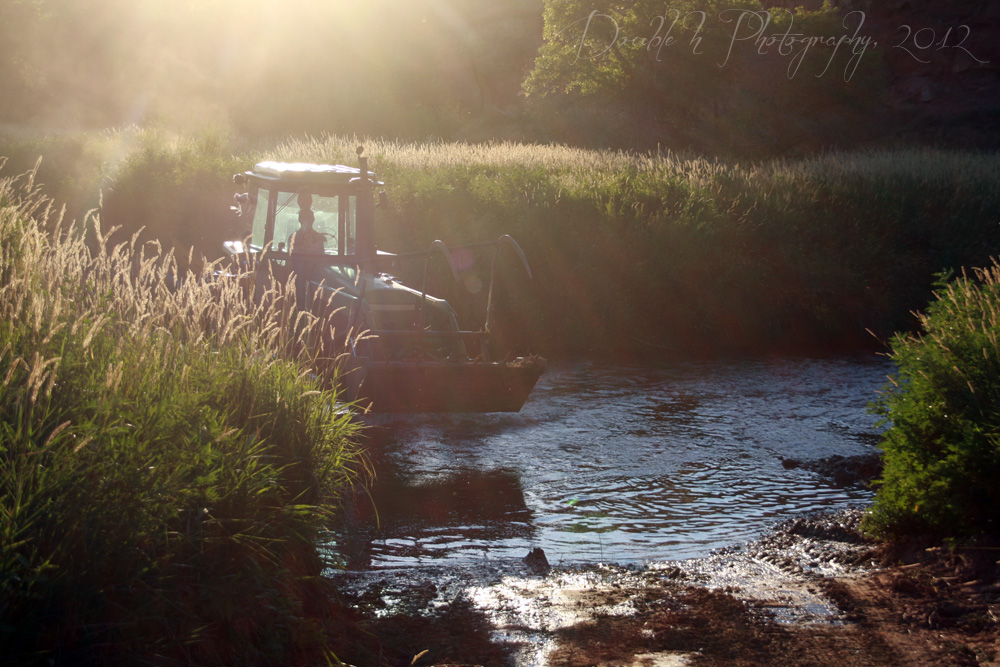
(Tractor equals farming where I'm from, sorry for those of you who are really from farm country)
Did you know that today, each U.S. farmer produces food and fiber for 154 people in the U.S. and abroad? This compares to each farmer feeding 19 people in 1940, and 46 people in 1960.
In 1935, the number of farms in the U.S. peaked at 6.8 million. By 1940, there were 6.3 million U.S. farms. Today, there are 2.2 million farms.
Since 1950, the total U.S. crop yield (tons per acre) has increased more than 360 percent. Even though there are fewer farms today, farmers continue to improve their production practices and utilization of modern tools and technologies to increase productivity and maintain their ability to feed a growing world population.
Tuesday, March 15, 2011
National Ag Day
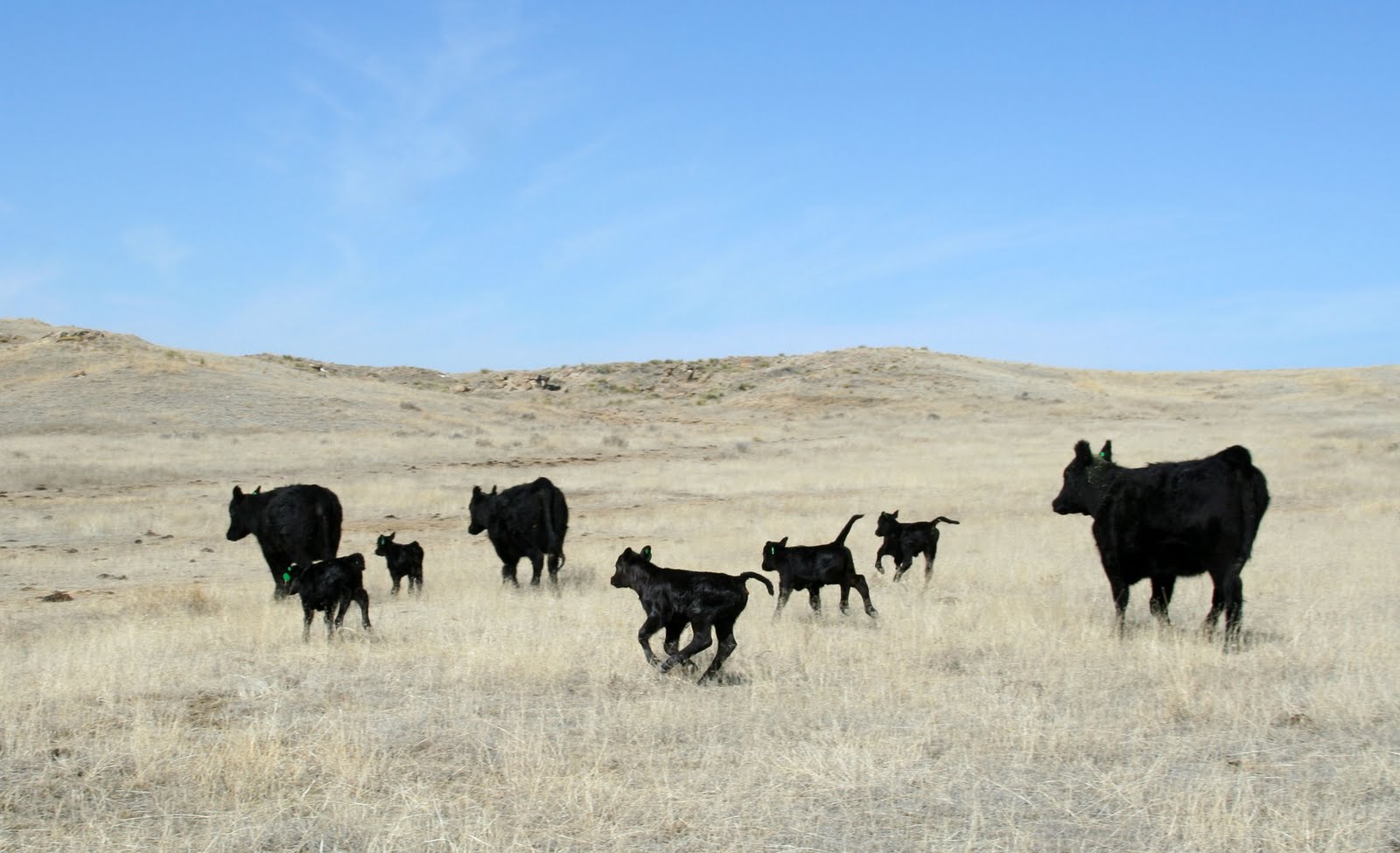 Today is National Ag Day. If you aren't involved in agriculture, take a moment to celebrate and thank the farmers and ranchers that provide you with the food you eat, clothes you wear, and countless other necessary items in your daily life. While this is just one day a year, those of us who make a living in agriculture are fortunate enough to celebrate agriculture every day, while we make these products for our country and world.
If you want to know more about National Ag Day, you can go here.
If you want to know more Wyoming agriculture, and what we do, go here.
Subscribe to:
Posts (Atom)