
First they gathered the cows and calves, and sorted. This was also weaning day for this bunch. The calves can be seen in the far pen, and will stay there until they no longer miss their mothers.
 We preg check to eliminate any cows that aren't pregnant in our herds each year. There are several reasons to get rid of cows who aren't going to calve the following spring. Economics is a big one. It costs money to feed, vaccinate, transport and care for a cow and her calf year-round. An open cow can be replaced with one who will raise a calf for you, and calves are how you pay for the expenses.
 Where I'm from the rule of thumb is it takes 7 years to pay for a cow, then everything she produces for you after you've had her in production 7 years is profit. Everything up until that point pays for the costs you incurred getting her grown up, bred and those annual expenses I mentioned. If you have to sell her much before she is 7, you will lose money. If you sell her when she over 7, whatever she brings is profit. Cows typically make it 10 years where I'm from, so the margin of income isn't really high...we want our cows to be bred!
Another reason to get rid of open cows is that if she doesn't have a calf for a year some people (myself included) believe she loses a lot of her mothering ability.
So if you keep her another year and she has a calf, you have double the money in her to get that calf, and she may not like it because she hasn't been a mother for so long. This could result in the calf dying, or being scrawny.
There are also sexually transmitted diseases in cattle, and one of the main symptoms for these diseases are cows who abort their calves early (which you wouldn't notice, except she wouldn't be pregnant in the fall) or cows who simply don't breed.
Getting rid of any open cows significantly reduces the risk of these sexually transmitted diseases infecting your herd, and pretty much eliminates the chance of some of them occurring.
There are other reasons for preg-checking, and they vary from operation to operation, but those are the two biggest ones- Economics and a means of preventing disease in your herd.
I personally feel it's an important management decision and I disagree with those people who don't get rid of their open cows, either through preg-checking and selling them in the fall, or selling them the following spring when they don't have a calf, and before the bulls are turned in.
 Here's what we did. First we maneuvered the vet's hydraulic chute into place. Using a hydraulic chute makes it easier to handle the animals and isn't as hard on the people running the chute.
 Here is the setup. Please note the camera bag. I put it there for a specific story I will tell in another post. My job was moving cattle up this alleyway to the chute to be pregged.
Those cement blocks hanging there are for the gate at the end of the alley that can be seen in the above and below pictures. The gate is weighted, and you can just barely pull on it and it will go up or down.
When I was very little my job was to close this gate when the cows went in the alley. My grandpa was in the back in those days, and I took my job very seriously and enjoy the memory now.
 Here's the other side of the alleyway in the previous picture. Cows come down a large alley, around a 90-degree corner, and into a single-file alleyway. My cousin was in the back and can be seen loading the alleyway I was in charge of. I mentioned being "in the back," and that refers to the the position he has. He's in back of the alley for the day.
 The gate...This gate prevents cows in front of it from back up the alley and either getting out or smashing the cows behind them. It is almost perfectly balanced, and the cows know to bump it, which will cause it to swing up like the photo below.
 Then they walk forward, and ideally the gate hangs like it is here. If she backs up it is low enough that her tailhead will catch it and cause it to swing down, preventing her from getting out. This gate is the key to this alley, and keeps everything moving efficiently.
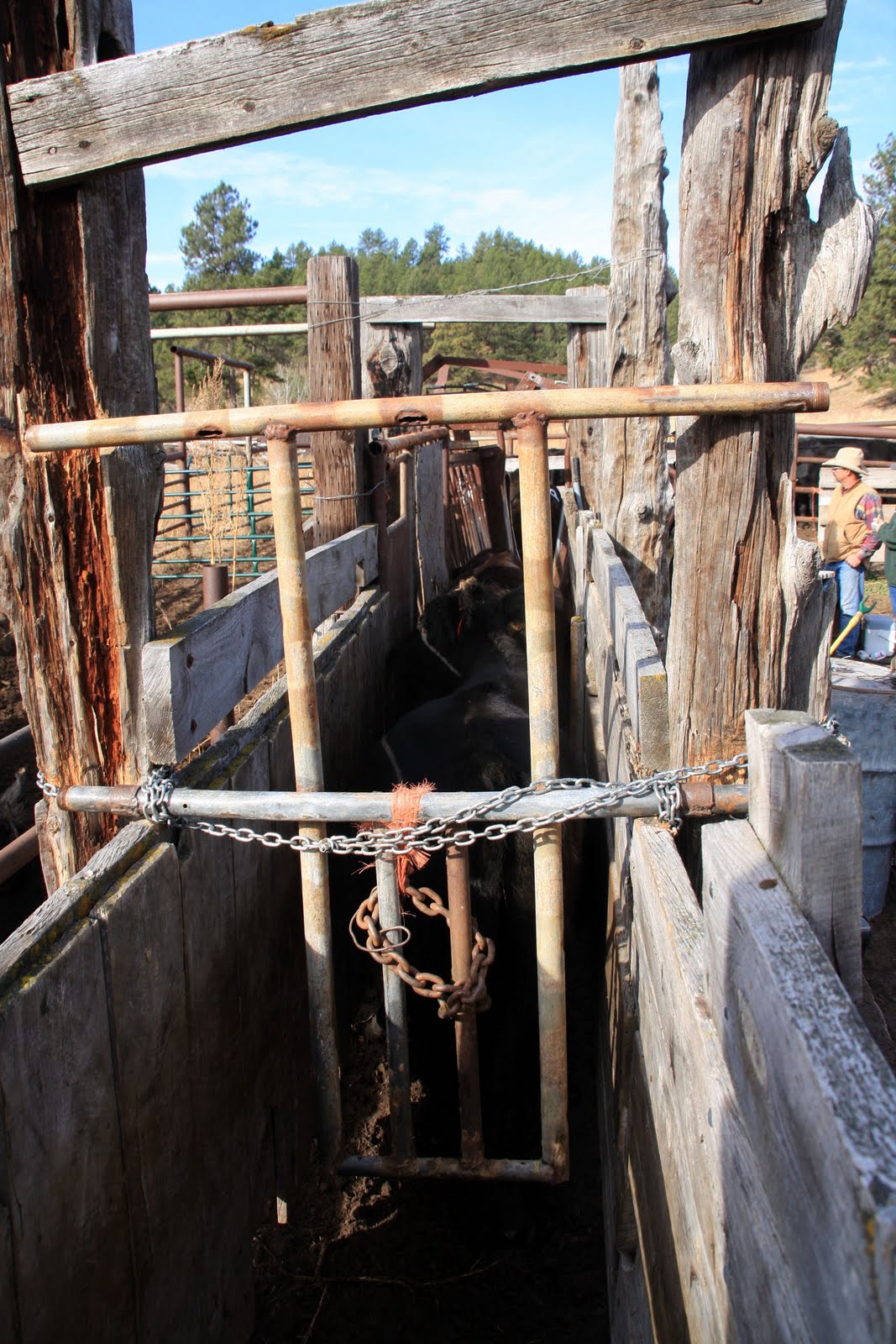 It's also scary. I've seen my dad get his head caught between the wooden poles and the top horizontal pipe when a cow backed up. My uncle jerked it down and drug my dad out. You want to watch how you handle it and keep your neck, fingers and everything out of the path between the top horizontal pipe and the wooden pole.
 Here's the alleyway full, and the gate partially up as a cow goes under it.
 Then they enter the chute, and the vet "Doc" performs the rectal pregnancy check. He will loudly yell "PREGNANT" or "OPEN" after he checks each cow. He wear's a plastic sleeve on his arm and washes after every cow. If a cow is open, he dunks a big "O" (for open) in his bucket of bright white paint, and puts an "O" on either side of the cow's back so she is easily identifiable. He also has a big "P" and can put that on cows too.
 We sort off any cows that are over a certain age and sell them because as they age they wear their teeth out and have a harder time staying in good condition through the colder months. The old cows all get an O or a P to help sort them at the salebarn. The cows we are keeping that are pregnant don't get any mark.
 Cows also get poured with a pesticide that will kill any bugs, like lice or worms, that they may have. This is called a spray gun, and it's attached to a plastic bottle filled with the pesticide. The gun measures a set amount of the liquid, then someone sprays it down the back of each cow. She absorbs it through her skin and it kills a variety of pests if any are in her.
 Cows are also given a shot to prevent them from getting any respiratory diseases over the winter. Pregging is a chance to do a variety of other health-related things to cows in the fall. It's all about efficiency, and we try to run the cows down the alleyway and through the chute as little as possible. This is because it takes time, and why not do it all at once while the cows, vet and working crew are all present.
 After all that the cow exits the chute and heads back up the corral. You can see the vet's plastic sleeve in this picture. He also wears full-body coveralls, and they can get messy.
After all the cows had been run through we either haul or trail them to their winter pasture.


