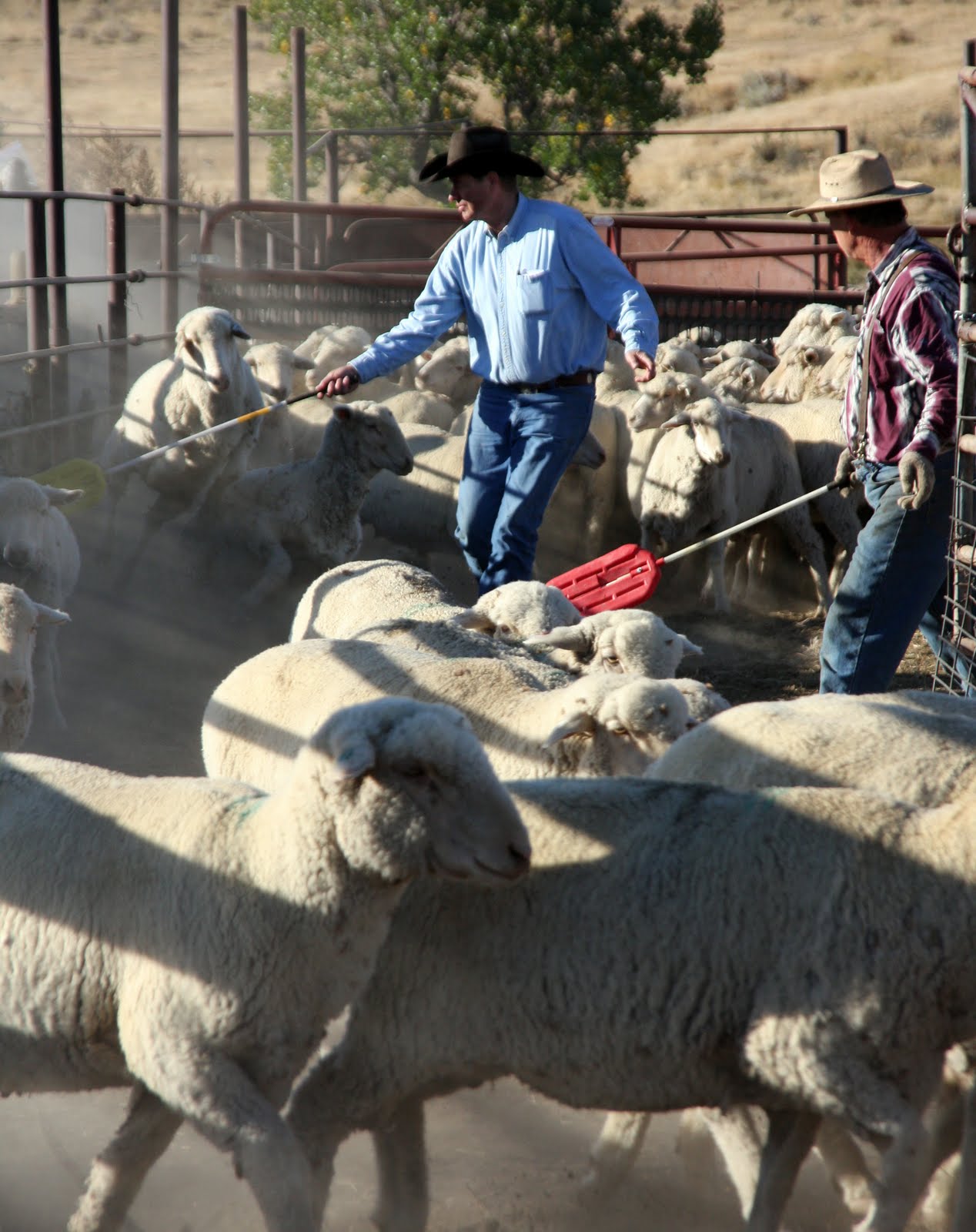
We are finally finished with our fall cattle work as of Nov. 8. This run of weaning, shipping, preg-checking and hauling off drys usually takes 3-4 weeks. It took three months this year. Above is a photo from August 27 - the day we weaned our first calf heifers. Also the earliest my father ever remembers weaning April born calves.
Why is it all so spread out this year? The response typically starts with, "this is an odd year," and I'm sure people who don't understand ag, and even some who do, are sick and tired of hearing farmers and ranchers say that around here.
Perhaps a better way to say it is the unusual weather resulted in altered management practices in an effort to do what was best for our livestock and land longterm.
For example, we did not wean in August, when it was over 100 degrees, just for kicks and giggles. We did that because we had very little grass for the cows to consume, and with the increased energy they use to produce milk for their calf, we thought it may be most effective to wean the calves and feed them a high quality diet, rather than expect the cow to feed him on a limited, poor quality diet. This was also thinking ahead because if the cow doesn't have enough nutrition, she will absorb her new pregnancy before she stops producing milk for her current calf, and we didn't want to reach that point and have a bunch of our young cows come up open (not pregnant) which means they're sold on our outfit.
We also started supplementing the cows in August, which is also incredbibly early, to help them get as much as they could out of the available grass. By "we" I mean my mother and I. The other half of the "we's" around here were already booked solid hauling hay over twice as far per load as last year, trying to get as much accomplished as possible before winter set it. That is also unusual, and a direct result of the weather. All ranchers are concerned about winter, and want to make sure they are in a position to care for their livestock regardless of what happens in the next several months.
Then, as September rolled along, we were feeding the weaned calves every day. As soon as possible after pulling the bulls out their mothers were preg-checked, and any that were open were immediately sold to conserve as much grass as possible for those that were bred. Our yearling heifers were also pregged as early as possible, via ultrasound, and turned out with the other young cows. The guys literally took those days off, then climbed back in their trucks - either to haul hay or have repairs made.
From there we dove into the older cows, who spent the summer on far better grass 200 miles north of our home place at a grazing association. This always involves a day of gathering, weaning and shipping calves home, followed a few days later with gathering and shipping the cows home. This is all done for two separate bunches of cows - my father's and my uncles, so you can take that list and double it.
The calves were all shipped to the feedlot, in two separate bunches because some were at home and some went straight from the grazing association. Hay was also hauled to the feedlot. The last two yeras we haven't gone to a feedlot, and that switch took extra days to vaccinate the calves based on the feeder's health program and to load them out. Prior to that our management resulted in the calves all being together, which meant one day of shipping, not two.
Then, I called the vet, and scheduled our last pregging based on his next available date, which was three weeks out at the time. So, from the time the cows were hauled home from the grazing association until last week they were fed every bite they ate. This was because it was a toss up which was more efficient - feeding them near the house where there was no feed, or trailing them to the far end of the place, then gathering and trailing them back a week later. We chose to feed them, and on a nice morning with lots of help, we finished up the last cow, shipped off the last drys, counted out the last bunch, and trailed them to their winter home.
One thing I've noticed this fall is that for taking so long, I don't know how it could have gone any better. I don't remember ever having better weather for every single day. With a couple exceptions it was sweatshirt weather. Just last year I was hobbling around on my first, and very well done sprained ankle, on days with freezing rain and dust all at the same time. Plus, I have doctored a significantly smaller percentage of calves than in recent years, which always makes me happy.
Did all our plans to do what was best for our land and livestock work perfectly - no. The early weaned calves looked tough when they headed to the feedlot and we came to the conclusion that we would rather feed the cow with the calf on her than wean early and feed the calf. However, for the most part we consider the extra time and effort well spent. Things look rough around here, and there aren't any fat cows on this place this year. But, there aren't very many overly thin cows either, and those that are thin are picking up fast. Plus, we have managed to stretch what we have to the point that we're going to make it work for this winter, much like our friends and neighbors.
Showing posts with label shipping. Show all posts
Monday, November 12, 2012
Friday, June 1, 2012
Spring Rush
(A big thank you to my mom for taking the only branding related photos of the year last week)
We've been running, literally it seems, around here for the past few weeks. Allow me to explain what I've been up to in my blogging absence:
May 23: Branded at my Uncle's
May 24: Gathered stray pairs out of the neighbors. Including three that were in a 4,800 acre pasture. Prepared to brand.
May 25: Gathered for our branding, got rained out. Played cards and visited with the family.
May 26: More rainy weather! Fed steers and worked on trailer house.
May 27: Fed, drove up and gathered for my Uncle's second branding.
May 28: Branded at my Uncle's again. Mom took above photo.
May 29: Shampooed trailer house carpets, more than once.
May 30: Hauled cows for neighbor. I fixed fence, searched for potential escapee cows, caught up with a good friend over coffee, primed bedroom in trailer house.
May 31: Finally branded our big bunch.
June 1: Oh, that's today... So far we've gathered up our dries and they are on their way to the sale. Decided to try to cancel D.C. trip (contingent on conversation with lady in charge of trip) . Fed, and now I am impatiently waiting for the computer repairman (my new laptop is falling apart, physically) while doing laundry and dishes and preparing supper in my head. So far this repairman has put multiple cramps into my busy schedule over the last week (he seems to think I have plenty of time to sit by the phone and wait for him to call). This afternoon we are gathering up the few pairs we somehow missed yesterday and branding them. Assuming the computer repair man is on time...
And, while that was fairly busy, here's what's coming up next, and is totally subject to change based on weather, attitudes, vehicles breaking down etc...
June 2: Sort first round of pairs to haul to summer pasture. Possibly go to town.
June 3: Possibly go to town, depending on how the 2nd goes. OR, fly out to D.C.
June 4: Shipping first round to summer pasture, and trailing a couple miles to pasture due to recent rain. OR, first day of meetings in D.C.
June 5: Sort second round of pairs. OR, more D.C. meetings in a.m., then flying home in p.m.
June 6: Haul second round of pairs to summer pasture and trail in. Did I mention this summer pasture is three hours away, one way?
June 6, 7, 8 or 13: Sell yearling steers? Otherwise you can add feeding them to every day.
June 6-9: Haul my Uncle's stuff to summer pasture. Ride, sort pairs.
June 6-15: Haul hay from ND (this isn't me, but it will affect my schedule too)
June 15: All bulls turned out with cows, including hauling some the three hours to one bunch of cows.
June 16: Photographing first wedding of summer
June 17: Run errands, drive home from wedding.
June 18: Checking into rehab to sleep.
I truly love what I do, and this is one of my favorite times of year. But, I must admit that I'm also glad the entire year isn't as busy as late May and early June! Bear with me, and I'll be back to posting more regularly after I'm out of rehab bright and early June 19 : )
Tuesday, September 6, 2011
The Calendar
Hello! Things are really starting to happen around here. Spring and fall are particularly busy on our ranch, and the calendar is reflecting that. If you want something done, or a day to do something specific, you better write it on the calendar, in a bright color, where everyone can see it. Pencil at the bottom of a date won't get you anywhere this time of year. You'll have to step up to pen or marker to get noticed around here!
These are our next few weeks, and this is just the ranch work. In addition to the ranch related activities, we have three other businesses running out of our home (a trucking company, record and document destruciton business and my photography/writing). That calendar just reflects the ranch/livestock dates for the this month. Somewhere in there my mom will have to schedule her paper shredding days, my dad and brother have several thousand ton of hay to haul (over the course of the entire fall/winter), and I have multiple stories and a couple potential photography jobs to get done.
It looks pretty hectic, and it is. But, it's also a fun time of year when we see the results of our hard work over the last 12 months. We wean calves, preg-check our cows, sell and deliver our yearlings, ship cattle home from summer leases and a variety of other necessary jobs. We're also trying a couple new things this year I'll do my best to tell you all about!
By the way, if any of the jobs I just listed, or you saw on the calendar, are something you would be particularly interested in hearing about and seeing pictures of on here, just let me know (I have connections with the people in charge of this blog) : )
Another reason there's so much stuff on there is this is a family operation, which for us means that we help my uncle's family with all of his fall work (he ranches a couple hours from us) and he helps us with ours.
My cousins are both currently in college, and my dad just had surgery, so my brother, uncle and I will be swapping help even more than normal this year to ensure everything on both of our operations gets done. We've always done this, and the result is a close-knit family that can work exceptionally well together at just about any task we're presented with. The longer I live and more I see, the more I appreciate that about my family.
This also means we spend several evenings with our calendar out on the table, scheduling dates for two ranches, and writing it all down. Then, after cattle buyers schedule delivery dates, truckers are lined up for hauling pairs home from summer pastures, vet's are scheduled to preg-check and other necessary arrangments are made on each place, we sit back down and go over it all again, making any changes that may have occured.
Most of the days start early, take most of the day, and leave you exhausted in a way only physical labor at something you love does. It's a very wearing, but also very rewarding time of year. I'm starting to get excited about it, which is good because our first round of preg-checking is tomorrow.
I hope you're all enjoying the summer to fall transition too!
Also, just in case you thought fall work only lasted one month, here's a glimpse at what we've got scheduled for October as of now...
Thursday, September 30, 2010
Selling Out
We sold our sheep. All of them. This was due to a variety of factors, the largest being that coyotes have killed over half of our lambs since they were born. To reduce such losses we have historically used guard dogs, but our neighbors don't like guard dogs and shoot them...so that obviously doesn't work anymore. Buying $800 plus dogs just have your neighbor kill them gets pretty spendy.
A guy I recently interviewed for the paper summed it up best when he said, "it's completely demoralizing to gather your sheep a week before selling your lambs and to find a bunch of dead lambs from coyotes. There is an entire year's worth of your work, laying there with its throat cut, completely useless. It wears you down, I don't blame people for getting out of the sheep business."
That's what happened in our case. We finally had enough. We like our livestock, and we cannot find an effective method of protecting our sheep from the predators - we semi-jokingly say our local trapper couldn't find a coyote in his kitchen, and without guard dogs it's crazy the amount of killing they do.
So when the sheep market peaked this summer we sold out.
It was sad, I helped load the first truck last weekend. We all (with the exception of my mom) have always commented on how much we dislike sheep, but in reality they were a very useful way of diversifying our operation and we are all aware of the benefits of having them around.
We counted specific numbers to put in each compartment of the truck. One thing I've learned over the last 12 years or so of raising sheep is that if you think you're a livestock person (which we all thought we had a pretty good grip on that) go work some sheep. They will keep you humble. They are completely different to work than cattle, and will really improve your livestock handling skills....or injure you to the point you're out of the way anyway.
They jump, run, stop, turn, run over you, and continue on as one massive woolly unit usually. I have been hurt much worse and with a much greater frequency working sheep than working cattle. It takes practice to get working them down...and I don't think anyone ever gets it completely perfected. The people we bought them from originally would come to help us, and they're as close having it perfected as anyone, and they would just stare at us as we ran around in a chaotic mess the first couple years.
Up to the loading dock they go...
And into the cattle pot. Loading sheep is another adventure and sometimes you get to load each one individually. It was that bad this time...but they didn't just run on every time either. This ewe is on the top deck of the pot...
And these are on the bottom deck. The door in the upper left corner of the photo is where the single ewe was standing in the previous photo. Cattle pots are very efficient in their space utilization. A specific number of cows, calves or sheep are put in each compartment based on weight and space. You don't want to crowd sheep too much, especially on a long haul. It's also very important to take them off water the night before. If you don't several will die during transit...I can't remember why, but it's not good. We also take ours off feed the night before because it makes them haul better too, it's easier on them to not have a full stomach.
This really isn't as full as it looks. You can see some space on the top right, and there is space at the back on the left and right sides too. While I mentioned you don't want a compartment too full, you also don't want it too empty. If there aren't enough sheep they get bumped around more. The right number allows them to cushion each other, but they don't suffocate either.
The rest will be shipped off this weekend. My dad said he doubts we will ever have sheep again, which is too bad. We live in some of the best sheep country in the world...if you can control the predators.
A guy I recently interviewed for the paper summed it up best when he said, "it's completely demoralizing to gather your sheep a week before selling your lambs and to find a bunch of dead lambs from coyotes. There is an entire year's worth of your work, laying there with its throat cut, completely useless. It wears you down, I don't blame people for getting out of the sheep business."
That's what happened in our case. We finally had enough. We like our livestock, and we cannot find an effective method of protecting our sheep from the predators - we semi-jokingly say our local trapper couldn't find a coyote in his kitchen, and without guard dogs it's crazy the amount of killing they do.
So when the sheep market peaked this summer we sold out.
It was sad, I helped load the first truck last weekend. We all (with the exception of my mom) have always commented on how much we dislike sheep, but in reality they were a very useful way of diversifying our operation and we are all aware of the benefits of having them around.
We counted specific numbers to put in each compartment of the truck. One thing I've learned over the last 12 years or so of raising sheep is that if you think you're a livestock person (which we all thought we had a pretty good grip on that) go work some sheep. They will keep you humble. They are completely different to work than cattle, and will really improve your livestock handling skills....or injure you to the point you're out of the way anyway.
They jump, run, stop, turn, run over you, and continue on as one massive woolly unit usually. I have been hurt much worse and with a much greater frequency working sheep than working cattle. It takes practice to get working them down...and I don't think anyone ever gets it completely perfected. The people we bought them from originally would come to help us, and they're as close having it perfected as anyone, and they would just stare at us as we ran around in a chaotic mess the first couple years.The rest will be shipped off this weekend. My dad said he doubts we will ever have sheep again, which is too bad. We live in some of the best sheep country in the world...if you can control the predators.
Subscribe to:
Posts (Atom)