Showing posts with label grass. Show all posts

Tuesday, July 17, 2012

2012 Summer Grass Report

This year's grass report is short....literally. In case your new, or have missed these in the past, I try to do a post on our grass from time to time to compare the current year to the past few. The idea is to show you what I'm talking about when I say a good year, or bad year, or the grass is great, or doing poorly.
Perhaps you've heard that we are having an odd year out west. It's hot, dry and about as unconducive to growing grass at it gets. We're typically semi-arid where I'm from, and this year calling us arid would be complimentary.
Here's what I mean -

Taken in one of our pastures on 7-18-12. This is as tall as it got this year (about an inch on average), and it was only greener than this for a couple weeks.


 Another photo, taken on 7-2-12. This is also in the middle of a pasture, in the bottom of a draw, which are typically greener than the tops like what was shown in the previous picture.


 Our creek bottom, as of 7-18-12. Anything you see that is green is either Kosha weed or thistle.


 A close up of the forage on our creek, taken 7-18-12.

Now, let's see how this compares to the last couple years

2011:

 Taken in a pasture on 6-26-11, very similar location to the top two photos from 2012.


 Our creek bottom on 6-18-11. I realize this is a month sooner than this year's photos. But, it never even thought about getting this tall this year.


 Creek bottom on 6-16-11. Same tree in the background as the 7-18-12 photo, I'm just turned slightly more toward the east in this photo.

Now for 2010:

 Pasture photo on 6-28-10. This was a great year.


And the creek bottom on 6-27-10. No, they aren't standing in a hole or anything, and that yellow spot on the side of that heifer is the head of a shoot of grass. Yes, we can grow grass like that here....on an exceptional year.

So, just in case you don't want to scroll back and forth. That was 2010, and here the same location in 2012 again, which is anything but an exceptional year.


If you want to see how the years prior to 2010 were around here, you can head over to my 2010 June Grass Report post.

Saturday, July 16, 2011

The Dynamic Duo

If you haven't met my dogs Emmie Lou and Pearl, you can read about each of them here.
It's been a while since I gave an update on my canine companions. They are digging being back home, and Emmie has especially come around from her stint in town (she was not a fan).


They've got their ears flipped back, hair matted with mud, grass and unmentionable materials, and have been right in the middle of all the spring and summer ranch work.


The grass is so tall in eastern Wyoming this year you can lose your toy Aussie in it, which Emmie thinks is a ball of fun.


So much fun that she will romp and jump through the grass, hiding and reappearing as Mister watches and tries to keep up.


Can't you just imagine her laughing at his inability to find her.


Off she goes again. This can go on all evening and keep them both entertained.


While branding, Pearl partook of the fresh rocky mountain oysters. Actually, overdosed would be a more accurate description.


Feeling the pain of too many oysters in a single sitting.


Trying to sleep it off...with no success.


Pearl also tried her act at making new friends, with my aunt, during branding this year. It was difficult for her, but I think my aunt crossed the bridge to non-demon (that's as close as non-family members get to being friends with Pearl) in Pearl's eyes.


Emmie supervised the building of the new corrals on our place.
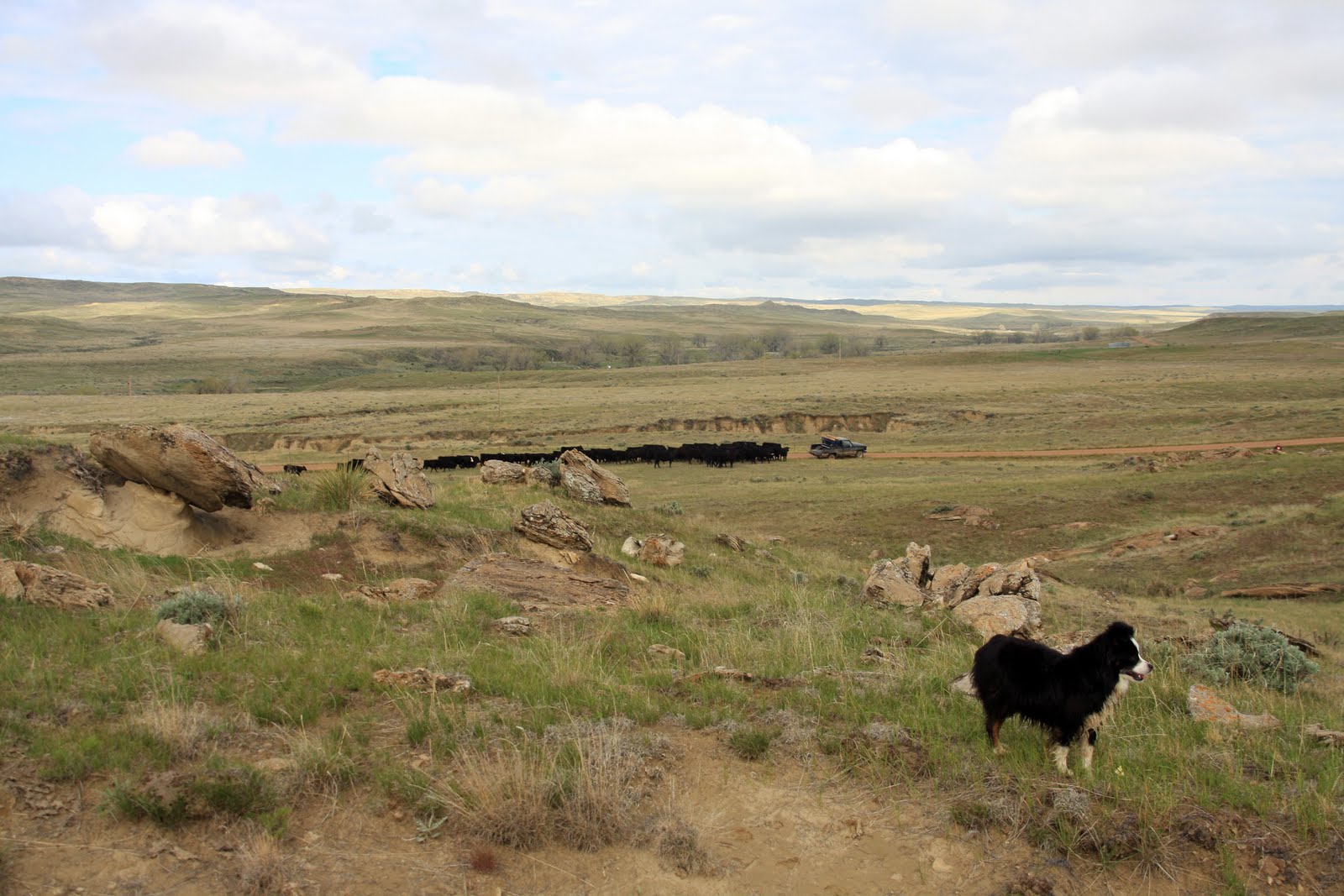


She was also involved in the gathering of the yearling steers a couple times this spring. Pearl was off attempting to kill a bird, mouse or other rodent when I took this.


She had just finished killing several mice here, and considering her duties complete, settled in to guard the sunscreen (lay on that coat), also while we were fencing.

Friday, December 31, 2010

Ringing in the New Year

I had a weekend brimming with activities planned, and the bad weather has put a halt to all of them. Originally I was considering going to the Bucking Ball in Gillette tonight, then heading to Cheyenne for Liz's bachelorette party. But, the entire state of Wyoming has slick roads, with some closures and several listed as no unnecessary travel. So I am at my parents tonight, settled in with milk and cookies, preparing to switch to whiskey and partake in a few games of cards. I'm thrilled to be spending more time with my family, but I'm also disappointed I am missing these events, especially Liz's party.


Here's what we did today, before settling in by the pellet stove. We fed more of our grass hay to our calves and yearling heifers.


All that snow on their backs means they are in good shape. The fat on their backs is insulating them against the cold snow, so it sits on their hair, and they stay warm internally. If they are thin, more of their body heat escapes, and melts the snow.


We tucked them in behind this hill, out of the wind.


Then we chopped more ice. It was about zero here this morning. Those railroad ties on the ground prevent the cattle from dragging all the dirt away from the tank.


Now our calves can eat, drink, and be merry as they ring in the new year!


Then we did the same thing for our yearling heifers.


After completing all the outdoor chores, my parents drove into Lusk for a funeral. Holly and I baked cookies and a cherry crisp this afternoon. My brother just left, without much heads up, for the Bucking Ball (I might have gone with him had I known), and the rest of us are sitting around staying warm.
Hope you all have a fun and happy introduction to 2011!

Wednesday, December 29, 2010

Digestive preparations

I just mentioned in a recent post that we adjust our feeding schedule based things like bad weather. Today I was busy preparing for what is forecasted to be a nasty winter blizzard starting around midnight tonight.
The radio was saying they expect 30+ mph winds, 6-10 inches of snow, temperatures ranging from zero to 30 below zero...it doesn't sound fun.

The first thing I did was gather these 26 cows out of the pasture neighboring where they are supposed to be. After preg checking we just turned the cows into this pasture, and they typically make their way to the next one out of habit. If they don't, most come when you start feeding. The gates between the two pastures are left open, because when we're feeding usually the cows come every day and it isn't an issue.
But the nice weather this year...and the questionable intelligence level of these individuals...resulted in them never coming to feed. This wasn't a big deal with the very nice temperatures we've had so far this winter. The abundant left over grass was more than enough for these cows to thrive on so far.


But the impending blizzard, and the fact that we want these cows to come to feed along with everyone else, meant I gathered and trailed them through this gate to the proper pasture. Then I closed the gate, trailed them down to water, and fed everyone a double ration to get their energy levels up before the cold weather hits.
As I also mentioned the linked post, we feed our cows every other day. I just fed these cows yesterday, but gave them more hay today so they'll be ready for the wind, snow and cold.


Here they are trailing into feed.


I also briefly mentioned that a cow has a ruminant stomach, which allows them to utilize forages, or feedstuffs, over 24, or 48, hour periods.
This ruminant stomach is separated into four compartments.


When the cow swallows a mouth full of hay, it has two choices. Heavy, or big, pieces of hay will drop into the Reticulum. From this compartment the cow can regurgitate the feed and chew on it again. This is called chewing her cud, and is something cows do regularly, and is typically done when they're calm and relaxed. This unique ability allows a cow to eat a whole bunch in one sitting, like when I'm feeding a bale of hay, then regurgitate it later and chew it more thoroughly before digesting it. It's like a built in storage/recycling system for food, and is one reason you can feed them a couple days apart.
Smaller, and lighter, pieces of feed go into the Omasum. While the picture doesn't really show it, the cow's stomach will sort the bigger and heavier pieces of feed from the lighter, smaller pieces at the junction of Omasum and Reticulum.
From that point the feed goes on through the Abomasum, to the Rumen, then into the intestines.
Another key aspect of ruminant digestion are the microbes, which are just microscopic bugs, present in a ruminant's stomach. Most of these microbes are in the Rumen compartment. These microbes are what allow the animal to digest feedstuffs. For example, one group of microbes found in the Rumen are called Cellulolytics, and they break down Cellulose, which is the primary component in forages.
Humans and other single-stomached creatures lack the efficiency, and often the ability, to break down roughage's, specifically Cellulose, into a usable energy source. This is why cattle, sheep, and other ruminants are so vital to society. They take the forages found all over the country, and world, that we cannot utilize as humans, and they eat it, and because of their unique stomachs, they are able to convert it to energy to grow and produce a usable food for humans - meat.


Here's what it looks like from the outside. The other thing all this digesting creates is heat. The coarser the forage they're eating, the longer it takes the microbes, or bugs, to eat and process it. The longer it takes the microbes to break it down, the more heat they generate during the process.


So for those reasons I fed the cows a couple older, coarser bales. This means it was forage with bigger stems. While not the highest quality hay we feed, it has a definite place when we want to keep our cows warm.
Grass hay is an example coarser hay, that takes longer to digest. Alfalfa hay, is finer, and microbes can attack and process it faster. So Alfalfa creates energy faster, but it is much shorter lived, while grass is a slower starting, longer lasting form of energy.
We also feed hay that is a combination of the two, to maximize to the benefits of both.

Thursday, September 16, 2010

My 1,017 pound babies

Have I mentioned I love cattle? I love looking at them, picking them apart visually, and breeding them to make them the best they can be. It's so exhilarating to take a bunch of cows and make them produce a superior product year and year. It's a fun challenge!

Every cow and bull has genetic triats, like people do. People pass traits such as eye color on to their children, and some traits are more heritable than others. Cattle are the same way, and through available information producers can select animals that have specific traits. That's what I do - select specific traits and make sure each bull we buy has the traits we like and doesn't have traits we don't like.

The result of all that time and energy are our cull heifers and steers we market each year, in addition to our replacement heifers we put back in the herd.

I believe you can have a herd that does it all and you can have high enough quality cattle to top any market you choose to sell them in. I think this is possible because there is so much information on the genetics traits cattle posses, and so many cattle to choose from.

My family has marketed our cattle in almost every way possible, with the exception of using the internet. We have sold weaned calves, backgrounded calves, grass fed yearlings, corn fed stockers and fat cattle. We've also sold cattle in the beef and on the grid. Let me know if you want to know more about these marketing options and I'll cover them more in depth or reference someone else who has.

We believe in being flexible, innovative and keeping up with trends, and it's starting to really work for us. Through selling our cattle in these different ways we have acquired a lot of data that tells buyers about the quality of our cattle before they even see them. We also keep a list of bulls we've used, which tells buyers about our cattle's pedigrees.

This year was the first time in about seven years we kept our steers home and put them on grass for the summer.

It worked well. The average weight of the bunch was 1,017 pounds each and they gained 2.64 pounds a day from May through September on just grass. The closest guess on weight was the buyer, who thought they would weigh 990 pounds each.

It's always nice when you're cattle perform better than even the buyer guessed!
The cattle buyer is a guy who has purchased our cattle several times over the last decade. He bought them sight-unseen. It's a wonderful thing when you can work with people you trust, and this was one of those situations.


Here we are loading the trucks. My mom took the first two pictures. Where I'm from is famous for it's gains on grass. Some places south of Lusk boast gains of over 3 pounds a day for yearlings on just grass. I'm ready to increase how much ours gain each day over the next couple years through genetic selection.

Some of the best cattle in the world are from my region of the USA. People work hard every day to produce a high quality, safe and wholesome product. My family is no different and these steers are the result of over a year's worth of work. We have nurtured and fed and doctored them since March of 2009, when they were born.


They will be fattened in a feedlot in central South Dakota and harvested in February of 2011 as black, implant free cattle. We are planning a trip out around Thanksgiving to go hunting and check on them.

Like I said, I love producing quality cattle, and these guys are result of my entire families work and dedication for the last year. Now it's time to move on to the next bunch, who are just about ready to be weaned from their mothers.

Thursday, July 8, 2010

More June grass

Remember this post on June grass?? If you have the time..or interest.. look at it again then check out the following photos.

First, please ignore my composition, I was driving the 4-wheeler through this tall grass scared to death because I've never not been about to see the ground when driving the 4-wheeler. (The journalist really came out in that sentence)

While not the greatest photos quality wise, these both do a good job showing the June 30, 2010 grass on my family's ranch. This is the same creek as the tractor picture in 2007 and the heifers on June 1, 2008. Also, these heifers are pretty much the same size as those in the June 1, 2008 photo.


Thursday, June 17, 2010

June grass


This year has been wonderfully and unusually wet. That means grass, and grass makes people in agriculture happy. Some people are getting a little tired of all the rain and it has certainly set spring work back-but nobody dares curse the moisture because for the last 10 years we've been in a very severe drought and we know the rain will stop. I personally love it!

It's also funny and irritating to hear people in Casper curse the rain, then curse the humidity that follows it. Now it's sunny and the wind is howling in typical Casper style, and they're cursing that too. There's just no pleasing some people. I have to resist the urge to walk up and shush them for daring to curse getting 3+ inches of rain over a 2 week period in June.

Here's how the grass situation has looked for the last 4 years where I'm from. It will help explain the whole, "rain is a good thing" mentality.

Taken June 8, 2007. This is a meadow and it's already dusty and the grass is turning. It's also pretty short. We are heading out to rebuild fence in this picture and the temp. was already in the high 90's in the first week of June.

Taken June 16, 2007. Note how short the grass is and that its already turning brown. This was a bad year for growing grass and this was as good as it was that year. It was hot and there wasn't any rain to speak of. Where I'm from we receive of 6-10 inches annual precipitation, so we are never anything more than semi-arid. But 2007 was an extreme case of heat and lack of moisture.

Taken June 1, 2008. Greener than 2007, but not very tall. It didn't get much taller than this all year either. These heifers had just arrived home from the feedlot, where they were grown over the winter, partially because the drought resulted in us having to reduce our carrying capacity (number of head we run).

Taken June 17, 2009. We grew some grass last year, but the grasshoppers ate most of it. You can see there are some short spots and the cheatgrass is already turning a purplish brown color. We had a cold, wet spring-but the combined July heat and ravenous grasshoppers took care of most of it.

Taken May 28, 2010. This calf in this photo is in almost the exact location of the tractor in the June 8, 2007 photo (It's just looking the opposite direction). While this was taken a couple weeks earlier, the grass is already significantly taller and I'm told it looks even better today.

This is in almost the exact location of the heifer in the June 1, 2008 photo.

There's grass everywhere, and while I haven't been home in a few weeks I'm told it's still green, tall and growing. There is also a record-breaking grasshopper hatch this year, but we and almost everyone else in the county is signed up to spray them and hopefully minimize their impact.

This is a good example of why agriculturalists spend so much time discussing, watching and worrying about the weather. It impacts us significantly every year. 2007 was hard, frustrating and depressing for many.

My uncle said it best when branding this year when he noted how fat and happy our cows were, and how most of them had never been fat before in their life. It's a good year to raise livestock in eastern Wyoming!