Here is another cow of note for you. Any guesses as to which one I'm talking about?
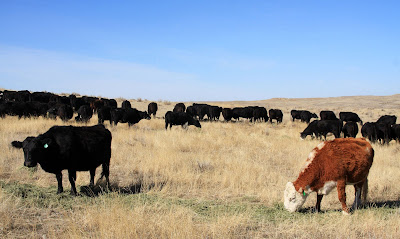 This Hereford cow is the last of her kind on our operation, and she will be sold this fall because of her age. There was a time, about 25 years ago, when this picture would have looked opposite the way it does now. By that I mean there would have been one or two black cows, and the rest would have been Herefords.
She is a cow of note because she represents the basis from which all these black cows were derived. Most operations in the west were strictly Hereford a couple decades ago, but things change fast in agriculture, and the shift from a Hereford to Angus commercial cowherd in the U.S. is one prime example of this.
Why this shift? Well, there are a few reasons. One is the Angus breed did a far superior job marketing their breed, and created a demand for (black) Angus cattle that far exceeded the demand for any other single breed. The Angus breed also started collecting lots of data, and provided this to producers to help in their breeding decisions.
Another reason is the Hereford breed isn't perfect, and a few of the problems are especially irritating, and practically non-existent in Angus cows. These include cancer eyes, prolapsing, sunburnt bags, horns and calves that didn't get right up and suck like Angus calves.
I have personally been involved in a couple blizzards that resulted in us milking our Hereford range (read-not tame) cows twice a day for two weeks. This had to be done because after the cow's bags (udders) were sunburned, it hurt to have their calves suck, so they kicked them off. If we hadn't milked them, the milk in their bags would have gone sour, and ruined them, as in they wouldn't produce milk anymore. So we ran them all through our chute, twice a day, and milked them, then applied bag balm to ease their pain. Meanwhile we were also bottle feeding several of their calves.
Just another example of what we're willing to do for the health of our livestock.
But, dealing with issues like this make Angus cows look alright in comparison, as their black pigmented bags don't get sunburned, you don't have to dehorn their calves, and they don't prolapse or get cancer eyes nearly as frequently.
(I'm getting to the plus side for you Hereford lovers out there)
Now, don't get me wrong, I really like the Hereford breed, and they have really good things going for them too. A Hereford cow is typically in better shape than her similarly managed black counterparts. This means she will raise a calf, breed back, and not be skin and bones in the fall. They're also a mellower breed disposition wise, and it's hard to beat a big black baldy calf.
As for a positive Hereford story, I have several. My first show heifer was a Hereford, and my grandpa took a load of Hereford steers to Denver in the earlier 1900's that made the paper and were said to be the best load of steers to go through the Stockyards to date.
But, while the Angus cow isn't perfect either, she quickly gained popularity for her color, quality, vigor and the amount of data backing her, in addition to other reasons depending on who you talk to.
Demand for Hereford cattle plummeted, and as a result the Hereford breed has worked hard to cull out the animals responsible for those negative traits. It's a whole new Hereford breed today, and several people are starting to go back to Hereford bulls to take advantage of the heterosis, or hybrid vigor, and the all-around good cross a Hereford and Angus pairing results in.
This Hereford cow is the last of her kind on our operation, and she will be sold this fall because of her age. There was a time, about 25 years ago, when this picture would have looked opposite the way it does now. By that I mean there would have been one or two black cows, and the rest would have been Herefords.
She is a cow of note because she represents the basis from which all these black cows were derived. Most operations in the west were strictly Hereford a couple decades ago, but things change fast in agriculture, and the shift from a Hereford to Angus commercial cowherd in the U.S. is one prime example of this.
Why this shift? Well, there are a few reasons. One is the Angus breed did a far superior job marketing their breed, and created a demand for (black) Angus cattle that far exceeded the demand for any other single breed. The Angus breed also started collecting lots of data, and provided this to producers to help in their breeding decisions.
Another reason is the Hereford breed isn't perfect, and a few of the problems are especially irritating, and practically non-existent in Angus cows. These include cancer eyes, prolapsing, sunburnt bags, horns and calves that didn't get right up and suck like Angus calves.
I have personally been involved in a couple blizzards that resulted in us milking our Hereford range (read-not tame) cows twice a day for two weeks. This had to be done because after the cow's bags (udders) were sunburned, it hurt to have their calves suck, so they kicked them off. If we hadn't milked them, the milk in their bags would have gone sour, and ruined them, as in they wouldn't produce milk anymore. So we ran them all through our chute, twice a day, and milked them, then applied bag balm to ease their pain. Meanwhile we were also bottle feeding several of their calves.
Just another example of what we're willing to do for the health of our livestock.
But, dealing with issues like this make Angus cows look alright in comparison, as their black pigmented bags don't get sunburned, you don't have to dehorn their calves, and they don't prolapse or get cancer eyes nearly as frequently.
(I'm getting to the plus side for you Hereford lovers out there)
Now, don't get me wrong, I really like the Hereford breed, and they have really good things going for them too. A Hereford cow is typically in better shape than her similarly managed black counterparts. This means she will raise a calf, breed back, and not be skin and bones in the fall. They're also a mellower breed disposition wise, and it's hard to beat a big black baldy calf.
As for a positive Hereford story, I have several. My first show heifer was a Hereford, and my grandpa took a load of Hereford steers to Denver in the earlier 1900's that made the paper and were said to be the best load of steers to go through the Stockyards to date.
But, while the Angus cow isn't perfect either, she quickly gained popularity for her color, quality, vigor and the amount of data backing her, in addition to other reasons depending on who you talk to.
Demand for Hereford cattle plummeted, and as a result the Hereford breed has worked hard to cull out the animals responsible for those negative traits. It's a whole new Hereford breed today, and several people are starting to go back to Hereford bulls to take advantage of the heterosis, or hybrid vigor, and the all-around good cross a Hereford and Angus pairing results in.
 I'm one of those people that would like to use some Hereford genetics on our black cows, due largely to my love of black baldy cows. But, for now, my dad is hanging tough with Angus bulls, and I'm fine with that too. But this cow is a great cow of note, because she represents where our herd came from, and it's a great history.
I read recently in a PETA magazine how all cows are anonymous to their heartless, rancher owners. That's not true, and these "cows of note" posts are my response, and show that we know our cattle individually, and can often differentiate between hundreds of black cows at a glance.
I show cows from my own, or my family's, herd, and explain what makes them unique.
 This cow of note belongs to me. She is a cow of note for several reasons. But, the biggest reason is because she had twins as a first-calf heifer, and liked and raised both of them. She also bred back, and stayed in decent condition while raising twins.
Often, when cows have twins, especially if they have them as a heifer, they only like one. Not this cow, she happily raised her two calves, and would be paired up with both of them throughout the summer.
She is also a cow of note because her mother was my favorite cow, aka, another cow of note. I like crossbred cows, and this cow's mother was 1/2 Angus, 1/2 Gelbvieh. So, this girl is 3/4 Angus, 1/4 Gelbvieh.
She shows her Gelbvieh heritage, and I like that. She's moderate framed, obviously fertile, functional, has a great disposition, and is still feminine.
So, she's a cow of note because she's pretty, has good bloodlines, and is a great mother. I like her, which I guess is a good thing, since I own her.
This cow of note belongs to me. She is a cow of note for several reasons. But, the biggest reason is because she had twins as a first-calf heifer, and liked and raised both of them. She also bred back, and stayed in decent condition while raising twins.
Often, when cows have twins, especially if they have them as a heifer, they only like one. Not this cow, she happily raised her two calves, and would be paired up with both of them throughout the summer.
She is also a cow of note because her mother was my favorite cow, aka, another cow of note. I like crossbred cows, and this cow's mother was 1/2 Angus, 1/2 Gelbvieh. So, this girl is 3/4 Angus, 1/4 Gelbvieh.
She shows her Gelbvieh heritage, and I like that. She's moderate framed, obviously fertile, functional, has a great disposition, and is still feminine.
So, she's a cow of note because she's pretty, has good bloodlines, and is a great mother. I like her, which I guess is a good thing, since I own her.
I just mentioned in a recent post that we adjust our feeding schedule based things like bad weather. Today I was busy preparing for what is forecasted to be a nasty winter blizzard starting around midnight tonight.The radio was saying they expect 30+ mph winds, 6-10 inches of snow, temperatures ranging from zero to 30 below zero...it doesn't sound fun. The first thing I did was gather these 26 cows out of the pasture neighboring where they are supposed to be. After preg checking we just turned the cows into this pasture, and they typically make their way to the next one out of habit. If they don't, most come when you start feeding. The gates between the two pastures are left open, because when we're feeding usually the cows come every day and it isn't an issue.But the nice weather this year...and the questionable intelligence level of these individuals...resulted in them never coming to feed. This wasn't a big deal with the very nice temperatures we've had so far this winter. The abundant left over grass was more than enough for these cows to thrive on so far.
 But the impending blizzard, and the fact that we want these cows to come to feed along with everyone else, meant I gathered and trailed them through this gate to the proper pasture. Then I closed the gate, trailed them down to water, and fed everyone a double ration to get their energy levels up before the cold weather hits.As I also mentioned the linked post, we feed our cows every other day. I just fed these cows yesterday, but gave them more hay today so they'll be ready for the wind, snow and cold.
 Here they are trailing into feed.
 I also briefly mentioned that a cow has a ruminant stomach, which allows them to utilize forages, or feedstuffs, over 24, or 48, hour periods.This ruminant stomach is separated into four compartments.
 When the cow swallows a mouth full of hay, it has two choices. Heavy, or big, pieces of hay will drop into the Reticulum. From this compartment the cow can regurgitate the feed and chew on it again. This is called chewing her cud, and is something cows do regularly, and is typically done when they're calm and relaxed. This unique ability allows a cow to eat a whole bunch in one sitting, like when I'm feeding a bale of hay, then regurgitate it later and chew it more thoroughly before digesting it. It's like a built in storage/recycling system for food, and is one reason you can feed them a couple days apart.Smaller, and lighter, pieces of feed go into the Omasum. While the picture doesn't really show it, the cow's stomach will sort the bigger and heavier pieces of feed from the lighter, smaller pieces at the junction of Omasum and Reticulum.From that point the feed goes on through the Abomasum, to the Rumen, then into the intestines.Another key aspect of ruminant digestion are the microbes, which are just microscopic bugs, present in a ruminant's stomach. Most of these microbes are in the Rumen compartment. These microbes are what allow the animal to digest feedstuffs. For example, one group of microbes found in the Rumen are called Cellulolytics, and they break down Cellulose, which is the primary component in forages. Humans and other single-stomached creatures lack the efficiency, and often the ability, to break down roughage's, specifically Cellulose, into a usable energy source. This is why cattle, sheep, and other ruminants are so vital to society. They take the forages found all over the country, and world, that we cannot utilize as humans, and they eat it, and because of their unique stomachs, they are able to convert it to energy to grow and produce a usable food for humans - meat.
 Here's what it looks like from the outside. The other thing all this digesting creates is heat. The coarser the forage they're eating, the longer it takes the microbes, or bugs, to eat and process it. The longer it takes the microbes to break it down, the more heat they generate during the process.
 So for those reasons I fed the cows a couple older, coarser bales. This means it was forage with bigger stems. While not the highest quality hay we feed, it has a definite place when we want to keep our cows warm.Grass hay is an example coarser hay, that takes longer to digest. Alfalfa hay, is finer, and microbes can attack and process it faster. So Alfalfa creates energy faster, but it is much shorter lived, while grass is a slower starting, longer lasting form of energy.We also feed hay that is a combination of the two, to maximize to the benefits of both.
 Cows trailing in to eat. The snow visible on their backs is a sign that they are in good shape and have a layer of fat protecting them. If they were thinner the snow would melt as more body heat escaped.
 Reading Bell of the Blogs latest post got me thinking. As an individual who is knowledgeable about certain aspects of the agriculture industry, what can I do to provide accurate information to people who don't know about our great industry?This lead me to the idea that I love reading about people whose lives are different than mine. Someone from Hawaii could write 300 words about sitting on the beach and I would be enthralled and take their every word to heart. With that in mind I have decided to explain what my family does daily on our ranch.I have time to do this because I have a desk job these days. But I have spent the better part of my life at our ranch, and it's what I love to do, so sharing the experiences should be easy. Furthermore, if you happen upon my blog and don't know about ranching, this will be the real deal straight from someone whose family has been doing it for multiple generations. Feel free to leave comments, questions or ideas.First a little background information. My family is from the most rural part of Wyoming, on the eastern side of the state. Lets just say it doesn't get much more remote than where I'm from and it's wonderful there. Our closest neighbors are 2 1/5 miles away cross country. If you have to drive to their place its about 5 miles. It is 56 miles to the closest high school and about 200 miles to a Starbucks, Walmart or hospital.We raise commercial cattle that are mostly Angus with some black baldies. We also raise commercial Rambouillet sheep. Ultimately we market pounds of beef and sheep raised. We work hard every single day of the year to take care of our livestock, our land and the lifestyle we live.This time of year w
 e spend a lot of time feeding our animals because the snow and cold temperatures increase their nutritional requirements. We feed hay and cake (not the birthday variety, please scroll down on the link to see the photo and info.) to ensure livestock get enough protein and energy to meet their daily needs.We have special feeders on pickups, the hay feeder looks like this, that are used to feed and the entire process takes from seven or eight in the morning until noon roughly. Sometimes it turns into an all day event if something unexpected happens. While feeding we also check water, fix water problems and chop ice. We observe the livestock to make sure they aren't getting too thin and that each one is healthy.If there is a problem we determine a course of action, such as increasing how much we feed. Much as humans can count calories to lose or gain weight, we can monitor how many pounds each cow is eating and how much protein or energy is contained per pound of feed. We can make adjustments to her ration based on the weather, her body condition or if she is nursing a calf.One of the things that really baffles me
 is how animal activist groups call ranchers hateful people who don't care for their animals. My family spends more time with our cattle and sheep each day than most people spend with their pet. My dad and I have been known to sit on a hillside for hours watching the cows trail in to the feed ground, commenting on each one and taking note of anything we aren't satisfied with. We even have cows we call "cake munchers" because they will eat right out of our hand.We want them to be healthy and happy and work hard to ensure they are. If we don't take care of them they won't perform and we will go out of business. There are a multitude of reasons for us to care for our animals, and we do care for and about them.More on winter ranching activities next time.
 It was a beautiful 45 degree day with no wind or clouds north of Torrington yesterday. I was there for the Booth Family Bull SaleBuying bulls is one of my favorite activities! I am fascinated by genetics and the potential to change a herd through genetic selection. Since my family doesn't AI, we do these things through selecting bulls. I spend hours each winter and spring pouring over catalogs, deciding if there are enough bulls that meet our specifications to attend a sale. I thoroughly enjoy this time spent researching producers and bloodlines, it's fun for me.Then there is the day spent wandering through pens of bulls, looking at them, bidding on them and being outside. If my dad attends there are discussions and comparisons.By the way my dad is awesome and I am so grateful he isn't one of those dads who was hesitant to let me do something because I'm a girl. He's actually quite the opposite and I've thrived thanks to that attitude. He's often said, "Most girls might not be able to that, but Heather isn't most girls." Every girl should be so lucky to have such a great dad who believes in them!Anyway, my point is I had an awesome day yesterday and was fully in my element and am very thankful that my father let me take over the genetic selection side of our operation. It's what I love to do and yesterday was a blast!

Gathering cattle

Working Cattle

Feeding cattle :)

 This Hereford cow is the last of her kind on our operation, and she will be sold this fall because of her age. There was a time, about 25 years ago, when this picture would have looked opposite the way it does now. By that I mean there would have been one or two black cows, and the rest would have been Herefords.


