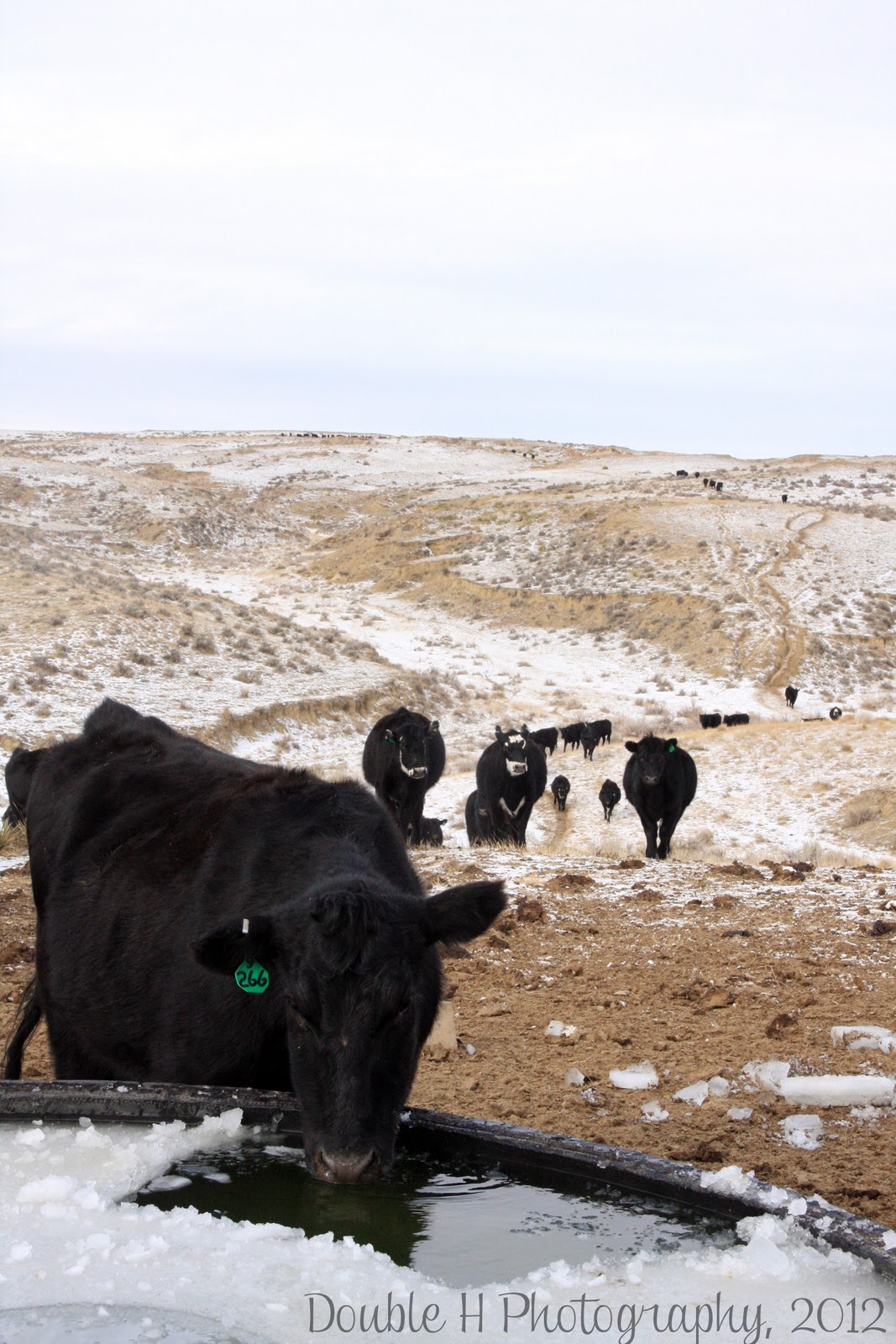
You've heard a lot about feeding cattle from me this winter, primarily because that's the main thing we do with our cattle this time of year, especially on years like this when they don't have any grass to partially fill up on.
The thing about feeding cows is it is easily one of my favorite activities. I love gathering up my two little dogs, making a latte, grabbing my camera, and loading everything into an old pickup with squeaky doors, dents, and other downfalls that come with hard working vehicles, then slowly shifting through the gears on the way to load up with cake or hay.
From there it's a drive down deserted, often rutted roads, where at most I will see one other vehicle belonging to our neighbor, who is also out feeding. The more common traffic is of the bovine, sheep or wildlife variety.
Upon reaching the pasture and catching a glimpse of where the cows are, a decision is made on where to feed. Then I wait. In my busy, often hectic but wonderful life, the most important part of my day is waiting for cows to trail in for the meal I have on the back of my vehicle. This wait varies from minutes to well over an hour, depending on how far away the cows are from a location I can reach and feed them at. Weather also hinders or helps their progress.
Some days this causes me frustration and stress, as there are a lot of things to knock of the "to do" list before I can quit for the day. But, most of the time, this chance to sit, let my dogs out to explore, drink my coffee, and listen to the radio if its working that day, is a wonderful and rare opportunity to relax. There is no computer or phone, no people or tasks demanding attention, no noise beyond that of the wind, pickup and radio.
There is just this land my family loves so much, and these cows we have worked so hard to make into what they are today. My camera, dogs and coffee round out the list, and are also all things I love and hold dear.
It is a joyful task, and that joy doesn't diminish as the cows arrive. As they trail in I get to look at them, admire personal favorites, mentally change less outstanding individuals, and enjoy all over again these animals that we are blessed to make our living from while admiring the results of the care we've provided over the winter months in their current shine and condition.
Once the feeding is over, I often take a moment to drive back through the cows, or stop and enjoy the fact that they are completely happy and perfectly content, munching away on their cake or hay, and that they will also be warm and full until I return. Just look at the cows above. Sometimes it's hard to believe that this is part of my "job," because it's so fulfilling, enjoyable, and important, all at once.
To me, the chance to feed a cow is worth waiting for.
Showing posts with label winter ranch work. Show all posts
Thursday, January 24, 2013
Thursday, December 20, 2012
Feeding cows with little dogs
My two little dogs LOVE to go feeding. The mere question of, "you guys ready to go feed," results in racing around the house, whining, jumping on you as you put your gear on, and shooting out the door like two hairy rockets when it finally opens. The same act begins again when we reach the pickup, and sometimes Miss Weenie has to run several circles, tail wagging profusely, until she calms down enough to stop and let me toss her the cab. Emmie can get in herself, thank you very much, through an opening roughly half her actual width.
What is so exciting about the prospect the feeding, you may wonder. Well, the highlight is when, upon nearing the feedgrounds, or a two track road we're going down that day, I stop, and let them out. Yes, that's what it takes to be the best master in the world : )
Their happiness and excitement is unmatched, and they leap, growl, and charge through the sagebrush, literally blowing off steam. After the initial rush wears off, about a mile in, serious sniffing, exploring and excavating ensues. It's almost more joy than they can handle at once.
This all may have something to do with me turning them loose into this:
Do you see Emmie?
There she is. Chasing rabbits, climbing rocks,...
crawling in and out of holes, racing around...
and investigating what Miss Weenie may have found.
You may wonder if there is anything that can ruin this. The answer is yes, and the worst part about feeding is when the excitement exceeds intelligence, and the return to the pickup is postponed...until after the cows arrive.
This is especially troublesome if we're feeding the heifers, who love feeding not only for the food, but also for the chance to chase the hairy toys that I sometimes bring for their entertainment.
I bet there's a rabbit on the hill, laughing at the irony.
What is so exciting about the prospect the feeding, you may wonder. Well, the highlight is when, upon nearing the feedgrounds, or a two track road we're going down that day, I stop, and let them out. Yes, that's what it takes to be the best master in the world : )
Their happiness and excitement is unmatched, and they leap, growl, and charge through the sagebrush, literally blowing off steam. After the initial rush wears off, about a mile in, serious sniffing, exploring and excavating ensues. It's almost more joy than they can handle at once.
This all may have something to do with me turning them loose into this:
Do you see Emmie?
There she is. Chasing rabbits, climbing rocks,...
crawling in and out of holes, racing around...
and investigating what Miss Weenie may have found.
You may wonder if there is anything that can ruin this. The answer is yes, and the worst part about feeding is when the excitement exceeds intelligence, and the return to the pickup is postponed...until after the cows arrive.
This is especially troublesome if we're feeding the heifers, who love feeding not only for the food, but also for the chance to chase the hairy toys that I sometimes bring for their entertainment.
I bet there's a rabbit on the hill, laughing at the irony.
Tuesday, February 28, 2012
Feeding cows in the snow
Today it is snowing and the wind is blessedly absent at my house. I took these photos while feeding this morning. Always love photographing black cattle in the snow, especially when it's coming straight down! Hope you enjoy.
Guarder of the hay bale
Sunday, February 26, 2012
Buried
I have been pretty swamped in February. Some days I feel in over my head, much like this cow, except in work and life instead of food. Well..some days it's food too, but we won't cover that here : )
Between my trip to Michigan, a few trips around Wyoming for my writing/photography and the constant feeding and water checking tasks at the ranch, it has been a hectic month. I am hoping to be back on track, and giving this blog more attention, in upcoming weeks.
On the ranch we are still spening the majority of our time feeding and checking water every day. In the next few weeks we will be altering some of our feeding in preparation for calving. Bangs vaccinating our heifers, getting set up for calving and weighing our steers.
Since feeding is such a big part of our operation in the winter, and the number one cost on some ranches, it gets a lot of attention. I haven't covered it as much this winter, but last year I explained feeding cake to our calves and hay to our cows, more than once. I did highlight our latest piece of feeding equipment a couple weeks ago, which we are using daily right now.
This year we are feeding what are called tubs, instead of cake, to the calves. I am planning to explain that in the next few days. In the mean time, you can swing over and check out the cake and hay feeding options.
Hope everyone else is having a productive 2012 thus far! I will also be answering emails in the next few days (I hope). I really appreciate people taking the time to comment on my blog or send me emails, and have not forgotten you, I promise!
Between my trip to Michigan, a few trips around Wyoming for my writing/photography and the constant feeding and water checking tasks at the ranch, it has been a hectic month. I am hoping to be back on track, and giving this blog more attention, in upcoming weeks.
On the ranch we are still spening the majority of our time feeding and checking water every day. In the next few weeks we will be altering some of our feeding in preparation for calving. Bangs vaccinating our heifers, getting set up for calving and weighing our steers.
Since feeding is such a big part of our operation in the winter, and the number one cost on some ranches, it gets a lot of attention. I haven't covered it as much this winter, but last year I explained feeding cake to our calves and hay to our cows, more than once. I did highlight our latest piece of feeding equipment a couple weeks ago, which we are using daily right now.
This year we are feeding what are called tubs, instead of cake, to the calves. I am planning to explain that in the next few days. In the mean time, you can swing over and check out the cake and hay feeding options.
Hope everyone else is having a productive 2012 thus far! I will also be answering emails in the next few days (I hope). I really appreciate people taking the time to comment on my blog or send me emails, and have not forgotten you, I promise!
Wednesday, February 15, 2012
The Hay Buster
We purchased a hay buster this winter. This is a machine that grinds up hay and feeds it onto the ground, or into a bunk, for livestock. The benefit of grinding hay is livestock can better consume and digest hay if it's already been ground into smaller pieces. We are utilizing this machine to make some of the poorer quality hay we have on hand more palatable to our calves. If we didn't grind it,they would pick through it and consume less of the total volume of hay we fed them due to its coarseness. It still has nutritional value, but in its whole form it's not as appealing to the calves.
Here are the controls, which run the hay buster. The lever with the blue tape and handwriting on it is used to run the arms, and pick up hay bales and drop them into the grinder. The red-handled lever next to the blue one, and the lever on the right side of the photo that slides back and forth are used to feed the bale once it's in the grinder. Just ignore the rest of those controls for this job : )
Here is what the inside of the hay buster looks like. When you adjust the levers in the cab appropriately, the chains in the bottom move, and the whole unit works to tear the hay bale into smaller pieces, and shoot it out the side on the left in the photo.
As the feeder, this is how it looks to drive the tractor. The calves love their hay, and often start heading toward the house when they hear the tractor start in the morning.
When you reach the feed grounds, there is a specific order to things. First, you get the tractor, which is a manual and has two gear shifting knobs (technical terminology at its finest), and a lot of gear choices. You need to get into a relatively low (slow) gear.
Second, you have to turn on the lever that slides in the photo of the controls, and let it get up to speed. I apologize for those of you that know all the accurate terminology. I am not that mechanical, I just know how to run the stuff.
Third, you let out the clutch and start moving, while pushing the red handled lever forward, which turns on the actual grinder.
The result is that the hay bale starts spinning as the grinder chews it up and spits it out on the ground. You can manually adjust how coarse or fine it will chop the hay, and how wide of a pile it spits out on the machine. The size and width of the pile on the ground is also impacted by how fast or slow you drive.
The second bale just rests on the back until you're done feeding the first. Then you run the arm control to dump it into the grinder.
Here's what it looks like from outside the tractor.
Feeding, like most ranch tasks, can be a dirty, dusty job.
But the calves don't mind.
Then, when you're done with the last bale, you pull the red handled lever back, turn off the one that slides, and head for home.
This is what the hay looks like after being run through the buster. We don't have it set to chop the hay extremely fine, partially because we're feeding on the ground. But, the difference in palatability is noticable, and my dad is just tickled with his purchase.
Saturday, February 11, 2012
Feeding in the Snow
We've been getting some snow this week. Here are a few photos from feeding our yearling heifers and two-year-old cows two days ago. Have a fantastic weekend!
Monday, January 23, 2012
Let Them Eat Cake
I've been busy feeding:
and chopping ice:
for our livestock in recent weeks. Also have several writing/photography irons in the fire, as usual.
Hope everyone else is staying busy at tasks they love!
It's a couple days after I first posted this, but I am linking it up to Farm Photo Friday!
P.S. If the title didn't make sense to you. The crumbs on the top cows nose are cake crumbs. Cake is a protein/energy supplement we feed our livestock in the winter months to keep them healthy and at an appropriate weight level.
and chopping ice:
for our livestock in recent weeks. Also have several writing/photography irons in the fire, as usual.
Hope everyone else is staying busy at tasks they love!
It's a couple days after I first posted this, but I am linking it up to Farm Photo Friday!
P.S. If the title didn't make sense to you. The crumbs on the top cows nose are cake crumbs. Cake is a protein/energy supplement we feed our livestock in the winter months to keep them healthy and at an appropriate weight level.
Friday, January 13, 2012
Winter Water
Kerstin asked another question a few weeks ago:
Here's another consumer question: How does the water 'system' (the one with the tire) work? Is there a trick to keep it ice in the winter and alga/bacteria free in the summer? How do you fill it? Thank you! K.
Thank you for the question Kerstin! I didn't have the pictures I needed when you asked, but I got them all snapped, and here we go.
Our water system is all based on about 30 miles of underground, PVC pipeline, that transports water from multiple water wells to more than 20 water tanks, most of which are recycled tractor tires, like the one below. We also use a couple windmills to pump water, and have a solar well on our place that we pump water with also. The system is kind of like a town's water system, where water is piped to various residents (water tanks) from a large well (several wells in our case).
We put in all the pipeline and tanks ourselves, do the maintenance on them, and specifically designed our water system so that every pasture has water that comes from at least two sources. That way if one well/water tank/ pipeline/etc.. breaks, our livestock will still have water from a different source.
Each tank has a center cement ring, seen here. Some of them are covered, and some are uncovered. All the "guts" of the tank are located in this ring. Having a ring around the guts keeps the cows from breaking everything when they crawl into the tank (yes, they do this), and reduces the risk of the guts freezing even more.
Here are the guts. Our water tanks work exactly like the tank on your toilet. The water is piped up into the tank from the pipeline, windmill, or solar well, and the big black ball is a float that controls a valve on the water pipe. The float floats on the water, and when the tank is full it turns the water pipe valve off. As cows drink, the water level drops. This is like when you flush the toilet. The float drops with the water level, and opens the valve it controls more and more as it drops, which refills the tank. There are holes in the bottom of the cement ring that feeds the water into the entire tank.
We set each float to shut the valve off at a certain level, and that's what keeps the tank from spilling over the sides. This is done in a very high tech fashion: we bend the metal stem the float attaches to the valve with until it stops at the right spot : )
That white PVC pipe is what we call an overflow. This is a key part in reducing the amount of ice, and freezing, that occurs on a tank. The little part that is sticking out to the left is a nipple, with a hole in the end. That allows water to constantly flow out of the tank in a small volume, which also keeps water flowing in very slowly.
This is based on the science that atoms in motion are warmer than atoms not in motion. The continual movement of water within the tank created by the continuous flow in, and out, keeps it from freezing, or freezing as bad, as it would without any flowing motion.
The overflow also doubles as a drain for the tank. You can pull out the part you see above. Then the water can flow out a pipe the same size as the visible overflow pipe.
When we drain a tank, we use a specially designed key to turn off a valve that controls water flow to the tank. The valve you turn on or off is called a stop and waste valve. It stops water from flowing to the tank, and "wastes" any water left in the pipe by allowing it to seep back into the ground, thus preventing the pipe from freezing. The key we use is several feet in length, because pipelines are several feet (5 feet for us) below ground. You drop the key down a pipe that "T's" onto the pipeline, work it onto the valve, and turn it to turn the valve on or off.
Here is a different tank's overflow. It goes down a little draw. The amount of water coming out of the pipe is about what we want to flow out of the overflow. This one doesn't ice up near the tank, and basically irrigates this little draw and provides additional water to a number of small and medium wildlife species that can't reach the tank, in addition to reducing how much ice we have to chop every day. Win win!
Here is a tank where the overflow wasn't working. We turned it on a while before we turned some cows into the pasture it's in, then didn't check it until the cows were turned in. The ice was 8-10 inches thick, and the cement ring was frozen solid. In these cases we get a bar, and pound all the ice out of the ring, then fix whatever we broke (and by "we," I mean my brother in this instance), then get it up and running again.
Here's another consumer question: How does the water 'system' (the one with the tire) work? Is there a trick to keep it ice in the winter and alga/bacteria free in the summer? How do you fill it? Thank you! K.
Thank you for the question Kerstin! I didn't have the pictures I needed when you asked, but I got them all snapped, and here we go.
Our water system is all based on about 30 miles of underground, PVC pipeline, that transports water from multiple water wells to more than 20 water tanks, most of which are recycled tractor tires, like the one below. We also use a couple windmills to pump water, and have a solar well on our place that we pump water with also. The system is kind of like a town's water system, where water is piped to various residents (water tanks) from a large well (several wells in our case).
We put in all the pipeline and tanks ourselves, do the maintenance on them, and specifically designed our water system so that every pasture has water that comes from at least two sources. That way if one well/water tank/ pipeline/etc.. breaks, our livestock will still have water from a different source.
Each tank has a center cement ring, seen here. Some of them are covered, and some are uncovered. All the "guts" of the tank are located in this ring. Having a ring around the guts keeps the cows from breaking everything when they crawl into the tank (yes, they do this), and reduces the risk of the guts freezing even more.
Here are the guts. Our water tanks work exactly like the tank on your toilet. The water is piped up into the tank from the pipeline, windmill, or solar well, and the big black ball is a float that controls a valve on the water pipe. The float floats on the water, and when the tank is full it turns the water pipe valve off. As cows drink, the water level drops. This is like when you flush the toilet. The float drops with the water level, and opens the valve it controls more and more as it drops, which refills the tank. There are holes in the bottom of the cement ring that feeds the water into the entire tank.
We set each float to shut the valve off at a certain level, and that's what keeps the tank from spilling over the sides. This is done in a very high tech fashion: we bend the metal stem the float attaches to the valve with until it stops at the right spot : )
That white PVC pipe is what we call an overflow. This is a key part in reducing the amount of ice, and freezing, that occurs on a tank. The little part that is sticking out to the left is a nipple, with a hole in the end. That allows water to constantly flow out of the tank in a small volume, which also keeps water flowing in very slowly.
This is based on the science that atoms in motion are warmer than atoms not in motion. The continual movement of water within the tank created by the continuous flow in, and out, keeps it from freezing, or freezing as bad, as it would without any flowing motion.
The overflow also doubles as a drain for the tank. You can pull out the part you see above. Then the water can flow out a pipe the same size as the visible overflow pipe.
When we drain a tank, we use a specially designed key to turn off a valve that controls water flow to the tank. The valve you turn on or off is called a stop and waste valve. It stops water from flowing to the tank, and "wastes" any water left in the pipe by allowing it to seep back into the ground, thus preventing the pipe from freezing. The key we use is several feet in length, because pipelines are several feet (5 feet for us) below ground. You drop the key down a pipe that "T's" onto the pipeline, work it onto the valve, and turn it to turn the valve on or off.
Where does this water that's flowing out go? Downhill. Here is one overflow example. The water flows out, away from the tank. Sometimes it creates ice, which can be bad in the winter for cattle, but we design each tank in a way that cattle can get to it with ease, and without crossing the ice.
Here it is a little closer. The board is sitting there so we can see the overflow, and don't accidentally drive over it. The pipe "cage" on this tank is to keep livestock from crawling into the tank.
Here is a different tank's overflow. It goes down a little draw. The amount of water coming out of the pipe is about what we want to flow out of the overflow. This one doesn't ice up near the tank, and basically irrigates this little draw and provides additional water to a number of small and medium wildlife species that can't reach the tank, in addition to reducing how much ice we have to chop every day. Win win!
Here is a tank where the overflow wasn't working. We turned it on a while before we turned some cows into the pasture it's in, then didn't check it until the cows were turned in. The ice was 8-10 inches thick, and the cement ring was frozen solid. In these cases we get a bar, and pound all the ice out of the ring, then fix whatever we broke (and by "we," I mean my brother in this instance), then get it up and running again.
In contrast, here is how thick the ice is on a tank with a working overflow, in similar temperatures. Having cattle drinking out of a tank also reduces freezing, because the more water they drink, the more the tank has to refill, and the more movement of water that occurs.
Using tires for tanks also helps with ice because they're black, and absorb more heat than light colored tanks would.
As you've probably noticed, there is still ice to chop. In addition to the ideas we've implemented to reduce ice, we also check our livestock's water every day, and always have an ax and a shovel with us so we can chop ice and make sure they have water to drink. Where I'm from is considered very mild winter country, and in other parts of the state and country, ranchers have to chop a lot of ice every day, no matter what they do, because the weather is so cold.
As for algae/bacteria, yes we do have both, algae especially. Not as much in our black tire tanks, but the one I showed that wasn't a tire gets a lot of algae in it. We think this also has something to do with the colors of the tanks , and amount of sunlight the algae gets. My mom puts about a gallon of vinegar in it every so often to kill the algae.
We also empty most of our tanks when cattle aren't using them, and that controls algae and bacteria too.We use our water system to control the areas of a pasture that our cattle graze in, and turn tanks on and off to maximize the use of our grass, without overgrazing any specific area.
Thanks for asking, and I hope that helps answer your question!
Tuesday, January 10, 2012
Winter in Wyoming
Subscribe to:
Posts (Atom)