A couple weeks ago, I offered to do my boyfriend's chores for him because he had to get up really early to unload a load of hay for one of his neighbors, that my father was hauling. Clear as mud?
Anyway, key point here is that I said I could handle the chores, and expected it to be easy, seeing as how I had helped numerous times by this point.
I watered everyone, then began gathering up buckets, keeping mind I had been to the chiropractor the previous afternoon, and was supposed to avoid any heavy lifting, jarring activity, etc... for at least one day. No problem, he had a wheelbarrow right next to his barn, and it would be no problem to wheel the buckets of grain around instead of pack them on this particular morning. Problem solved.
I approached this grain bin, positioned my bucket just so, and tried to open the sliding door, which is on an angle. It didn't budge. I wiggled and maneuvered and used my single-cup-of-coffee fueled brain to try to figure this farming related contraption out, knowing it had to slide up. Then I got a little irritated and gave it a big yank down to jar it loose. The door came open, all the way open, and jammed that way since I had not yanked it straight down.
I went from no grain to a flood of grain in a snap, and was desperately trying to now get the door to close with much more vigorous wiggling and yanking, to no avail. The first bucket filled and began to run over. I stopped to switch buckets, then went back to trying to close it, knowing my hand was not large enough to stem the flow. With the second bucket near the overflowing stage, I finally got the door to shut.
I sat there in the dirt, stunned, realizing I had ground grain in places it would definitely stay all day. Then I glanced up. There stood his two horses, clearly amped for amateur day at the ranch, practically licking their lips in anticipation of me failing at getting that door shut.
I glared at them, crawled out from under the grain bind and loaded a bucket in the wheelbarrow. I located a shovel nearby, and returned to find one horse, his name is Garfield, in a carefully executed yoga position, on one and a half hooves, two-thirds of the way under the grain bin, licking the grain that had overflowed. After getting him out of there I scooped up the excess, thinking no one had to know about my rough start and obvious lack of experience with grain bins.
I wheeled my load over the below pens, where the gilts and boars are housed.
I grabbed a bucket, balanced it on the fence, stepped over, and fell. And fell and fell and fell across half the pen. I landed with a thump, the knee torn out of my jeans and a nice rug burn on my knee. The bucket of the grain flew through the air, and ironically landed in one the of feed tubs in the pen. The hogs all managed to avoid my crash landing in their pen, and carefully eased around me on their way to breakfast.
More than a little irked at this point, I gathered myself back up, and headed back to the fence. There, just inside the pen, was one of those compacted high spots I had gotten wet while watering earlier, and which was very slick.
I finished chores and my second cup of coffee just in time for my boyfriend to arrive back home. I had to tell him what had happened, partially because I could see the humor, and partially because I looked like I had lost a fight with a mud-covered corn cob. A couple days later I had to go back to the chiropractor to get everything straightened out a second time. I am in hopes my second attempt goes much better, funny as the first one is in retrospect.
Showing posts with label caring for livestock. Show all posts
Wednesday, October 24, 2012
Monday, October 22, 2012
Feeding Pigs + a Giveaway!
My boyfriend, who recently said I could put him on my blog, happens to be the largest hog producer in western South Dakota. Now, you may be thinking that it probably doesn't take much to acquire that title in that part of the state, and you would be correct. But, he does markets several hundred hogs a year, and uses them as a means of diversifying his operation. He describes them as an FFA project gone mad.
They are not in a confined, super disinfected building, but are instead housed in an open-faced shed that provide shade and protection from the wind, with pens that run out into the sunshine. When sows get close to farrowing, they are put inside a specially designed building, into a farrowing crate, where they remain until their piglets are weaned. Then they return to the open faced shed pens until they farrow again.
I love them, in a "I do not deal with them on a daily basis, nor am I responsible for their continual care, feeding, or upkeep of their facilities" kind of way. He thought I was crazy for taking such a liking to them, then he met a few of my friends, who REALLY like hogs, and I'm sure he now wonders what is up with these Wyoming girls and their interest in loud, smelly pigs.
One thing about his operation is he has to feed his breeding sows every single day. Pigs mean chores, and lots of them. He, has calculated numerous rations based on what he grows on his farm/ranch, and what is most affordable and available to buy each year. We're talking somewhere in the neighborhood of 15 possible rations he has figured out, stowed in a 3-ring binder one of his tractors.
Every week or so he grinds another batch of feed for the breeding sows, adding various grains, soybean meal, vitamins and minerals to ensure their dietary and health needs are met. He puts the ground mixture into the above grain bins, which are miserable to operate alone (more on that later). Each morning he fills a specific number of buckets for each pen and farrowing crate, and each night he returns to feed the sows in farrowing crates a second time.
His sows and boars are nice to be around. I know this because I cannot toss the grain 6 feet across the pen, and must climb over the fence and wade through the masses to deliver the feed to the various pans in each pen. He also currently waters each pen twice a day with a garden hose, as this setup is relatively new and the automatic waterers are not set up yet.
Here's what greats him most mornings. It's an eccentric crowd, but nevertheless happy to see him coming with his bucket of grain.
Now for the giveaway part! Enter your best caption for the above photo of the pigs and horse for a chance to win a photo cutting board or 11x14 Double H Photography print of your choice! My boyfriend and/or father, neither of whom spend a lot of time on the Internet, will be the judges. I will anonymously read them each entry, and they will select a winner. You must be a follower of my blog, and can enter in the comments section of this post. If you like my Double H Photography Facebook page, you can also enter there for a second chance to win. The contest will close at midnight on Nov. 1, and I'll get a winner selected as soon as possible after that date.
Good luck, can't wait to read what you come up with!
Thursday, August 23, 2012
Pulling bulls
This week we are pulling our bulls. If you aren't certain what I mean by that, we are not going to physically pull them around (assuming their are no attitude issues), and what I mean by that statement is we are going to take them out of our cows.
Ranchers can manage when they start calving by when they turn their bulls out with their cows. They manage when they stop calving by when they take the bulls out of their cows. This is all assuming the neighbors bull doesn't pitch it before or after your bulls are with your cows. Artificial Insemination (AI) is another very effective way of managing calving, but we don't currently use that method and this will focus on natural breeding.
Managing your calving season is important for several reasons, one being that you want to work around the weather in your area, especially if you don't have adequate protection in case of bad weather. Another is that the closer in age all your calves are, the more uniform they will be their entire lives.Your firstborn calves will also have the competitive, size and age advantage over their younger counterparts for their entire lives. When you will market the calves is another thing to keep in mind when choosing a time to calve.
We strive to have all our calves born as close together as possible each year so they are uniform, easier to manage (think one branding instead of three because calves keep being born for several months), and more marketable (extra big or small calves may be sorted off when you sell).
But, we also want as many cows to calve as possible, and it's not economical to turn a bull out for 10 days, and only get a 50 percent or so calf crop. A cow's estrus cycle lasts 21 days, and gestation length is 280-some days, or about 9 months. So, for each cycle you leave the bulls in, you extend your calvig season by one month. With that in mind, we will typically leave our bulls in for one, two or three estrus cycles (called simply cycles), depending on the group of cows, year, and other factors.
Lots of people also put bulls with their first calf heifers sooner than they put them with their mature cows. This is because calving sooner will give the heifer more time to put on condition post-calving, and before she is turned back out with a bull to breed again. Trying to get a cow to breed back after she's had her first calf is one of the most challenging aspects of livestock reproduction, and a lot of management decisions are geared toward getting her pregnant for a second time.
To put it in perspective, since June 15, when we turned the bulls out with the cows, we have been managing what will be happening on our ranch starting next March, and on through the remainder of next year with our next calf crop. Or, you can think of it the opposite way, in that we have been managing for this year's calf crop that we're about to wean since June, 2011, and actually before when we purchased the bulls that sired them. As in many cases, this is one area of ranching that takes significant planning and investment long before you see the fruits of your labor.
This year we left the bulls in with our yearling heifers, who are those being bred for the first time, for 40 days, or two cycles. This gave every heifer two chances to get bred. If she didn't breed she will be sold, which eliminates the least fertile females from ever entering our mother cow herd. Often times we only leave the bull in with the heifers for one cycle. This ensures we are retaining the most fertile and efficient females into our herd, and makes calving heifers last one month instead of two. The less time spent calving heifers the better in most cases, plus it goes back to having a uniform calf crop and giving each heifer more time to gain condition before she's expected to breed again.
In our mature cows, the bulls are going to be pulled at roughly 60 days, or three cycles. These cows are in much larger pastures, have a calf sucking on them which uses more energy and can make it more difficult for the cow to breed back, and have already had enough money invested in them to make it worthwhile to give them three chances to get bred.
Another key consideration in putting in and pulling bulls is that gestation length in cattle varies, just as it does in humans. Different bulls and different cows will throw calves that are born early, right on time, or late. So, since we turned the bulls in on June 15, we will expect to start calving at least one week early. This is particularly important in our heifers because we use low birthweight bulls, and the way you get a lower birthweight is through a shorter gestation period. Combine that with that fact that we are continuously available to help our first-calf heifer during calving, and it becomes something to pay close attention to.
Some years the bulls aren't pulled, typically because we get so busy with other tasks. We also have cows spread out over a 200 mile area, so it's not like we just spend an hour and they're all gathered. For us, pulling bulls is a big "want to" each year, but not a "absolutely have to" management practice.
If you don't pull bulls the vast majority (over 90 percent) of mature cows will still be bred in 60 days in our place. Very few head will be bred later than that. Big deal you may be thinking, and really it's not a catrastrophe, but it is a pain in the neck. You will have to set up a second day to brand those few head, if they aren't branded they will have to sorted off when you're shipping to summer pasture (and they are always in the way during this), and throughout the entire spring you will spend extra time shuffling, sorting gathering those few head. Plus, those calves you have to spend all that extra time on will be worth less than their larger, more mature siblings for the majority of their lives.
Sunday, March 25, 2012
Pulling a Calf
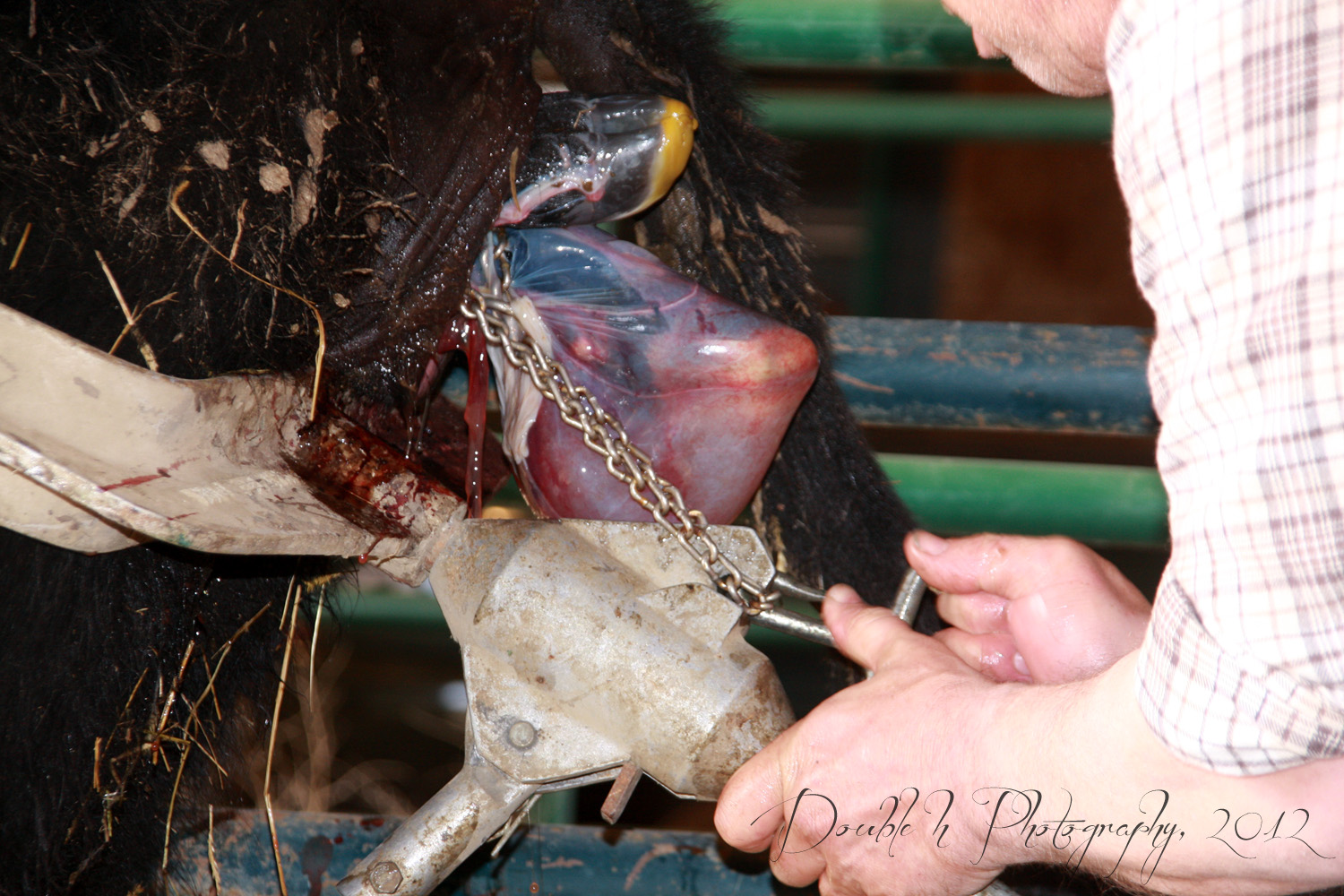
When calving heifers, you inevitably have to help one now and then. This year we are pulling a few more calves than usual, which is a bull related issue. We aren't the sort to wait around several hours for a heifer to have a calf, which some people do. If she isn't progressing in a timely fashion, we like to get her in and get the calf pulled before the heifer is worn out from trying to have her baby, and the calf is exhausted from being squeezed. It's a system that works well for us.
Below is one such example, and I must admit that as far as getting excited about pulling a calf, this is as close as I've ever been. Getting to pull one in the daylight, with lots of help present so I could take photos, isn't the usual story of how it goes.
Just to let you know, I'm going to show you everything. If you don't want to see everything involved in pulling a calf, now is the time to leave.
Upon deciding to pull a calf, we move the heifer into our calving shed, and pen, making every effort to keep her calm. This little pen at the front of the photo is our calving pen, and consists of an automatic head catch, which you can see on the left, and is designed so one person can do the entire job alone, and efficiently. We like our calving pen!
Using the swinging wing, you maneuver the heifer until she sticks her head into the head catch. The wing has that red arm at the top that catches in a specially designed contraption and holds it in place. That guy is my dad, who has been pulling calves for decades. She is in fine hands with his help.
This is where our system varies from most I've seen. Dad grabs that rubber strap, and pulls it under the heifer.
Then he hooks it to a cable, which is connected to a wench. My dad and brother are mechanical gurus, and they incorporated this component.
Now the mother is ready. Her back is supported, but her feet are still on the ground. The wing is pulled back out of the way at this point.
Then he gets his sterilized OB chains, makes a loop with one end, and holds it in one hand. With the other hand he reaches into the heifer, and locates one front foot. He also feels for the head, to make sure it isn't turned back.
He positions the loop above the hock (ankle, or like a dewclaw on a dog), and pulls it snug. If you don't get the loop above the hock, you can pull the hoof off the calf while pulling it. Newborn calves hooves are very soft, and not hard like mature cattle hooves. It's very important to get it positioned correctly
He grabs his handy little hook, and gently tugs/pulls on the calf until the other hoof shows up.
He makes a loop with the other end of the OB chain, and positions it on the other hoof. Like so.
Then this tool comes into play, which is called a calf puller.
You position the calf puller like this, and rest the other end on the ground.
He pulls the chain, and hooks it onto the calf puller, like this.
Then he pushes down on the handle, keeping it angled down like you see above, and starts very slowly pulling and releasing the handle. You don't just crank on the handle and pull the calf out as fast as you can.
When the heifer pushes, then you crank. When she stops pushing, you stop cranking.
When the nose becomes visible, we make sure the sac isn't covering it. If the calf is really big, you have to be careful as you work the calf past the heifer's pelvic bones. If a calf is really big, or a heifer's hips are really small, they can get hip locked, which is when the heifer's hips get stuck on the calve's hips as he tries to pass through the opening. This is a bad situation, and often the heifer and calf get hurt. We haven't dealt with that issue on our place for a long time because of genetic selection, and while this guy was husky, she was plenty big enough to have him with our help.
He continues working with the heifer, cranking when she pushed and stopping when she rested, easing the calf out. Sometimes, once you get the head and shoulders out, the whole calf just comes out. Sometimes you have to continue to work the entire time. Each time we pull a calf it's a little bit different.
Dad had to continue helping all the way with this guy, but he wasn't overly hard to pull. He was big, but shaped right in that he was a long, smooth calf, not a wide, overly stout one.
Once the calf comes out, he immediately unhooks the chains from the calf pullers, sets the pullers aside, and pulls the calf to opposite side of the pen. He does this because when the cow is released, she has to back up, and we don't want her to accidentally step on her calf and hurt it. So, we get it out of the way. Sometimes the new mothers are a little excited too, which is another reason to get the calf out of her way.
He lays the calf on its side and removes the chains.
This is what a very brand new calf looks like. Dad gets the rest of the afterbirth off of him.
Then he grabs a piece of straw and tickles the calf's nose with it. This causes the calf to sneeze, start breathing, and clears the nasal passages and lungs. It also usually gets them to sit up and realize they are no longer inside mamma.
When the calf is alert, the OB chains are rinsed thoroughly in a specially designed livestock disinfectant, and hung up for the next patient.
He returns to the heifer, lowers the cable, and unhooks the rubber strap.
Then releases the heifer. The moment she shows interest in the calf, we leave them alone for a while so they can bond. Causing distraction at this moment can cause big problems in the bonding process. She will lick him off, and he will be up and sucking in under an hour.
Here she is with him about three hours after he was born, up and at em, just the way we like it.
Below is one such example, and I must admit that as far as getting excited about pulling a calf, this is as close as I've ever been. Getting to pull one in the daylight, with lots of help present so I could take photos, isn't the usual story of how it goes.
Just to let you know, I'm going to show you everything. If you don't want to see everything involved in pulling a calf, now is the time to leave.
This is typically what it looks like when a heifer is calving in general, and often the stage she ends up at when she needs help, although the sac is often broke, and you can see one or two feet sticking out. One reason heifers sometimes have difficulties is because the calf is backwards, or in another awkward position. Just like in humans, most come the "right" way (feet and head first), but not every one. One of the first things you note when observing a heifer calving is how many feet are out, and if they are pointed up or down. You want to see two feet, toes pointed down, because that means the calf is coming the right way.
Another reason we might need to pull a calf is because the heifer is a little lazy, and just won't work at it hard enough. Or, sometimes the calve's head, shoulders, hips, or all three, are too big to pass through the birthing canal with ease, and assistance is required to help get the calf maneuvered and pulled out of the birthing canal. With modern advances in breeding, size related issues aren't as prevalent as in decades past, but it does still happen.
If you don't pull calves in these instances, the chance of death greatly increases for the calf, as does the chance of physical injury or health related problems for the cow. In some cases, the cow will also die. Best case scenario for a heifer that experiences calving difficulties, or dystocia, and doesn't receive assistance is a longer interval following calving for both mom and calf to return to optimum health. But, usually the turnout is much less optimistic than that.
We watch our heifers 24-7, and there is always one member of our family on-hand during calving to provide any assistance needed by these first-time mothers.
Using the swinging wing, you maneuver the heifer until she sticks her head into the head catch. The wing has that red arm at the top that catches in a specially designed contraption and holds it in place. That guy is my dad, who has been pulling calves for decades. She is in fine hands with his help.
This is where our system varies from most I've seen. Dad grabs that rubber strap, and pulls it under the heifer.
Then he hooks it to a cable, which is connected to a wench. My dad and brother are mechanical gurus, and they incorporated this component.
Then he uses a control (the read handle) to pull the rubber strap up, until it is snug under the heifer's flank. This is used to keep the heifer on her feet while pulling the calf, and keeps her back straight, which reduces the chance of her being injured. It also prevents the chance of her sitting down halfway through pulling her calf.
Now the mother is ready. Her back is supported, but her feet are still on the ground. The wing is pulled back out of the way at this point.
Then he gets his sterilized OB chains, makes a loop with one end, and holds it in one hand. With the other hand he reaches into the heifer, and locates one front foot. He also feels for the head, to make sure it isn't turned back.
He positions the loop above the hock (ankle, or like a dewclaw on a dog), and pulls it snug. If you don't get the loop above the hock, you can pull the hoof off the calf while pulling it. Newborn calves hooves are very soft, and not hard like mature cattle hooves. It's very important to get it positioned correctly
He grabs his handy little hook, and gently tugs/pulls on the calf until the other hoof shows up.
He makes a loop with the other end of the OB chain, and positions it on the other hoof. Like so.
Then this tool comes into play, which is called a calf puller.
You position the calf puller like this, and rest the other end on the ground.
He pulls the chain, and hooks it onto the calf puller, like this.
Then he pushes down on the handle, keeping it angled down like you see above, and starts very slowly pulling and releasing the handle. You don't just crank on the handle and pull the calf out as fast as you can.
When the heifer pushes, then you crank. When she stops pushing, you stop cranking.
When the nose becomes visible, we make sure the sac isn't covering it. If the calf is really big, you have to be careful as you work the calf past the heifer's pelvic bones. If a calf is really big, or a heifer's hips are really small, they can get hip locked, which is when the heifer's hips get stuck on the calve's hips as he tries to pass through the opening. This is a bad situation, and often the heifer and calf get hurt. We haven't dealt with that issue on our place for a long time because of genetic selection, and while this guy was husky, she was plenty big enough to have him with our help.
He continues working with the heifer, cranking when she pushed and stopping when she rested, easing the calf out. Sometimes, once you get the head and shoulders out, the whole calf just comes out. Sometimes you have to continue to work the entire time. Each time we pull a calf it's a little bit different.
Dad had to continue helping all the way with this guy, but he wasn't overly hard to pull. He was big, but shaped right in that he was a long, smooth calf, not a wide, overly stout one.
Once the calf comes out, he immediately unhooks the chains from the calf pullers, sets the pullers aside, and pulls the calf to opposite side of the pen. He does this because when the cow is released, she has to back up, and we don't want her to accidentally step on her calf and hurt it. So, we get it out of the way. Sometimes the new mothers are a little excited too, which is another reason to get the calf out of her way.
He lays the calf on its side and removes the chains.
This is what a very brand new calf looks like. Dad gets the rest of the afterbirth off of him.
Then he grabs a piece of straw and tickles the calf's nose with it. This causes the calf to sneeze, start breathing, and clears the nasal passages and lungs. It also usually gets them to sit up and realize they are no longer inside mamma.
When the calf is alert, the OB chains are rinsed thoroughly in a specially designed livestock disinfectant, and hung up for the next patient.
He returns to the heifer, lowers the cable, and unhooks the rubber strap.
Then releases the heifer. The moment she shows interest in the calf, we leave them alone for a while so they can bond. Causing distraction at this moment can cause big problems in the bonding process. She will lick him off, and he will be up and sucking in under an hour.
Here she is with him about three hours after he was born, up and at em, just the way we like it.
Monday, March 5, 2012
More Cow Tattoos
We bangs vaccinated our heifers on Friday. This vaccination is required by law in Wyoming for all breeding heifers, and must be given prior to one year of age. Our heifers were born starting in late March, 2011, so we were fine in the age department.
I went over the actual process last year, and you can read that post here. Today, I'm going to give a little more information on why we bangs vaccinate, and why it is a law in Wyoming.
The shot must be administered by a vet, who will also give the heifer a tattoo her in ear, and an official bangs vaccination tag. A bangs shot protects the heifer, and her future offspring, from the disease brucellosis.
Brucellosis is a bacterial disease that can affect cattle, elk, bison/buffalo, and humans. In cattle it will cause abortions, and there is no known cure for infected animals. Here are a couple links to some information on the disease in Wyoming.
While it has been eradicated in most of the U.S., the elk and buffalo populations, especially in the Greater Yellowstone Area, mean we still have to be very diligent in our fight against the disease in Wyoming. Cattle can contract the disease by coming into contact with an infected elk or buffalo placenta, and this is the most common means of a cow contracting the disease. The most critical time of year is coming up in late spring and early summer, when these wildlife species will have their young, and potential infect cattle herds. This isn't a very big concern in Eastern Wyoming, where I'm from, but causes a lot of issues for ranchers in the Western part of the state. However, as the elk populations continue to explode, and inhabit new areas, the level of concern will also increase where I live.
Personally, I feel that the government should be held to the same standard of disease control that we as livestock owners embrace and practice to ensure our herds remain disease free.
Wednesday, January 25, 2012
From Start to Finish
Perhaps you've heard that it takes a long time for ranchers to raise the product we sell, which in our case is beef. This post covers the timeline from start to finish for you. I realize some of the photos aren't my best - I wasn't planning this post for the last two years, and my photography has improved since 2009. My hope is to follow this post with one of photos of our calves over this same time period, so you can see how they change and grow.
Today I am showing you the timeline for the steers we sold in September, 2011. We started planning for them in June of 2009, when we turned the bulls in with our cows. This was the first time we managed specifically for the following year's calf crop.
In late 2009, we poured all our cows for parasites, and preg checked them. All pregnant cows were kept, and given a shot to protect their pregnancy. We fed them every other day all winter to ensure they had enough energy to produce a healthy calf and stay healthy themselves.
Nine months after we turned the bulls in, around late March and April of 2010, the calves were born. We were still feeding at this time because the grass hadn't turned green yet, and the cows were using more energy to produce milk for their calves.
When born the calves weighed between 70 and 80 pounds.
In May, 2010, we branded all our calves, castrated the bull calves, gave everyone an ear tag, and a shot to protect them against common diseases in our area. Then we turned them back out with their mothers on grass for the summer to grow.
Around October 1, 2010, we gathered all our cows and calves back up, and weaned the calves from their mothers. At this time we kept them in the corral for a few days and monitored them closely for sickness. Then we turned them back out on grass, and fed them cake and hay for the winter. Our calves weighed between 500 and 525 pounds when we weaned them.
Lots of ranchers where I'm from market their calves at weaning, or in the months following. Theirs may weigh more than ours at that time because calves are sold by the pound, and ranchers work hard to make as much money as possible, as all good business people do.
In late 2009, we poured all our cows for parasites, and preg checked them. All pregnant cows were kept, and given a shot to protect their pregnancy. We fed them every other day all winter to ensure they had enough energy to produce a healthy calf and stay healthy themselves.
Nine months after we turned the bulls in, around late March and April of 2010, the calves were born. We were still feeding at this time because the grass hadn't turned green yet, and the cows were using more energy to produce milk for their calves.
When born the calves weighed between 70 and 80 pounds.
In May, 2010, we branded all our calves, castrated the bull calves, gave everyone an ear tag, and a shot to protect them against common diseases in our area. Then we turned them back out with their mothers on grass for the summer to grow.
Around October 1, 2010, we gathered all our cows and calves back up, and weaned the calves from their mothers. At this time we kept them in the corral for a few days and monitored them closely for sickness. Then we turned them back out on grass, and fed them cake and hay for the winter. Our calves weighed between 500 and 525 pounds when we weaned them.
Lots of ranchers where I'm from market their calves at weaning, or in the months following. Theirs may weigh more than ours at that time because calves are sold by the pound, and ranchers work hard to make as much money as possible, as all good business people do.
Winter, 2010. Here is a photo from feeding over the course of the winter. We fed them every other day, and checked their water every day.
We also weighed every calf when we weaned, and again in January, 2011 to determine how well each calf was gaining. During the second weighing, we sorted the heifers from the steers and turned them back out in separate pastures.
In early 2011 we also bangs vaccinated all our heifers, which is required by law for all replacement heifers (those we kept for breeding)
In March of 2011 the calves were one year old, and weighed between 600 and 700 pounds. Around this time (there's no set date) they went from being "calves," to "yearlings."
In May, 2011, we poured our steers for parasites, counted them and hauled them to their summer pasture.

In June, 2011, the heifers were turned out with a bull for the first time.
Meanwhile, the steers were happily grazing and gaining on grass for the summer.
Then, on September 17 we sold our steers after managing and working with them for 26 months. They weighed just under 1,000 pounds, and went to a feedlot to be fed a high energy diet for a few months prior to entering the food chain.
We received our one and only paycheck for the steers on that day too, after carrying the expense of growing them for those 26 months. During the time we owned them, we saw them almost every day, and never went more than a week without checking on them for their entire life.
Their sisters will take another two years to start earning income, when we sell their first calves. That's four years of time and money invested prior to seeing any return. Now, I don't want to you think I'm complaining, because I love and enjoy what we do. I'm just explaining.
Ranchers all love what they do for the most part. People who are just in a profession for the money don't typically choose this one. It takes a certain mindset and love for your work to put an animal's well being before a regular paycheck. This is also why you'll often hear ranchers call our profession a lifestyle - because it transcends the definition of a job regularly.
So, to recap quickly. We started in June of 2009, when we turned the bull in with the cows.
Nine months later the calves were born.
And a year and half after that, we sold the steers.
Monday, January 23, 2012
Let Them Eat Cake
I've been busy feeding:
and chopping ice:
for our livestock in recent weeks. Also have several writing/photography irons in the fire, as usual.
Hope everyone else is staying busy at tasks they love!
It's a couple days after I first posted this, but I am linking it up to Farm Photo Friday!
P.S. If the title didn't make sense to you. The crumbs on the top cows nose are cake crumbs. Cake is a protein/energy supplement we feed our livestock in the winter months to keep them healthy and at an appropriate weight level.
and chopping ice:
for our livestock in recent weeks. Also have several writing/photography irons in the fire, as usual.
Hope everyone else is staying busy at tasks they love!
It's a couple days after I first posted this, but I am linking it up to Farm Photo Friday!
P.S. If the title didn't make sense to you. The crumbs on the top cows nose are cake crumbs. Cake is a protein/energy supplement we feed our livestock in the winter months to keep them healthy and at an appropriate weight level.
Subscribe to:
Posts (Atom)