Showing posts with label ranchers caring for livestock. Show all posts

Tuesday, October 15, 2013

The Atlas Blizzard in photos

A week ago we were dealing with the images below firsthand. Tuesday was the day of riding, searching, counting the living and tallying the dead. It was awful. One week later we are doing better. The initial emotional shock is wearing off, my husband and I are both holding colds fairly at bay and everyone is making headway toward recovering from this disaster, with full knowledge that we still have a long road ahead of us.
 

 One of my husband's cows that didn't make it as well as a couple calves belonging to a neighbor. Beyond them are some of the cattle that survived the storm.


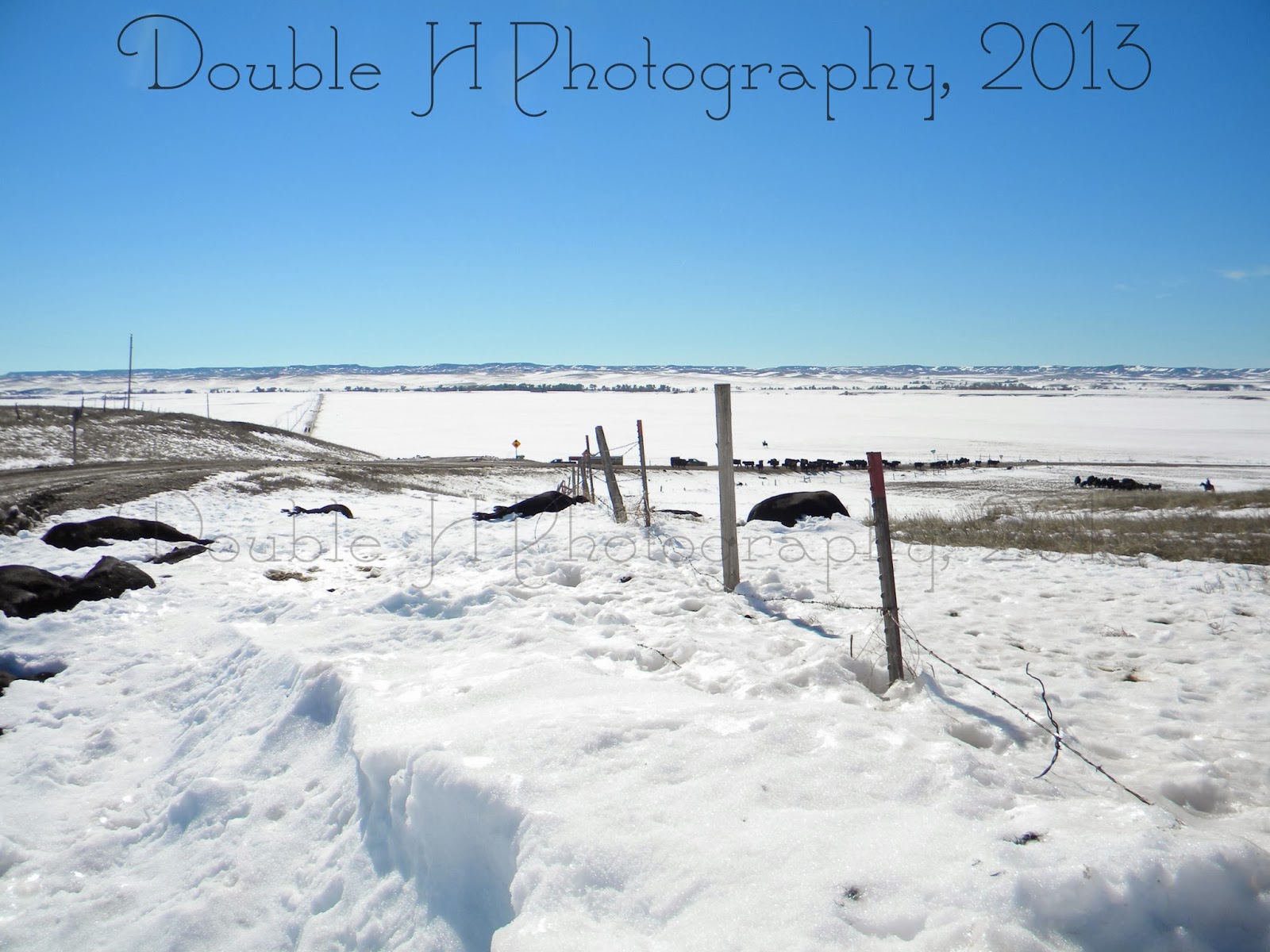
 The scene on the fence line to the pasture our cattle were in prior to the storm. The majority of these animals are not ours, and our living cattle can be seen trailing up the road and back to their pasture. There is one of my cows in this area though, dead because she would not crawl through the fence with the rest of our herd.


 Everyone helped everyone, and shown are some of our neighbor's calves, which we put with our cattle and fed this week. The poor guy crawling through the fence was not all there mentally after his experience in the storm.


 My sister-in-law and I rode in search of our yearling heifers, counting and trailing everyone we found back home. These got out when a power line pole fell on the fence and they drifted over it. As you can see the ground didn't freeze and dealing with the deep mud was a big problem in getting around to check on animals, as was the deep snow on top of the mud.


The guilty power line pole. If not for it, we may not have lost any yearlings. Or, what we did lose may have been in a pile on this fence along with all you see alive in this picture.


This heifer was alone, stuck in the corner of a pasture by a winding creek filled with snow. Every time we drove her out to this corner, she headed back into the trees to stand in the same spot on the creek bank.


When my sister-in-law finally got off her horse to walk the heifer out, she found the reason behind her returning to the same location. All her buddies, and our missing count, were in the bottom of the creek.
This is a heifer we found buried in snow, but still alive! She is basically sitting on her butt, to give you an idea of how deep the snow was in this location.


These were not as fortunate.


 The gardener snake we also found partially buried, but alive.


 My father-in-law headed to the trees and creek where the buried alive heifer was located to help pull her out. Then she was carried in the tractor bucket to higher, dryer ground and propped up against a hay bale.


Carefully loading her up.


 My parents brought their feed pickup. loaded with food, water, a generator and a 4-wheeler, and helped us for two days. We are so blessed to have such amazing parents and families!


 Me, taking pictures for insurance and work purposes. This is next to the creek where our missing yearling heifers were found, including the one still alive.


At the end of the day, we were all worn out, including my sister-in-law and I, but it helped knowing for ourselves where we stood, what shape the livestock were in, and being able to move beyond the worry and concern of not knowing.
For those interested in learning more about the blizzard, who have questions regarding why we lost so many cattle, or who want to contribute toward helping those impacted, here are some additional links.


Wednesday, September 5, 2012

Cow vs. Porcupine

Livestock and wildlife co-exist on all operations. For the most part this co-existence works great for both species because ranchers manage their operations in a way that continuously enhances and improves the land, which means they also improve wildlife habitat. Ranchers also manage nuisance animals that demolish the landscape, encroach upon other wildlife or livestock species, or who are predatory to the point they have a negative impact on other wildlife and/or livestock. 
The porcupine falls into the nuisance category. This animal lives on the bark of trees, and trees are scarce around here. Trees also aid in erosion control, are an important component of our ecosystem  and provide shade, to name a few benefits. Once a porcupine eats a trees bark, the tree dies, so as you may imagine they aren't overly welcome, and are eliminated when located. 
Then there are their quills, which many an animal has found painfully lodged in themselves when attempting to tangle with a porcupine. In severe cases these quills can lodge in the tongue and throat, causing extreme pain and possibly death.
The curious will also get stabbed with quills, usually in the nose as they walk along sniffing the porcupine, who will eventually get mad and whack them with his tail. When we weaned last week we spotted this cow of my brothers, who most likely got her quills as a result of being curious.
 
 
We hauled her home so that we could remove the quills. In this location, the quills would eventually get broken and/or worn off. They aren't life threatening, and more of a discomfort to her than anything. But, we didn't want her to have to suffer, so we readily took the time to remove this poky problem from her face.


Once caught, the guys went to work, using their leathermans to pull each quill, all while trying to keep the cow as calm as possible.


Ouch! But, not nearly as painful as dealing with the quills for several weeks or months. These aren't very deep, and I've seen cows and dogs with almost the entire quill stuck in them before.


 And so it goes, until they're all removed, and the cow is thoroughly checked to make sure none were missed.


Then she was turned back out. While not particularly happy or interested in dealing with a human for a few days, she was otherwise none the worse for wear. Now she will be able to eat, lick, move her nose, etc... without the painful quills constantly poking her.

Friday, April 20, 2012

A Rough Start

It's been busy around here lately, and I just haven't had any time to keep things updated on here. I apologize for my lack of posts over the last week. Today I am sharing one of the events that combined with numerous others to keep me so busy.
Last Saturday night my parents were up from 1:00 a.m. to 3:00 a.m., waiting on a heifer to calve. She finally did, without help, and they headed back to bed. On their way, Parent A told Parent B (names withheld for my protection, lol) to just leave the gate open between the calving lot and our yard area.
Later, Sunday morning, my dad left to feed, and found a heifer laying behind our horse trailers, were no one would see her or think to look, in the yard area. She had been trying to calve for several hours based on how things looked, which wasn't good. He and I immediately pulled the calf right there, and were thankful to find him alive.
We went on about our feeding and left mother and baby alone to do their thing. When we returned a while later, the cow still hadn't gotten up, and wouldn't. This was due to a nerve being pinched during birth - my dad compared it to a human getting a spinal tap. We managed to get her up, and my dad helped her balance by pulling on her tail, but she just staggered around the yard and went down again.
A cow will also be unable to get up if a calf gets hip locked during birth, but fortunately that is not what happened in our case.
The cow needed to get up to get blood flowing back into her rear legs to help her regain control of her back half. The calf also needed to eat, and a calf's first meal of colostrum is especially important in life. Here is what we did to help the cow and her calf on Sunday:


We fabricated a strap in the shop from old hay straps and chains.


Then we got the tractor, and prepared to pick her up and help her stand until she got blood flowing and regained control of her rear end. There was no guarantee our efforts would work, but this is a case where you do everything you can to give the animal the best chance of recovery possible. Sometimes, you have to do this over and over for several days until the cow regains enough strength and coordination to stand by herself. Sometimes they don't ever regain that strength.


Thank goodness she was a nice, gentle heifer, and we worked slow and gently around her so she wouldn't get excited. My dad eased the chain and strap partway under her.
My mother thought she might like a drink, which is why the water is there. My mother was also kind enough to take these photos, so I could share this with you. As you can see, photo taking wasn't very high on my list when this was going on.


Then he pulled her hips over and I grabbed the chain and pulled the strap the rest of the way under her.


We positioned the strap under her flank. We used a strap because it is wide, and less likely to hurt the cow when supporting her compared to a narrow chain or rope.


Then we hooked the chains on the tractor...


and began to slowly lift her back end up.


We worked with the heifer until she was standing..sort of.


We tried to get her back legs positioned so she could, and would, stand on them.


When it became apparent that she wasn't going to be able to stand on her own right then, and we would have to continue working with her, we milked her as much as we could so we could feed her calf the colostrum she produced.


Then we gently laid her back down on the ground when her back legs gave out, and unhooked the chains from the tractor. We just left the strap under her for the next time we lifted her.


Meanwhile, we had moved her calf into our calving shed, because naturally this event occurred on a cold and very windy day. He was never dried off properly and we didn't want him to get chilled. I fed him the colostrum we had milked from his mother, which is far superior to any milk replacer product we had on hand and could have mixed up for him.


Then, since he was still wet and it was so cold and windy, we put one of our calf coats (dog coats) on the big guy...


And packed him back outside to this mother so they could be together and not forget about each other.


Which wasn't a problem. This is how they stayed most of the day. He was worn out from being born, and one of those big and slower moving calves anyway. But, as the day progressed she kept trying to get up, which was encouraging to us.


That evening I took a bottle of milk replacer out to feed her calf. We had decided to let her rest until the following morning, then lift her up again. About halfway through feeding him, she got up! Though very wobbly, she managed to stay up. Here she is in a photo I grabbed from the house. Her calf is laying behind that pile of hay we fed her.
I am happy to report that after another couple days in the corral, where we could feed her and ensure she didn't have to travel a lot for food or water, she and her calf were turned out, and are doing great! That's the kind of ending we always hope for and work toward when situations like this occur.

Sunday, April 1, 2012

Our calving routine

Calving heifers is one of those tasks where if you ask 10 people how to do it, you'll probably get 11.5 answers. The best way to go about it varies dramatically depending on location, environment, facilities, how much help there is, the quality of the help, the livestock, the weather, and numerous other variables.
Some people keep everything in a corral at night, and in a larger lot during the day. Others sort their heavies (the heifers they think are closest to calving) off at night and put them in the corral, and everyone else stays out in the lot. Some people stay up with them all night, others just check them periodically, and a few say they're on their own if they calve after 10:00 p.m. Some people have lots of problems calving heifers, others don't.
Here's what we do. We put our heifers in a 20 acre lot, and have them water out of our corrals. This gets them comfortable with going into the corral, where our shed and calving pen also happen to be located. If a heifer is comfortable going somewhere, it makes your job a whole lot easier to get her back there when she needs help calving. They stay in this lot, and have access to the corral, 24-7. Most calve on their own in the lot.
We check our heifers every three hours, around the clock. We all arrange our schedules so that someone is always here during the day to make sure all is well in the calving department. My brother, dad, mom and myself each take a night/morning shift (10:00p.m., 1:00p.m., 4:00a.m., and 7:00a.m.), and are responsible for that three hour shift if anyone is calving.
To be a little more specific, we cruise out to the lot on a 4-wheeler with our flashlight that is closer to being a stadium light in hand at night, slowly drive through all the girls, checking every one for signs of labor. If all is well, you can go back to bed or on with your day. But, if a heifer is in labor, you're on duty to make sure she has a healthy, live calf for the next three hours. Depending on how far along she is, this may mean checking her in 15 minutes or in two hours, and can make for some long nights at times. It's also not uncommon for more than one to be calving at once, and you're on duty for all of them. Everyone's schedule gets all messed up during calving.
You check, without fail, come blizzard, howling winds, exhaustion, and anything else you can imagine. Our heifers come first this time of year, period, amen.


When you're done with your shift, you report any new births, why someone is locked in the corral, etc... (wildlife sightings are not required) on this dry erase board, located on our porch. This lets the next person know how many new calves should be in the lot, if the calving pen is full, not to tag the skunk, and just helps with communication between tired people.


During the day, we are generally driving by the lot often enough that we don't keep a strict three hour regiment for checking them. Everyone just pays attention and keeps an eye on things. We are also out tagging any new calves, sorting out pairs, and shuffling the odds and ends that always result from calving heifers. So far this year our odds and ends consist of one heifer that doesn't like her calf. We have to put her in a small pen three times a day, then sit there and watch while her calf sucks. It's tedious, and irritating, but so far better than bottle feeding the little guy.
Every evening we feed the bunch their daily ration of hay. While not proven (especially not this year so far), we've found that feeding in the evening reduces the number of calves we have at night. This may be due to the heifer's filling up, laying down and relaxing. Highly scientific, I know, but it does seem to work for us most of the time, and you will try a lot of things to reduce how many nights you have to stay up waiting for a calf to be born!
It is pretty much a full time job calving heifers. When your future cowherd is on the line, it's worth a lot of time and effort to keep them alive and healthy. It's also just the right thing to do in caring properly for them, and calving season is one time of the year when I become especially irritated at those who say ranchers don't care for their animals, and are cruel to them. I've often wished I had one of those individuals with me on a particularly busy, cold, blustery night when you work tirelessly to save calves, keep them warm, healthy, and paired up. When a couple are on your porch, another in the bath tub, and there is enough milk replacer spilled in your house that it would be mistaken for a crack house if the authorities showed up. When, no matter how cold, wet and physically exhausted you get, you don't stop because of how much you do care for the cattle. Oh yeah, then I would want them to stay for the few days following such a night as you continue on.
Anyway, off my soapbox. We are just finishing up our second week of calving, and are just over half done. It has gone exceptionally well, especially with all of us home this year, which hasn't been the case for the last several years. Hope if you calve, your routine is going great too!

Saturday, March 17, 2012

First Calf of 2012!


 Our first calf of the year arrived yesterday afternoon, healthy and without assistance, and nine days early. As of today, she has been tagged, and is patiently awaiting siblings/cousins to arrive so she and her mother can be turned out of the calving lot with some company.


Tuesday, February 28, 2012

Feeding cows in the snow

Today it is snowing and the wind is blessedly absent at my house. I took these photos while feeding this morning. Always love photographing black cattle in the snow, especially when it's coming straight down! Hope you enjoy.


 Guarder of the hay bale


Saturday, February 11, 2012

Feeding in the Snow

 We've been getting some snow this week. Here are a few photos from feeding our yearling heifers and two-year-old cows two days ago. Have a fantastic weekend!