Showing posts with label calving. Show all posts

Sunday, March 3, 2013

Calf Adoption Services

This little guy showed up yesterday at my fiancee's place, but unlike most of the calves, he wasn't born here. He was born at the neighbor's, but his mom didn't make it through having him. When that happens, the rancher bottle feeds the calf and cares for it, unless or until a surrogate mother can be found.
The surrogate mother ended up being one of my fiancee's cows, who lost her calf to unknown causes day before yesterday. The idea was to put the calf without a mother with the cow who lost her calf, and create an adopted pair. This process is called grafting in the ranching world.
If a cow loses her calf, there is a brief window of time consisting of a couple days when you can graft another calf onto her. After those few days, she will quit milking, and be unable to raise the calf. Grafting calves onto cows who lose their own baby is sometimes a huge challenge, but usually worth it because it keeps the cow in production.
At our house, if a cow doesn't raise a calf, for any reason, she is sold. Whenever possible, we put in the effort to get a cow another calf if hers doesn't make it, assuming there is another calf who either lost its mother, or who was a twin, somewhere nearby. This also eliminates the chore of bottle feeding a calf multiple times a day, and the calf does better on a cow than on a bottle. If it all works, grafting a calf is a win/win result of whatever circumstances resulted in an extra cow or calf being around during calving season.


 As I mentioned, a successful graft can be a big challenge. A mother cow will bond with her own baby at birth, and trying to get her to accept a different one can be tough, to say the least. Ranchers try a variety of tactics to help get the cow to accept her adopted baby, sometimes with great success, and sometimes with complete failure. A cow and calf can accept each other almost immediately and love one another as if they were biologically related. Or, sometimes a cow will feed a grafted calf, but never really care about it as she would her own. Sometimes it just doesn't work at all and she will kick the calf off continuously until the rancher gives up.
In this instance, the cow is really nice, and desperately wants a baby of her own. Being able to walk around a little pen like this while grafting is rare at my house, but my fiancee said is fairly common at his.
The trouble with this draft is the baby calf has been bottle fed since birth, so he sees a human as his parent and food source. He was perfectly content to suck on fingers, and had no idea what that big black thing was in the pen with him.


 My fiancee worked at getting him to check out the cow.


 The cow was pretty responsive, and more willing to give it a try than most I've seen.


 The calf was less impressed. He informed us both that his milk came in a white jug with a red rubber nipple, delivered to his pen twice a day, and that he had no idea why we expected him to give this big black thing any of his time.


 The look of exasperation, that you all know and understand if you've ever grafted a calf. To have such a willing cow, and such a simple calf, is kind of backwards, and frustrating. Time to switch plans.


 So, he walked the cow into his single-file alleyway, and brought the friendly and confused calf into tighter quarters to help show him what life was all about.


 He was a little reluctant at first, and wanted to run and buck around the pen until his lunch was delivered.


 But, with a little more one-on-one time, guidance, and proper demonstration, he finally caught on that this whole cow thing might be alright.
How about another round of applause for the cow, too! This would not happen like this at my house, but again, my fiancee has really calm cows. She just stood there, off to the side of the alley, and let my fiancee root around behind her until the little calf was in place. Then she continued to just stand there while the calf figured out that her bag was the source of all things great in a baby calf's world. That is a good cow, and most are not like her. Many of my family's would have taken your head off more then once by now if we tried what he is doing here.


After he got everything figured out, we both stepped back to see how the initial run was going to go. The calf got a drink, and the cow didn't kick him. That's about as good as it gets on the first try when grafting a calf!
This morning, my fiancee had to get the cow back in here before she would let the calf suck, but overall, this is a highly successful pairing so far. If the calf knew about getting his meals from a cow instead of a bottle, they would probably be stuck. But, since he is a little unenlightened on how things work in the real world, he isn't really aggressive.
While two of them will likely take some special care and help for the next week or two, my best guess is that they will get it figured out and get along great.

Thursday, August 23, 2012

Pulling bulls


This week we are pulling our bulls. If you aren't certain what I mean by that, we are not going to physically pull them around (assuming their are no attitude issues), and what I mean by that statement is we are going to take them out of our cows.
Ranchers can manage when they start calving by when they turn their bulls out with their cows. They manage when they stop calving by when they take the bulls out of their cows. This is all assuming the neighbors bull doesn't pitch it before or after your bulls are with your cows. Artificial Insemination (AI) is another very effective way of managing calving, but we don't currently use that method and this will focus on natural breeding.
Managing your calving season is important for several reasons, one being that you want to work around the weather in your area, especially if you don't have adequate protection in case of bad weather. Another is that the closer in age all your calves are, the more uniform they will be their entire lives.Your firstborn calves will also have the competitive, size and age advantage over their younger counterparts for their entire lives. When you will market the calves is another thing to keep in mind when choosing a time to calve.
We strive to have all our calves born as close together as possible each year so they are uniform, easier to manage (think one branding instead of three because calves keep being born for several months), and more marketable (extra big or small calves may be sorted off when you sell).
But, we also want as many cows to calve as possible, and it's not economical to turn a bull out for 10 days, and only get a 50 percent or so calf crop. A cow's estrus cycle lasts 21 days, and gestation length is 280-some days, or about 9 months. So, for each cycle you leave the bulls in, you extend your calvig season by one month. With that in mind, we will typically leave our bulls in for one, two or three estrus cycles (called simply cycles), depending on the group of cows, year, and other factors.
Lots of people also put bulls with their first calf heifers sooner than they put them with their mature cows. This is because calving sooner will give the heifer more time to put on condition post-calving, and before she is turned back out with a bull to breed again. Trying to get a cow to breed back after she's had her first calf is one of the most challenging aspects of livestock reproduction, and a lot of management decisions are geared toward getting her pregnant for a second time.
To put it in perspective, since June 15, when we turned the bulls out with the cows, we have been managing what will be happening on our ranch starting next March, and on through the remainder of next year with our next calf crop. Or, you can think of it the opposite way, in that we have been managing for this year's calf crop that we're about to wean since June, 2011, and actually before when we purchased the bulls that sired them. As in many cases, this is one area of ranching that takes significant planning and investment long before you see the fruits of your labor.
This year we left the bulls in with our yearling heifers, who are those being bred for the first time, for 40 days, or two cycles. This gave every heifer two chances to get bred. If she didn't breed she will be sold, which eliminates the least fertile females from ever entering our mother cow herd. Often times we only leave the bull in with the heifers for one cycle. This ensures we are retaining the most fertile and efficient females into our herd, and makes calving heifers last one month instead of two. The less time spent calving heifers the better in most cases, plus it goes back to having a uniform calf crop and giving each heifer more time to gain condition before she's expected to breed again.
In our mature cows, the bulls are going to be pulled at roughly 60 days, or three cycles. These cows are in much larger pastures, have a calf sucking on them which uses more energy and can make it more difficult for the cow to breed back, and have already had enough money invested in them to make it worthwhile to give them three chances to get bred.
Another key consideration in putting in and pulling bulls is that gestation length in cattle varies, just as it does in humans. Different bulls and different cows will throw calves that are born early, right on time, or late. So, since we turned the bulls in on June 15, we will expect to start calving at least one week early. This is particularly important in our heifers because we use low birthweight bulls, and the way you get a lower birthweight is through a shorter gestation period. Combine that with that fact that we are continuously available to help our first-calf heifer during calving, and it becomes something to pay close attention to.
Some years the bulls aren't pulled, typically because we get so busy with other tasks. We also have cows spread out over a 200 mile area, so it's not like we just spend an hour and they're all gathered. For us, pulling bulls is a big "want to" each year, but not a "absolutely have to" management practice.
If you don't pull bulls the vast majority (over 90 percent) of mature cows will still be bred in 60 days in our place. Very few head will be bred later than that. Big deal you may be thinking, and really it's not a catrastrophe, but it is a pain in the neck. You will have to set up a second day to brand those few head, if they aren't branded they will have to sorted off when you're shipping to summer pasture (and they are always in the way during this), and throughout the entire spring you will spend extra time shuffling, sorting gathering those few head. Plus, those calves you have to spend all that extra time on will be worth less than their larger, more mature siblings for the majority of their lives.

Wednesday, April 25, 2012

The Last Little While

 Over the last little while a lot has happened around here. We are down to four heifers to calve! Our cows are pretty much done too. It is very dry here, to the point of being concerning about our entire year. But, we are supposed to get some rain later this week, and are all holding our breathe that it actually comes through. We also got scours in our calves last weekend, which is practically unheard of here. After catching us very off guard, we got on the ball and I have been doctoring and monitoring this week.
My parents, brother and I have purchased a swanky trailer house for my brother and I to live in. I didn't know I could be so excited about a single wide trailer, but I am! The idea of my own bathroom and dedicated office space is something I am very grateful to have in my near future (we all really wish we could just move my Casper home out here). My brother and dad are staying plenty busy getting the water and sewer put in, before the gravel arrives that will elevate the trailer a few inches. We get serious flash floods around here (it's pretty much feast or famine in the rain department), and plan to attempt to divert water around our new home. We aren't looking to be floating down Dogie Creek the next time it does actually rain around here. New house, yes! New house boat, no!


I've been doing some traveling, and the sage grouse, turkeys and various other birds are in full strutting swing! It's like rush hour traffic on some gravel roads around here, and I've been at a complete stop more than once. I'll take this type of early morning traffic any day.


 One trip was to pick up two new Hereford bulls! We will be having a few more cute baldy calves next spring, and are very happy with how the bulls look in general too.


 Not so happy about the "genetic drift" seen in our calf crop this year. We should only have black calves, but have a few red ones that have been showing up. They may be the result of a neighbors bull, or one of our new "Registered Black Angus" bulls not quite being what he seems. I am investigating. Red I can deal with, but that grey one causes my blood pressure to rise. He just came to the feed ground for the first time yesterday, and I was less than impressed to see that one of our cows had managed to find a Charolais bull. Reds will fit on, but that guy is going to stick out that bad his entire life, and will most likely be unwanted by the buyer when we sell these guys in a year and a half.


On a happier note, here is a photo I found of my dad and I in my earlier days. I am using it in an upcoming Farm Bureau presentation, which is another project that has been coming together the last few days. It's always fun to look through old pictures and reminisce (not that I have a great memory of this time in my life).
Other than those few things, in the last month I've sent articles and photos to two new publications, and am working on multiple potential weddings to photograph this summer. Looking forward to meeting with some of the couples during a trip to Laramie for meetings later this week!
Hope all is well in all of your lives!

Friday, April 20, 2012

A Rough Start

It's been busy around here lately, and I just haven't had any time to keep things updated on here. I apologize for my lack of posts over the last week. Today I am sharing one of the events that combined with numerous others to keep me so busy.
Last Saturday night my parents were up from 1:00 a.m. to 3:00 a.m., waiting on a heifer to calve. She finally did, without help, and they headed back to bed. On their way, Parent A told Parent B (names withheld for my protection, lol) to just leave the gate open between the calving lot and our yard area.
Later, Sunday morning, my dad left to feed, and found a heifer laying behind our horse trailers, were no one would see her or think to look, in the yard area. She had been trying to calve for several hours based on how things looked, which wasn't good. He and I immediately pulled the calf right there, and were thankful to find him alive.
We went on about our feeding and left mother and baby alone to do their thing. When we returned a while later, the cow still hadn't gotten up, and wouldn't. This was due to a nerve being pinched during birth - my dad compared it to a human getting a spinal tap. We managed to get her up, and my dad helped her balance by pulling on her tail, but she just staggered around the yard and went down again.
A cow will also be unable to get up if a calf gets hip locked during birth, but fortunately that is not what happened in our case.
The cow needed to get up to get blood flowing back into her rear legs to help her regain control of her back half. The calf also needed to eat, and a calf's first meal of colostrum is especially important in life. Here is what we did to help the cow and her calf on Sunday:


We fabricated a strap in the shop from old hay straps and chains.


Then we got the tractor, and prepared to pick her up and help her stand until she got blood flowing and regained control of her rear end. There was no guarantee our efforts would work, but this is a case where you do everything you can to give the animal the best chance of recovery possible. Sometimes, you have to do this over and over for several days until the cow regains enough strength and coordination to stand by herself. Sometimes they don't ever regain that strength.


Thank goodness she was a nice, gentle heifer, and we worked slow and gently around her so she wouldn't get excited. My dad eased the chain and strap partway under her.
My mother thought she might like a drink, which is why the water is there. My mother was also kind enough to take these photos, so I could share this with you. As you can see, photo taking wasn't very high on my list when this was going on.


Then he pulled her hips over and I grabbed the chain and pulled the strap the rest of the way under her.


We positioned the strap under her flank. We used a strap because it is wide, and less likely to hurt the cow when supporting her compared to a narrow chain or rope.


Then we hooked the chains on the tractor...


and began to slowly lift her back end up.


We worked with the heifer until she was standing..sort of.


We tried to get her back legs positioned so she could, and would, stand on them.


When it became apparent that she wasn't going to be able to stand on her own right then, and we would have to continue working with her, we milked her as much as we could so we could feed her calf the colostrum she produced.


Then we gently laid her back down on the ground when her back legs gave out, and unhooked the chains from the tractor. We just left the strap under her for the next time we lifted her.


Meanwhile, we had moved her calf into our calving shed, because naturally this event occurred on a cold and very windy day. He was never dried off properly and we didn't want him to get chilled. I fed him the colostrum we had milked from his mother, which is far superior to any milk replacer product we had on hand and could have mixed up for him.


Then, since he was still wet and it was so cold and windy, we put one of our calf coats (dog coats) on the big guy...


And packed him back outside to this mother so they could be together and not forget about each other.


Which wasn't a problem. This is how they stayed most of the day. He was worn out from being born, and one of those big and slower moving calves anyway. But, as the day progressed she kept trying to get up, which was encouraging to us.


That evening I took a bottle of milk replacer out to feed her calf. We had decided to let her rest until the following morning, then lift her up again. About halfway through feeding him, she got up! Though very wobbly, she managed to stay up. Here she is in a photo I grabbed from the house. Her calf is laying behind that pile of hay we fed her.
I am happy to report that after another couple days in the corral, where we could feed her and ensure she didn't have to travel a lot for food or water, she and her calf were turned out, and are doing great! That's the kind of ending we always hope for and work toward when situations like this occur.

Sunday, April 1, 2012

Our calving routine

Calving heifers is one of those tasks where if you ask 10 people how to do it, you'll probably get 11.5 answers. The best way to go about it varies dramatically depending on location, environment, facilities, how much help there is, the quality of the help, the livestock, the weather, and numerous other variables.
Some people keep everything in a corral at night, and in a larger lot during the day. Others sort their heavies (the heifers they think are closest to calving) off at night and put them in the corral, and everyone else stays out in the lot. Some people stay up with them all night, others just check them periodically, and a few say they're on their own if they calve after 10:00 p.m. Some people have lots of problems calving heifers, others don't.
Here's what we do. We put our heifers in a 20 acre lot, and have them water out of our corrals. This gets them comfortable with going into the corral, where our shed and calving pen also happen to be located. If a heifer is comfortable going somewhere, it makes your job a whole lot easier to get her back there when she needs help calving. They stay in this lot, and have access to the corral, 24-7. Most calve on their own in the lot.
We check our heifers every three hours, around the clock. We all arrange our schedules so that someone is always here during the day to make sure all is well in the calving department. My brother, dad, mom and myself each take a night/morning shift (10:00p.m., 1:00p.m., 4:00a.m., and 7:00a.m.), and are responsible for that three hour shift if anyone is calving.
To be a little more specific, we cruise out to the lot on a 4-wheeler with our flashlight that is closer to being a stadium light in hand at night, slowly drive through all the girls, checking every one for signs of labor. If all is well, you can go back to bed or on with your day. But, if a heifer is in labor, you're on duty to make sure she has a healthy, live calf for the next three hours. Depending on how far along she is, this may mean checking her in 15 minutes or in two hours, and can make for some long nights at times. It's also not uncommon for more than one to be calving at once, and you're on duty for all of them. Everyone's schedule gets all messed up during calving.
You check, without fail, come blizzard, howling winds, exhaustion, and anything else you can imagine. Our heifers come first this time of year, period, amen.


When you're done with your shift, you report any new births, why someone is locked in the corral, etc... (wildlife sightings are not required) on this dry erase board, located on our porch. This lets the next person know how many new calves should be in the lot, if the calving pen is full, not to tag the skunk, and just helps with communication between tired people.


During the day, we are generally driving by the lot often enough that we don't keep a strict three hour regiment for checking them. Everyone just pays attention and keeps an eye on things. We are also out tagging any new calves, sorting out pairs, and shuffling the odds and ends that always result from calving heifers. So far this year our odds and ends consist of one heifer that doesn't like her calf. We have to put her in a small pen three times a day, then sit there and watch while her calf sucks. It's tedious, and irritating, but so far better than bottle feeding the little guy.
Every evening we feed the bunch their daily ration of hay. While not proven (especially not this year so far), we've found that feeding in the evening reduces the number of calves we have at night. This may be due to the heifer's filling up, laying down and relaxing. Highly scientific, I know, but it does seem to work for us most of the time, and you will try a lot of things to reduce how many nights you have to stay up waiting for a calf to be born!
It is pretty much a full time job calving heifers. When your future cowherd is on the line, it's worth a lot of time and effort to keep them alive and healthy. It's also just the right thing to do in caring properly for them, and calving season is one time of the year when I become especially irritated at those who say ranchers don't care for their animals, and are cruel to them. I've often wished I had one of those individuals with me on a particularly busy, cold, blustery night when you work tirelessly to save calves, keep them warm, healthy, and paired up. When a couple are on your porch, another in the bath tub, and there is enough milk replacer spilled in your house that it would be mistaken for a crack house if the authorities showed up. When, no matter how cold, wet and physically exhausted you get, you don't stop because of how much you do care for the cattle. Oh yeah, then I would want them to stay for the few days following such a night as you continue on.
Anyway, off my soapbox. We are just finishing up our second week of calving, and are just over half done. It has gone exceptionally well, especially with all of us home this year, which hasn't been the case for the last several years. Hope if you calve, your routine is going great too!

Sunday, March 25, 2012

Pulling a Calf

When calving heifers, you inevitably have to help one now and then. This year we are pulling a few more calves than usual, which is a bull related issue. We aren't the sort to wait around several hours for a heifer to have a calf, which some people do. If she isn't progressing in a timely fashion, we like to get her in and get the calf pulled before the heifer is worn out from trying to have her baby, and the calf is exhausted from being squeezed. It's a system that works well for us.
Below is one such example, and I must admit that as far as getting excited about pulling a calf, this is as close as I've ever been. Getting to pull one in the daylight, with lots of help present so I could take photos, isn't the usual story of how it goes.
Just to let you know, I'm going to show you everything. If you don't want to see everything involved in pulling a calf, now is the time to leave.

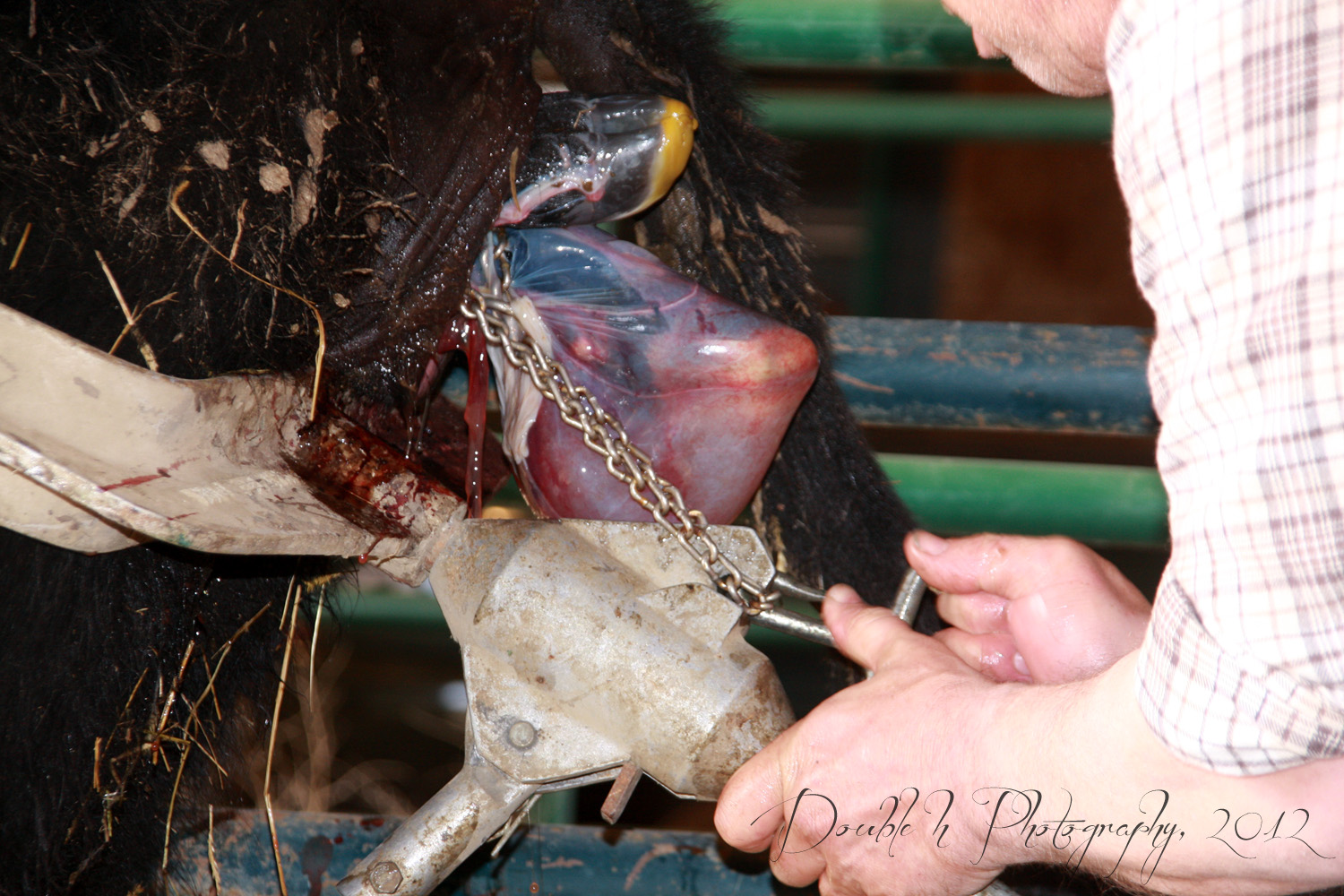
This is typically what it looks like when a heifer is calving in general, and often the stage she ends up at when she needs help, although the sac is often broke, and you can see one or two feet sticking out. One reason heifers sometimes have difficulties is because the calf is backwards, or in another awkward position. Just like in humans, most come the "right" way (feet and head first), but not every one. One of the first things you note when observing a heifer calving is how many feet are out, and if they are pointed up or down. You want to see two feet, toes pointed down, because that means the calf is coming the right way.
Another reason we might need to pull a calf is because the heifer is a little lazy, and just won't work at it hard enough. Or, sometimes the calve's head, shoulders, hips, or all three, are too big to pass through the birthing canal with ease, and assistance is required to help get the calf maneuvered and pulled out of the birthing canal. With modern advances in breeding, size related issues aren't as prevalent as in decades past, but it does still happen.
If you don't pull calves in these instances, the chance of death greatly increases for the calf, as does the chance of physical injury or health related problems for the cow. In some cases, the cow will also die. Best case scenario for a heifer that experiences calving difficulties, or dystocia, and doesn't receive assistance is a longer interval following calving for both mom and calf to return to optimum health. But, usually the turnout is much less optimistic than that. 
We watch our heifers 24-7, and there is always one member of our family on-hand during calving to provide any assistance needed by these first-time mothers.


Upon deciding to pull a calf, we move the heifer into our calving shed, and pen, making every effort to keep her calm. This little pen at the front of the photo is our calving pen, and consists of an automatic head catch, which you can see on the left, and is designed so one person can do the entire job alone, and efficiently. We like our calving pen!


Using the swinging wing, you maneuver the heifer until she sticks her head into the head catch. The wing has that red arm at the top that catches in a specially designed contraption and holds it in place. That guy is my dad, who has been pulling calves for decades. She is in fine hands with his help.


This is where our system varies from most I've seen. Dad grabs that rubber strap, and pulls it under the heifer.


Then he hooks it to a cable, which is connected to a wench. My dad and brother are mechanical gurus, and they incorporated this component.


Then he uses a control (the read handle) to pull the rubber strap up, until it is snug under the heifer's flank. This is used to keep the heifer on her feet while pulling the calf, and keeps her back straight, which reduces the chance of her being injured. It also prevents the chance of her sitting down halfway through pulling her calf.


Now the mother is ready. Her back is supported, but her feet are still on the ground. The wing is pulled back out of the way at this point.


Then he gets his sterilized OB chains, makes a loop with one end, and holds it in one hand. With the other hand he reaches into the heifer, and locates one front foot. He also feels for the head, to make sure it isn't turned back.


He positions the loop above the hock (ankle, or like a dewclaw on a dog), and pulls it snug. If you don't get the loop above the hock, you can pull the hoof off the calf while pulling it. Newborn calves hooves are very soft, and not hard like mature cattle hooves. It's very important to get it positioned correctly


He grabs his handy little hook, and gently tugs/pulls on the calf until the other hoof shows up.


He makes a loop with the other end of the OB chain, and positions it on the other hoof. Like so.


Then this tool comes into play, which is called a calf puller.


You position the calf puller like this, and rest the other end on the ground.


He pulls the chain, and hooks it onto the calf puller, like this.


Then he pushes down on the handle, keeping it angled down like you see above, and starts very slowly pulling and releasing the handle. You don't just crank on the handle and pull the calf out as fast as you can.


When the heifer pushes, then you crank. When she stops pushing, you stop cranking.


When the nose becomes visible, we make sure the sac isn't covering it. If the calf is really big, you have to be careful as you work the calf past the heifer's pelvic bones. If a calf is really big, or a heifer's hips are really small, they can get hip locked, which is when the heifer's hips get stuck on the calve's hips as he tries to pass through the opening. This is a bad situation, and often the heifer and calf get hurt. We haven't dealt with that issue on our place for a long time because of genetic selection, and while this guy was husky, she was plenty big enough to have him with our help.


He continues working with the heifer, cranking when she pushed and stopping when she rested, easing the calf out. Sometimes, once you get the head and shoulders out, the whole calf just comes out. Sometimes you have to continue to work the entire time. Each time we pull a calf it's a little bit different.


Dad had to continue helping all the way with this guy, but he wasn't overly hard to pull. He was big, but shaped right in that he was a long, smooth calf, not a wide, overly stout one.


Once the calf comes out, he immediately unhooks the chains from the calf pullers, sets the pullers aside, and pulls the calf to opposite side of the pen. He does this because when the cow is released, she has to back up, and we don't want her to accidentally step on her calf and hurt it. So, we get it out of the way. Sometimes the new mothers are a little excited too, which is another reason to get the calf out of her way.


He lays the calf on its side and removes the chains.


This is what a very brand new calf looks like. Dad gets the rest of the afterbirth off of him.


Then he grabs a piece of straw and tickles the calf's nose with it. This causes the calf to sneeze, start breathing, and clears the nasal passages and lungs. It also usually gets them to sit up and realize they are no longer inside mamma.


When the calf is alert, the OB chains are rinsed thoroughly in a specially designed livestock disinfectant, and hung up for the next patient.


He returns to the heifer, lowers the cable, and unhooks the rubber strap.


Then releases the heifer. The moment she shows interest in the calf, we leave them alone for a while so they can bond. Causing distraction at this moment can cause big problems in the bonding process. She will lick him off, and he will be up and sucking in under an hour.


Here she is with him about three hours after he was born, up and at em, just the way we like it.