What do you do when you start calving and the high, without windchill, is somewhere around zero? For my family, one answer has been to bundle up the newborn calves in their own coat. I brought this concept with me to South Dakota this spring, where it has come in very handy. By that I mean the first four calves wore the coat until the next calf was born.
We came across this idea years ago when someone, another family member perhaps, hooked us up with an actual "calf coat." Made of weather-proof material, and designed to allow the calf to stay dry and warm while also being able to go to the bathroom without making a mess, we were instantly impressed. We had used old vests, human coats, etc... for this same purpose, but a coat designed for the shape of a calf and made from weather-proof material was a significant improvement. The not so impressive aspect was the cost - around $50 apiece in most major vet catalogs. I realize that $50 really isn't all that much to spend, but it never hurts to see if there is a better deal to be had. Plus, when you're putting a coat on an animal that has no consideration for what you paid to keep them bundled up and warm, they rudely rub it on barb wire, stomp on it, chew on it, terrorize their buddies with it, and on and on. All made possible because the same coat kept them from chilling down.
So, we got creative, and found the above dog coats at a feed store a couple years ago for $20 apiece. Score! Show is Tough1 coat in a size large on a newborn calf weighing in the mid 70-pound range. It works great for the most part. The only thing I would change about this coat, from a livestock standpoint, is that you have to put it over the calf's head. With past coats, there was a Velcro strap that went across the chest and under the belly. But, considering I can buy 5 of these coats for the cost of 2 with that Velcro option, I'm happy. It also doesn't fit every calf perfectly, and sometimes the back end flies up a little, but again the affordability, ease with which you can put it on and take it off, and the fact that it's weather-proof material keeps the calf dry and warm means it gets the job done.
What does everyone else do to keep newborn calves warm in less than ideal conditions? We also have sheds at our disposal that are often used, and tried duct taping ears on a couple little guys this year. The baby calves were not at all impressed with that idea.
Fortunately today the weather is 45 degrees above zero and sunny, meaning the calves are happy and the coat is hanging in the basement!
Showing posts with label calving heifers. Show all posts
Thursday, February 13, 2014
Friday, April 20, 2012
A Rough Start
It's been busy around here lately, and I just haven't had any time to keep things updated on here. I apologize for my lack of posts over the last week. Today I am sharing one of the events that combined with numerous others to keep me so busy.
Last Saturday night my parents were up from 1:00 a.m. to 3:00 a.m., waiting on a heifer to calve. She finally did, without help, and they headed back to bed. On their way, Parent A told Parent B (names withheld for my protection, lol) to just leave the gate open between the calving lot and our yard area.
Later, Sunday morning, my dad left to feed, and found a heifer laying behind our horse trailers, were no one would see her or think to look, in the yard area. She had been trying to calve for several hours based on how things looked, which wasn't good. He and I immediately pulled the calf right there, and were thankful to find him alive.
We went on about our feeding and left mother and baby alone to do their thing. When we returned a while later, the cow still hadn't gotten up, and wouldn't. This was due to a nerve being pinched during birth - my dad compared it to a human getting a spinal tap. We managed to get her up, and my dad helped her balance by pulling on her tail, but she just staggered around the yard and went down again.
A cow will also be unable to get up if a calf gets hip locked during birth, but fortunately that is not what happened in our case.
The cow needed to get up to get blood flowing back into her rear legs to help her regain control of her back half. The calf also needed to eat, and a calf's first meal of colostrum is especially important in life. Here is what we did to help the cow and her calf on Sunday:
We fabricated a strap in the shop from old hay straps and chains.
Then we got the tractor, and prepared to pick her up and help her stand until she got blood flowing and regained control of her rear end. There was no guarantee our efforts would work, but this is a case where you do everything you can to give the animal the best chance of recovery possible. Sometimes, you have to do this over and over for several days until the cow regains enough strength and coordination to stand by herself. Sometimes they don't ever regain that strength.
Thank goodness she was a nice, gentle heifer, and we worked slow and gently around her so she wouldn't get excited. My dad eased the chain and strap partway under her.
My mother thought she might like a drink, which is why the water is there. My mother was also kind enough to take these photos, so I could share this with you. As you can see, photo taking wasn't very high on my list when this was going on.
Then he pulled her hips over and I grabbed the chain and pulled the strap the rest of the way under her.
We positioned the strap under her flank. We used a strap because it is wide, and less likely to hurt the cow when supporting her compared to a narrow chain or rope.
Then we hooked the chains on the tractor...
and began to slowly lift her back end up.
We worked with the heifer until she was standing..sort of.
We tried to get her back legs positioned so she could, and would, stand on them.
When it became apparent that she wasn't going to be able to stand on her own right then, and we would have to continue working with her, we milked her as much as we could so we could feed her calf the colostrum she produced.
Then we gently laid her back down on the ground when her back legs gave out, and unhooked the chains from the tractor. We just left the strap under her for the next time we lifted her.
Meanwhile, we had moved her calf into our calving shed, because naturally this event occurred on a cold and very windy day. He was never dried off properly and we didn't want him to get chilled. I fed him the colostrum we had milked from his mother, which is far superior to any milk replacer product we had on hand and could have mixed up for him.
Then, since he was still wet and it was so cold and windy, we put one of our calf coats (dog coats) on the big guy...
And packed him back outside to this mother so they could be together and not forget about each other.
Which wasn't a problem. This is how they stayed most of the day. He was worn out from being born, and one of those big and slower moving calves anyway. But, as the day progressed she kept trying to get up, which was encouraging to us.
That evening I took a bottle of milk replacer out to feed her calf. We had decided to let her rest until the following morning, then lift her up again. About halfway through feeding him, she got up! Though very wobbly, she managed to stay up. Here she is in a photo I grabbed from the house. Her calf is laying behind that pile of hay we fed her.
I am happy to report that after another couple days in the corral, where we could feed her and ensure she didn't have to travel a lot for food or water, she and her calf were turned out, and are doing great! That's the kind of ending we always hope for and work toward when situations like this occur.
Last Saturday night my parents were up from 1:00 a.m. to 3:00 a.m., waiting on a heifer to calve. She finally did, without help, and they headed back to bed. On their way, Parent A told Parent B (names withheld for my protection, lol) to just leave the gate open between the calving lot and our yard area.
Later, Sunday morning, my dad left to feed, and found a heifer laying behind our horse trailers, were no one would see her or think to look, in the yard area. She had been trying to calve for several hours based on how things looked, which wasn't good. He and I immediately pulled the calf right there, and were thankful to find him alive.
We went on about our feeding and left mother and baby alone to do their thing. When we returned a while later, the cow still hadn't gotten up, and wouldn't. This was due to a nerve being pinched during birth - my dad compared it to a human getting a spinal tap. We managed to get her up, and my dad helped her balance by pulling on her tail, but she just staggered around the yard and went down again.
A cow will also be unable to get up if a calf gets hip locked during birth, but fortunately that is not what happened in our case.
The cow needed to get up to get blood flowing back into her rear legs to help her regain control of her back half. The calf also needed to eat, and a calf's first meal of colostrum is especially important in life. Here is what we did to help the cow and her calf on Sunday:
We fabricated a strap in the shop from old hay straps and chains.
Then we got the tractor, and prepared to pick her up and help her stand until she got blood flowing and regained control of her rear end. There was no guarantee our efforts would work, but this is a case where you do everything you can to give the animal the best chance of recovery possible. Sometimes, you have to do this over and over for several days until the cow regains enough strength and coordination to stand by herself. Sometimes they don't ever regain that strength.
Thank goodness she was a nice, gentle heifer, and we worked slow and gently around her so she wouldn't get excited. My dad eased the chain and strap partway under her.
My mother thought she might like a drink, which is why the water is there. My mother was also kind enough to take these photos, so I could share this with you. As you can see, photo taking wasn't very high on my list when this was going on.
Then he pulled her hips over and I grabbed the chain and pulled the strap the rest of the way under her.
We positioned the strap under her flank. We used a strap because it is wide, and less likely to hurt the cow when supporting her compared to a narrow chain or rope.
Then we hooked the chains on the tractor...
and began to slowly lift her back end up.
We worked with the heifer until she was standing..sort of.
We tried to get her back legs positioned so she could, and would, stand on them.
When it became apparent that she wasn't going to be able to stand on her own right then, and we would have to continue working with her, we milked her as much as we could so we could feed her calf the colostrum she produced.
Then we gently laid her back down on the ground when her back legs gave out, and unhooked the chains from the tractor. We just left the strap under her for the next time we lifted her.
Meanwhile, we had moved her calf into our calving shed, because naturally this event occurred on a cold and very windy day. He was never dried off properly and we didn't want him to get chilled. I fed him the colostrum we had milked from his mother, which is far superior to any milk replacer product we had on hand and could have mixed up for him.
Then, since he was still wet and it was so cold and windy, we put one of our calf coats (dog coats) on the big guy...
And packed him back outside to this mother so they could be together and not forget about each other.
Which wasn't a problem. This is how they stayed most of the day. He was worn out from being born, and one of those big and slower moving calves anyway. But, as the day progressed she kept trying to get up, which was encouraging to us.
That evening I took a bottle of milk replacer out to feed her calf. We had decided to let her rest until the following morning, then lift her up again. About halfway through feeding him, she got up! Though very wobbly, she managed to stay up. Here she is in a photo I grabbed from the house. Her calf is laying behind that pile of hay we fed her.
I am happy to report that after another couple days in the corral, where we could feed her and ensure she didn't have to travel a lot for food or water, she and her calf were turned out, and are doing great! That's the kind of ending we always hope for and work toward when situations like this occur.
Thursday, April 12, 2012
My First Cow
My first cow's granddaughter just calved a few minutes ago. This big boy represents the fourth generation of my cowherd, and that makes me happy! Aside from being too big, mother and baby are doing great.
People get started in the cattle business in a variety of ways. For me it was through my family and the 4-H program. When I was eight years old I purchased my first heifer from the family ranch to show in 4-H, and as they say, the rest is history.
I've told this story before, but in case you missed it, there was quite the discussion over which heifer to choose. My dad, uncle and I narrowed it down to two choices. One was an exceptional individual that would have excelled in the show ring. She was big, fancy and an all around great heifer. The second was a small heifer with a big head, kind eyes and not a whole lot going for her from the show heifer angle. She was never going to be exceptional, physically.
My dad and uncle obviously wanted me to have a good start, both in the show ring and with my cowherd. But, my heart was dead set on the little gal, and despite some serious persuasion from my dad and uncle (I can still remember my uncle explaining the lower quarter of the great heifer, and how desirable that trait was, and how they both consented that it was my choice), I made the decision to purchase Sassy.
Meet Sassy, who made up for any physical traits she was lacking in with her disposition. We bonded, and I loved her and fell in love with showing cattle and having my own cows before the 4-H year was out. Following my first year with her, I went on to show more than 15 heifers and steers in 4-H.
After her stint as my first 4-H project, Sassy went on to be an exceptional cow. Weighing in at maybe 1,000 lbs, she raised over 10 calves for me. Her steers weighed 1,300 lbs. as fats, and I kept almost every heifer calf she produced. She was one of those cows who produced calves that were better than she was.
She survived a nasty March blizzard one spring, where a quarter of her bag was soured. But, God bless her, she wasn't one of the cows that kicked her calf off. As she aged, the thought of selling her was difficult. For a few of her later years we housed her with our calves, who she taught how to eat cake, and which allowed her to eat a higher quality ration.
Eventually, at about 13 or 14 years old (that is ancient for a cow here), I made the tough decision to sell my first cow. All her teeth were gone, so she couldn't consume enough to stay in optimal condition. Her calves got smaller too, and she was just old. So, after more than a decade, my first cow was sold for slaughter. It wouldn't have been right to keep her out of love for her and let her waste away on our place. I cared too much for her to let her die a slow death like that.
Today her influence is still evident in my herd, as you saw in that first photo. She also helped pay for my college education, first vehicle, and numerous other expenses. I would still argue that I made the right choice that brisk winter day in front my grandparents barn, when the great debate was waged over which way to go for my first cow purchase.
People get started in the cattle business in a variety of ways. For me it was through my family and the 4-H program. When I was eight years old I purchased my first heifer from the family ranch to show in 4-H, and as they say, the rest is history.
I've told this story before, but in case you missed it, there was quite the discussion over which heifer to choose. My dad, uncle and I narrowed it down to two choices. One was an exceptional individual that would have excelled in the show ring. She was big, fancy and an all around great heifer. The second was a small heifer with a big head, kind eyes and not a whole lot going for her from the show heifer angle. She was never going to be exceptional, physically.
My dad and uncle obviously wanted me to have a good start, both in the show ring and with my cowherd. But, my heart was dead set on the little gal, and despite some serious persuasion from my dad and uncle (I can still remember my uncle explaining the lower quarter of the great heifer, and how desirable that trait was, and how they both consented that it was my choice), I made the decision to purchase Sassy.
After her stint as my first 4-H project, Sassy went on to be an exceptional cow. Weighing in at maybe 1,000 lbs, she raised over 10 calves for me. Her steers weighed 1,300 lbs. as fats, and I kept almost every heifer calf she produced. She was one of those cows who produced calves that were better than she was.
She survived a nasty March blizzard one spring, where a quarter of her bag was soured. But, God bless her, she wasn't one of the cows that kicked her calf off. As she aged, the thought of selling her was difficult. For a few of her later years we housed her with our calves, who she taught how to eat cake, and which allowed her to eat a higher quality ration.
(Sassy in her later years with my sister riding her. We caught her in the pasture that day for a group of third graders who visited our ranch to learn about ranching. Everyone was thrilled to get to pet a cow.)
Eventually, at about 13 or 14 years old (that is ancient for a cow here), I made the tough decision to sell my first cow. All her teeth were gone, so she couldn't consume enough to stay in optimal condition. Her calves got smaller too, and she was just old. So, after more than a decade, my first cow was sold for slaughter. It wouldn't have been right to keep her out of love for her and let her waste away on our place. I cared too much for her to let her die a slow death like that.
Today her influence is still evident in my herd, as you saw in that first photo. She also helped pay for my college education, first vehicle, and numerous other expenses. I would still argue that I made the right choice that brisk winter day in front my grandparents barn, when the great debate was waged over which way to go for my first cow purchase.
Sunday, April 1, 2012
Our calving routine
Calving heifers is one of those tasks where if you ask 10 people how to do it, you'll probably get 11.5 answers. The best way to go about it varies dramatically depending on location, environment, facilities, how much help there is, the quality of the help, the livestock, the weather, and numerous other variables.
Some people keep everything in a corral at night, and in a larger lot during the day. Others sort their heavies (the heifers they think are closest to calving) off at night and put them in the corral, and everyone else stays out in the lot. Some people stay up with them all night, others just check them periodically, and a few say they're on their own if they calve after 10:00 p.m. Some people have lots of problems calving heifers, others don't.
Here's what we do. We put our heifers in a 20 acre lot, and have them water out of our corrals. This gets them comfortable with going into the corral, where our shed and calving pen also happen to be located. If a heifer is comfortable going somewhere, it makes your job a whole lot easier to get her back there when she needs help calving. They stay in this lot, and have access to the corral, 24-7. Most calve on their own in the lot.
We check our heifers every three hours, around the clock. We all arrange our schedules so that someone is always here during the day to make sure all is well in the calving department. My brother, dad, mom and myself each take a night/morning shift (10:00p.m., 1:00p.m., 4:00a.m., and 7:00a.m.), and are responsible for that three hour shift if anyone is calving.
To be a little more specific, we cruise out to the lot on a 4-wheeler with our flashlight that is closer to being a stadium light in hand at night, slowly drive through all the girls, checking every one for signs of labor. If all is well, you can go back to bed or on with your day. But, if a heifer is in labor, you're on duty to make sure she has a healthy, live calf for the next three hours. Depending on how far along she is, this may mean checking her in 15 minutes or in two hours, and can make for some long nights at times. It's also not uncommon for more than one to be calving at once, and you're on duty for all of them. Everyone's schedule gets all messed up during calving.
You check, without fail, come blizzard, howling winds, exhaustion, and anything else you can imagine. Our heifers come first this time of year, period, amen.
When you're done with your shift, you report any new births, why someone is locked in the corral, etc... (wildlife sightings are not required) on this dry erase board, located on our porch. This lets the next person know how many new calves should be in the lot, if the calving pen is full, not to tag the skunk, and just helps with communication between tired people.
During the day, we are generally driving by the lot often enough that we don't keep a strict three hour regiment for checking them. Everyone just pays attention and keeps an eye on things. We are also out tagging any new calves, sorting out pairs, and shuffling the odds and ends that always result from calving heifers. So far this year our odds and ends consist of one heifer that doesn't like her calf. We have to put her in a small pen three times a day, then sit there and watch while her calf sucks. It's tedious, and irritating, but so far better than bottle feeding the little guy.
Every evening we feed the bunch their daily ration of hay. While not proven (especially not this year so far), we've found that feeding in the evening reduces the number of calves we have at night. This may be due to the heifer's filling up, laying down and relaxing. Highly scientific, I know, but it does seem to work for us most of the time, and you will try a lot of things to reduce how many nights you have to stay up waiting for a calf to be born!
It is pretty much a full time job calving heifers. When your future cowherd is on the line, it's worth a lot of time and effort to keep them alive and healthy. It's also just the right thing to do in caring properly for them, and calving season is one time of the year when I become especially irritated at those who say ranchers don't care for their animals, and are cruel to them. I've often wished I had one of those individuals with me on a particularly busy, cold, blustery night when you work tirelessly to save calves, keep them warm, healthy, and paired up. When a couple are on your porch, another in the bath tub, and there is enough milk replacer spilled in your house that it would be mistaken for a crack house if the authorities showed up. When, no matter how cold, wet and physically exhausted you get, you don't stop because of how much you do care for the cattle. Oh yeah, then I would want them to stay for the few days following such a night as you continue on.
Anyway, off my soapbox. We are just finishing up our second week of calving, and are just over half done. It has gone exceptionally well, especially with all of us home this year, which hasn't been the case for the last several years. Hope if you calve, your routine is going great too!
Some people keep everything in a corral at night, and in a larger lot during the day. Others sort their heavies (the heifers they think are closest to calving) off at night and put them in the corral, and everyone else stays out in the lot. Some people stay up with them all night, others just check them periodically, and a few say they're on their own if they calve after 10:00 p.m. Some people have lots of problems calving heifers, others don't.
Here's what we do. We put our heifers in a 20 acre lot, and have them water out of our corrals. This gets them comfortable with going into the corral, where our shed and calving pen also happen to be located. If a heifer is comfortable going somewhere, it makes your job a whole lot easier to get her back there when she needs help calving. They stay in this lot, and have access to the corral, 24-7. Most calve on their own in the lot.
We check our heifers every three hours, around the clock. We all arrange our schedules so that someone is always here during the day to make sure all is well in the calving department. My brother, dad, mom and myself each take a night/morning shift (10:00p.m., 1:00p.m., 4:00a.m., and 7:00a.m.), and are responsible for that three hour shift if anyone is calving.
To be a little more specific, we cruise out to the lot on a 4-wheeler with our flashlight that is closer to being a stadium light in hand at night, slowly drive through all the girls, checking every one for signs of labor. If all is well, you can go back to bed or on with your day. But, if a heifer is in labor, you're on duty to make sure she has a healthy, live calf for the next three hours. Depending on how far along she is, this may mean checking her in 15 minutes or in two hours, and can make for some long nights at times. It's also not uncommon for more than one to be calving at once, and you're on duty for all of them. Everyone's schedule gets all messed up during calving.
You check, without fail, come blizzard, howling winds, exhaustion, and anything else you can imagine. Our heifers come first this time of year, period, amen.
When you're done with your shift, you report any new births, why someone is locked in the corral, etc... (wildlife sightings are not required) on this dry erase board, located on our porch. This lets the next person know how many new calves should be in the lot, if the calving pen is full, not to tag the skunk, and just helps with communication between tired people.
During the day, we are generally driving by the lot often enough that we don't keep a strict three hour regiment for checking them. Everyone just pays attention and keeps an eye on things. We are also out tagging any new calves, sorting out pairs, and shuffling the odds and ends that always result from calving heifers. So far this year our odds and ends consist of one heifer that doesn't like her calf. We have to put her in a small pen three times a day, then sit there and watch while her calf sucks. It's tedious, and irritating, but so far better than bottle feeding the little guy.
Every evening we feed the bunch their daily ration of hay. While not proven (especially not this year so far), we've found that feeding in the evening reduces the number of calves we have at night. This may be due to the heifer's filling up, laying down and relaxing. Highly scientific, I know, but it does seem to work for us most of the time, and you will try a lot of things to reduce how many nights you have to stay up waiting for a calf to be born!
It is pretty much a full time job calving heifers. When your future cowherd is on the line, it's worth a lot of time and effort to keep them alive and healthy. It's also just the right thing to do in caring properly for them, and calving season is one time of the year when I become especially irritated at those who say ranchers don't care for their animals, and are cruel to them. I've often wished I had one of those individuals with me on a particularly busy, cold, blustery night when you work tirelessly to save calves, keep them warm, healthy, and paired up. When a couple are on your porch, another in the bath tub, and there is enough milk replacer spilled in your house that it would be mistaken for a crack house if the authorities showed up. When, no matter how cold, wet and physically exhausted you get, you don't stop because of how much you do care for the cattle. Oh yeah, then I would want them to stay for the few days following such a night as you continue on.
Anyway, off my soapbox. We are just finishing up our second week of calving, and are just over half done. It has gone exceptionally well, especially with all of us home this year, which hasn't been the case for the last several years. Hope if you calve, your routine is going great too!
Sunday, March 25, 2012
Pulling a Calf
When calving heifers, you inevitably have to help one now and then. This year we are pulling a few more calves than usual, which is a bull related issue. We aren't the sort to wait around several hours for a heifer to have a calf, which some people do. If she isn't progressing in a timely fashion, we like to get her in and get the calf pulled before the heifer is worn out from trying to have her baby, and the calf is exhausted from being squeezed. It's a system that works well for us.
Below is one such example, and I must admit that as far as getting excited about pulling a calf, this is as close as I've ever been. Getting to pull one in the daylight, with lots of help present so I could take photos, isn't the usual story of how it goes.
Just to let you know, I'm going to show you everything. If you don't want to see everything involved in pulling a calf, now is the time to leave.
Upon deciding to pull a calf, we move the heifer into our calving shed, and pen, making every effort to keep her calm. This little pen at the front of the photo is our calving pen, and consists of an automatic head catch, which you can see on the left, and is designed so one person can do the entire job alone, and efficiently. We like our calving pen!
Using the swinging wing, you maneuver the heifer until she sticks her head into the head catch. The wing has that red arm at the top that catches in a specially designed contraption and holds it in place. That guy is my dad, who has been pulling calves for decades. She is in fine hands with his help.
This is where our system varies from most I've seen. Dad grabs that rubber strap, and pulls it under the heifer.
Then he hooks it to a cable, which is connected to a wench. My dad and brother are mechanical gurus, and they incorporated this component.
Now the mother is ready. Her back is supported, but her feet are still on the ground. The wing is pulled back out of the way at this point.
Then he gets his sterilized OB chains, makes a loop with one end, and holds it in one hand. With the other hand he reaches into the heifer, and locates one front foot. He also feels for the head, to make sure it isn't turned back.
He positions the loop above the hock (ankle, or like a dewclaw on a dog), and pulls it snug. If you don't get the loop above the hock, you can pull the hoof off the calf while pulling it. Newborn calves hooves are very soft, and not hard like mature cattle hooves. It's very important to get it positioned correctly
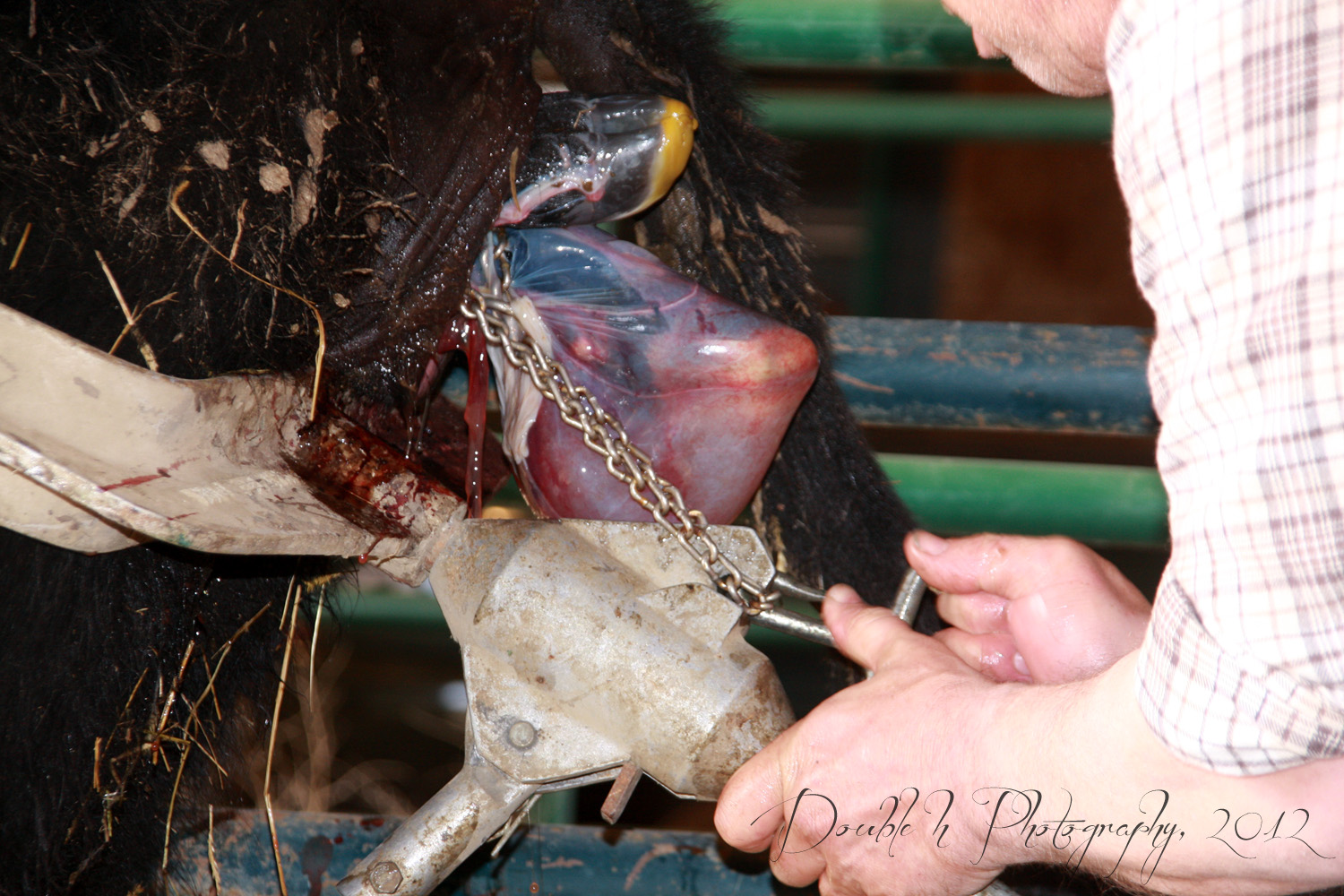
He grabs his handy little hook, and gently tugs/pulls on the calf until the other hoof shows up.
He makes a loop with the other end of the OB chain, and positions it on the other hoof. Like so.
Then this tool comes into play, which is called a calf puller.
You position the calf puller like this, and rest the other end on the ground.
He pulls the chain, and hooks it onto the calf puller, like this.
Then he pushes down on the handle, keeping it angled down like you see above, and starts very slowly pulling and releasing the handle. You don't just crank on the handle and pull the calf out as fast as you can.
When the heifer pushes, then you crank. When she stops pushing, you stop cranking.
When the nose becomes visible, we make sure the sac isn't covering it. If the calf is really big, you have to be careful as you work the calf past the heifer's pelvic bones. If a calf is really big, or a heifer's hips are really small, they can get hip locked, which is when the heifer's hips get stuck on the calve's hips as he tries to pass through the opening. This is a bad situation, and often the heifer and calf get hurt. We haven't dealt with that issue on our place for a long time because of genetic selection, and while this guy was husky, she was plenty big enough to have him with our help.
He continues working with the heifer, cranking when she pushed and stopping when she rested, easing the calf out. Sometimes, once you get the head and shoulders out, the whole calf just comes out. Sometimes you have to continue to work the entire time. Each time we pull a calf it's a little bit different.
Dad had to continue helping all the way with this guy, but he wasn't overly hard to pull. He was big, but shaped right in that he was a long, smooth calf, not a wide, overly stout one.
Once the calf comes out, he immediately unhooks the chains from the calf pullers, sets the pullers aside, and pulls the calf to opposite side of the pen. He does this because when the cow is released, she has to back up, and we don't want her to accidentally step on her calf and hurt it. So, we get it out of the way. Sometimes the new mothers are a little excited too, which is another reason to get the calf out of her way.
He lays the calf on its side and removes the chains.
This is what a very brand new calf looks like. Dad gets the rest of the afterbirth off of him.
Then he grabs a piece of straw and tickles the calf's nose with it. This causes the calf to sneeze, start breathing, and clears the nasal passages and lungs. It also usually gets them to sit up and realize they are no longer inside mamma.
When the calf is alert, the OB chains are rinsed thoroughly in a specially designed livestock disinfectant, and hung up for the next patient.
He returns to the heifer, lowers the cable, and unhooks the rubber strap.
Then releases the heifer. The moment she shows interest in the calf, we leave them alone for a while so they can bond. Causing distraction at this moment can cause big problems in the bonding process. She will lick him off, and he will be up and sucking in under an hour.
Here she is with him about three hours after he was born, up and at em, just the way we like it.
Below is one such example, and I must admit that as far as getting excited about pulling a calf, this is as close as I've ever been. Getting to pull one in the daylight, with lots of help present so I could take photos, isn't the usual story of how it goes.
Just to let you know, I'm going to show you everything. If you don't want to see everything involved in pulling a calf, now is the time to leave.
This is typically what it looks like when a heifer is calving in general, and often the stage she ends up at when she needs help, although the sac is often broke, and you can see one or two feet sticking out. One reason heifers sometimes have difficulties is because the calf is backwards, or in another awkward position. Just like in humans, most come the "right" way (feet and head first), but not every one. One of the first things you note when observing a heifer calving is how many feet are out, and if they are pointed up or down. You want to see two feet, toes pointed down, because that means the calf is coming the right way.
Another reason we might need to pull a calf is because the heifer is a little lazy, and just won't work at it hard enough. Or, sometimes the calve's head, shoulders, hips, or all three, are too big to pass through the birthing canal with ease, and assistance is required to help get the calf maneuvered and pulled out of the birthing canal. With modern advances in breeding, size related issues aren't as prevalent as in decades past, but it does still happen.
If you don't pull calves in these instances, the chance of death greatly increases for the calf, as does the chance of physical injury or health related problems for the cow. In some cases, the cow will also die. Best case scenario for a heifer that experiences calving difficulties, or dystocia, and doesn't receive assistance is a longer interval following calving for both mom and calf to return to optimum health. But, usually the turnout is much less optimistic than that.
We watch our heifers 24-7, and there is always one member of our family on-hand during calving to provide any assistance needed by these first-time mothers.
Using the swinging wing, you maneuver the heifer until she sticks her head into the head catch. The wing has that red arm at the top that catches in a specially designed contraption and holds it in place. That guy is my dad, who has been pulling calves for decades. She is in fine hands with his help.
This is where our system varies from most I've seen. Dad grabs that rubber strap, and pulls it under the heifer.
Then he hooks it to a cable, which is connected to a wench. My dad and brother are mechanical gurus, and they incorporated this component.
Then he uses a control (the read handle) to pull the rubber strap up, until it is snug under the heifer's flank. This is used to keep the heifer on her feet while pulling the calf, and keeps her back straight, which reduces the chance of her being injured. It also prevents the chance of her sitting down halfway through pulling her calf.
Now the mother is ready. Her back is supported, but her feet are still on the ground. The wing is pulled back out of the way at this point.
Then he gets his sterilized OB chains, makes a loop with one end, and holds it in one hand. With the other hand he reaches into the heifer, and locates one front foot. He also feels for the head, to make sure it isn't turned back.
He positions the loop above the hock (ankle, or like a dewclaw on a dog), and pulls it snug. If you don't get the loop above the hock, you can pull the hoof off the calf while pulling it. Newborn calves hooves are very soft, and not hard like mature cattle hooves. It's very important to get it positioned correctly
He grabs his handy little hook, and gently tugs/pulls on the calf until the other hoof shows up.
He makes a loop with the other end of the OB chain, and positions it on the other hoof. Like so.
Then this tool comes into play, which is called a calf puller.
You position the calf puller like this, and rest the other end on the ground.
He pulls the chain, and hooks it onto the calf puller, like this.
Then he pushes down on the handle, keeping it angled down like you see above, and starts very slowly pulling and releasing the handle. You don't just crank on the handle and pull the calf out as fast as you can.
When the heifer pushes, then you crank. When she stops pushing, you stop cranking.
When the nose becomes visible, we make sure the sac isn't covering it. If the calf is really big, you have to be careful as you work the calf past the heifer's pelvic bones. If a calf is really big, or a heifer's hips are really small, they can get hip locked, which is when the heifer's hips get stuck on the calve's hips as he tries to pass through the opening. This is a bad situation, and often the heifer and calf get hurt. We haven't dealt with that issue on our place for a long time because of genetic selection, and while this guy was husky, she was plenty big enough to have him with our help.
He continues working with the heifer, cranking when she pushed and stopping when she rested, easing the calf out. Sometimes, once you get the head and shoulders out, the whole calf just comes out. Sometimes you have to continue to work the entire time. Each time we pull a calf it's a little bit different.
Dad had to continue helping all the way with this guy, but he wasn't overly hard to pull. He was big, but shaped right in that he was a long, smooth calf, not a wide, overly stout one.
Once the calf comes out, he immediately unhooks the chains from the calf pullers, sets the pullers aside, and pulls the calf to opposite side of the pen. He does this because when the cow is released, she has to back up, and we don't want her to accidentally step on her calf and hurt it. So, we get it out of the way. Sometimes the new mothers are a little excited too, which is another reason to get the calf out of her way.
He lays the calf on its side and removes the chains.
This is what a very brand new calf looks like. Dad gets the rest of the afterbirth off of him.
Then he grabs a piece of straw and tickles the calf's nose with it. This causes the calf to sneeze, start breathing, and clears the nasal passages and lungs. It also usually gets them to sit up and realize they are no longer inside mamma.
When the calf is alert, the OB chains are rinsed thoroughly in a specially designed livestock disinfectant, and hung up for the next patient.
He returns to the heifer, lowers the cable, and unhooks the rubber strap.
Then releases the heifer. The moment she shows interest in the calf, we leave them alone for a while so they can bond. Causing distraction at this moment can cause big problems in the bonding process. She will lick him off, and he will be up and sucking in under an hour.
Here she is with him about three hours after he was born, up and at em, just the way we like it.
Subscribe to:
Posts (Atom)