Showing posts with label sorting pairs. Show all posts

Tuesday, June 11, 2013

Sorting pairs

All photos courtesy of Mama H, who was riding the 4-wheeler and photographing this task for me to share on here : )
 
 
We sorted and shipped the last two loads of pairs to summer pasture yesterday. What always precedes shipping pairs is the task of sorting pairs, and we did that on Saturday. Since these were the last two loads, we gathered the entire pasture, which is 3 miles long and 1/5 miles wide, and sorted everything.
Sorting pairs means sorting out each cow with her baby, and putting them somewhere else. We usually put them through a gate into a new pasture. One pair is one cow and calf that are mother and child. The idea behind sorting pairs is that by doing it successfully you will have everyone matched up when you load them on the trucks headed to summer pasture. It's 200 miles to our summer pasture, and if the wrong cow or calf ends up 200 miles from home, it's a big task to get them matched back up, and you might not get it accomplished. You don't just gather a bunch of cows and calves that you haven't sorted out of a big pasture, load them up and ship them out.
We also sort out any calves that haven't been branded yet, and make sure they don't make the trip. The calves are usually too small still, and you don't want to ship a slick calf 200 miles away without any way for someone to know who it belongs to. He could get lost or stolen very easily.
While we make every effort to get this perfect, it doesn't always happen that way. Cows are like people in that some are super good mothers and you can tell right away which calf is hers. Others still aren't sure they even have a kid "at home", and really don't care what he does, who he hangs out with or what time he gets home. But, we do our best, and it's rare to have a mismatched pair. It's the second type that causes us to scratch our heads sometimes, but we have a trick up our sleeves for them that I'll cover later in the post.


 We started with the gather, which went relatively fast with a 4-wheeler, motorcycle, and three people horseback. The motorized people can do the big circle and check the far corners, and the people horseback can gather the rougher areas of the pasture and start trailing everything to the south end. We really like to use a combination of the two on our place for those reasons.


 Here are those of us horseback, which included my brother's girlfriend, my dad and myself. We had a nice, cool day with a roaring wind for the job. A lot of the time we sort pairs with just two people horseback, or three of us horseback and one person on a 4-wheeler. My brother's girlfriend was a nice added bonus on this day.


 When we reached the south end we stopped the cows on one of two big flats along the fence line near a gate. We hold them in a fairly loose bunch, not letting any get away but providing enough room they can (hopefully) keep their calf with them. This is my brother guarding the back side of the bunch.


Here are my dad and I on the front side, both guarding the gate and sorting pairs. My brother's girlfriend is just to the left of the photo, preventing the cows from heading back north across the pasture instead of through the open gate, into a new pasture without anything in it before we started sorting.


Above is my dad making a sweep, where he rides a little way into the herd, turns and sweeps the cows out and toward the gate. This will usually result in those that are paired trailing out.


 Here I am behind him. On this pass we only got one. You can see how she is trailing out and the others that aren't paired have stopped to look for their calf or mom.


Here's a bigger group, four pair at once this time. We also try to do this in a calm fashion. If you go super fast and get everything stirred up, pretty soon no one can find their calf, everyone is upset, and it doesn't go well at all. It's a lot easier on the livestock and us if do things at a slower pace, plus it's faster when you look at the time it took to complete the entire task.


 You never want to let anyone through the gate unless you're sure they belong together. But, sometimes things happen, like a calf misses the gate and goes back down the wrong side of the fence. In that case you have to go get the cow and bring her back to get her calf again. That's what happened here.


 She knew she didn't have her calf, and jogged right back through the gate to go gather him up. It doesn't always go like this. Sometimes the cow just decides to leave, and you have to convince her to come back. That's when you want to be on a good horse.


But this was a good cow. Dad had her calf stopped, and she mooed at him and off they went again, together.


 Everyone has to work well together for a sorting to go well - both horses and people. This is a more technical ranch job in my opinion. Between keeping the cows grouped, but not too tight, making sure only pairs go through the gate, keeping a count on how many pairs you've sorted, being calm but able to run down a cow who has suddenly decided she's had enough and is leaving, then slowing right back down and go back to sorting, and being able to move to wherever you're needed to accomplish all these things in tandem requires everyone work together.


 Both made it through the gate the second time.


 Then, when we get toward the end, and down to those cows who don't have a clue or care in the world, we unleash "The Crackin." Ok, just kidding, his name is Mister, and this is him and my sister sitting in a low spot. Her job while sorting is to hold him on a leash until he's needed. Sometimes she sits on the 4-wheeler with him, but this was her spot of choice on Saturday.
If you're a mom, and you're in the grocery store, and there's a creepy, dirty guy that keeps eyeing you and your kids, you probably have them all lined up, accounted for and in your sight. Mister is the creepy dirty guy to a bunch of mother cows. He instills bellering, slobbering, chasing after him, and typically a much increased awareness of where a cow's calf is. The cows that don't care are usually much less dramatic in their response to him compared to the cows that do care, much like there are usually still a few screaming kids reaching by the creepy guy to get their favorite sugared cereal while the mom aimlessly looks at pop tarts across the aisle. But he still has some impact, enough on this day.
He helped convince the last few, at least for a few minutes at least, that junior wasn't yet of an age where he could do as he pleased and we got them sorted and through the gate.


When the last few went through the gate, we convened for a brief meeting of how many additional pairs we needed from the next pasture to get the correct number to fill our loads, trailed the slick calves and their moms to where they belonged, and continued on with our day.
Sorting pairs with his family has always been one of my dad's favorite jobs. There are big blow ups (with cows) and mad chases that last a matter of seconds, smooth cuts to bring out a big group that's paired, satisfying cuts and dodges on a horse that finally got it figured out, and a good feeling of having accomplished the task together as a family.

Wednesday, May 22, 2013

A run through the run down

 It's that time of year around here, where gathering, branding, breeding, sorting, shipping, weather related delays (hopefully), and numerous other tasks converge into a few hectic weeks known as spring work, spring ranch work, the spring rush, that time of year etc...
What I was unaware of, until about two weeks ago, was that this seasonal workload conveniently hits at my fiances about three weeks before it hits here, and dwindles down just in time for ours to kick into high gear. After about 10 days of firsthand experience at his house, I'm back home with a much more thorough understanding of how the timeline goes around his place, and with dark bags under my eyes as we get into the heart of our spring work.
Here is how it has gone. I have lots of photos I was, and still am, hoping to share in multiple detailed posts. But, I also realize that time will pass, there is also a wedding being planned in the midst of all this, and if I don't share a little about these tasks going on right now, I may not get around to sharing anything.


May 6 - Helped clean the drill and also "helped" plant Barley for the first time since I was old enough to walk.


May 8 - A fellow Wyoming Farm Bureau Young Farmer and Rancher State Committee member and myself drove to Sheridan to read last year's Ag Books for Kids and lead a coordinating activity on seeds as a part of the 1st grade's plant and soil section. I was so thrilled when they called and asked about having me back! What a wonderful compliment to the Ag Books program, and all the work our committee has been putting into making it great in our state!


Throughout all of this my fiancee was AI'ing his heifers to Connealy Irish, which was largely selected because of me. He has been teasing me that I will have to deal with the result of my first management decision for as long as the resulting cows are around, so about 10 years.


May 9 - My future SIL tilled up half the front yard and the some other areas for our grass and tree planting projects, part of which is coming up below.
May 10 - We put CIDR's in my fiancee's cows, which are used to help synchronize them. Those are the CIDRs above.


 May 11 - AI'id early in the morning, then went to two rope and drag brandings.


 May 13 - Planted between 1,000 and 1,500 trees (I have yet to hear the official number). This was very cool, and one topic I am hoping to cover more in depth! These trees will hopefully grow up into a natural windbreak and help keep all the snow from blowing in the corrals and yard, provide more moisture in the field they border and help protect the livestock in blizzards.


I headed back to Wyoming on May 14, and on the 15th we hung this new gate at the end of our alley, cleaned up and prepared for branding, and got a few more odd jobs done before the rain started!


 May 16 - My dad, brother and I gathered our three-year-old pairs and kicked them into a pasture closer to the house. I managed to get this picture of my favorite calf of the bunch : )


 May 17 - Our first branding of the year. Photo courtesy of Double H's mom.


May 19 - We headed north for my uncle's first branding, and finished in a drizzle that turned to a nice rain that lasted all afternoon and evening up there. It hit here the next day, and between the rain and the wind I stayed in and worked on wedding stuff.

Yesterday my brother and I spent the day horseback, sorting and tagging our calves, getting the bulls gathered and put behind an electric fence to assure they avoid sexual temptation for three more weeks. All but one, who was put in with my cows to help them get on their future South Dakota schedule, which includes calving earlier than we do.


Today I took a trip to town to be a part of our local Ag expo, hosted by our county Cattlewomens. This is my second year doing a booth, and my topic this year was explaining the differences between beef and dairy cattle. We looked at different breeds, I brought items from the grocery store that came from each type that we looked at and talked about, and the students decorated a cow cookie as one of the breeds and then told me what breed and type of cow it was.
Tomorrow we're branding again and Saturday morning is my uncle's second branding, followed by a wedding Saturday night.
Wedding plans have also continued throughout all this, and headway has been made! Invitations are out, I finally found someone to do our cake, started on decorations, worked out more specifics on the reception and various other tasks.
Somewhere along the line an article or two has also miraculously appeared, and a few have been skipped. I really appreciate my self employed status this time of year, and the wonderful, understanding people I do work for that are also ranch folks and therefore understand why the schedule is so erratic for these few weeks.
While I love this time of year, I'm also always happy to see the last cows turned out to summer grass, and know that the rush is over and we can settle into the summer months before we hit the fall rush, and do it all again in reverse.

Monday, May 21, 2012

Meanwhile, Back at the Ranch

 Lately I've been busy telling you about what I've been up to off the ranch, and covering a few other issues and topics. While I was doing that things certainly didn't stop at home. Among the latest events on the ranch are the following:
We're still feeding, everything. The sight of cows still trailing in for feed in late May isn't something we like to see, or something we had planned to spend a chunk of every morning completing.


We aren't the only ones still feeding, and my dad and brother's hay hauling business is seeing an unheard-of upswing for May. Combined with the usual cattle hauling jobs, they've been exceptionally busy this spring.


 We branded our heifer's calves on Friday, and have three more brandings scheduled between today and Memorial Day. We've also sorted out us kid's pairs and tagged them (most of them so far). Immediately following branding week will be a 10-day marathon of shipping pairs to summer pasture.
We also have pairs to gather out of a couple neighbors prior to branding.


The weight of our yearling steers has been thoroughly evaluated and discussed in preparation for possibly marketing them earlier than usual this year due to the drought.
The new bull I purchased earlier in the year has been branded and turned out with the other bulls and steers you see above.


We hauled in several loads of gravel, put in a sewer system, tore down a fence and cut tree branches to prepare for the arrival of my brother and I's new abode (aka the trailer). The trailer is now here, blocked and leveled on the gravel pad being dumped in the above photo. Cleaning the inside, skirting the outside and treating the roof are all on the immediate to-do list. I have also decided it would be wonderful to paint (I'm crazy I think) at least part of the interior.
Fencing projects, corral chores, repair and maintenance to various vehicles, a birthday part for my sister, a flat tire on the tractor, a sprinkle of rain and numerous other odd ball events here and there have capped off the very busy past few weeks.
Hope spring is going well at your house!

Sunday, April 1, 2012

Our calving routine

Calving heifers is one of those tasks where if you ask 10 people how to do it, you'll probably get 11.5 answers. The best way to go about it varies dramatically depending on location, environment, facilities, how much help there is, the quality of the help, the livestock, the weather, and numerous other variables.
Some people keep everything in a corral at night, and in a larger lot during the day. Others sort their heavies (the heifers they think are closest to calving) off at night and put them in the corral, and everyone else stays out in the lot. Some people stay up with them all night, others just check them periodically, and a few say they're on their own if they calve after 10:00 p.m. Some people have lots of problems calving heifers, others don't.
Here's what we do. We put our heifers in a 20 acre lot, and have them water out of our corrals. This gets them comfortable with going into the corral, where our shed and calving pen also happen to be located. If a heifer is comfortable going somewhere, it makes your job a whole lot easier to get her back there when she needs help calving. They stay in this lot, and have access to the corral, 24-7. Most calve on their own in the lot.
We check our heifers every three hours, around the clock. We all arrange our schedules so that someone is always here during the day to make sure all is well in the calving department. My brother, dad, mom and myself each take a night/morning shift (10:00p.m., 1:00p.m., 4:00a.m., and 7:00a.m.), and are responsible for that three hour shift if anyone is calving.
To be a little more specific, we cruise out to the lot on a 4-wheeler with our flashlight that is closer to being a stadium light in hand at night, slowly drive through all the girls, checking every one for signs of labor. If all is well, you can go back to bed or on with your day. But, if a heifer is in labor, you're on duty to make sure she has a healthy, live calf for the next three hours. Depending on how far along she is, this may mean checking her in 15 minutes or in two hours, and can make for some long nights at times. It's also not uncommon for more than one to be calving at once, and you're on duty for all of them. Everyone's schedule gets all messed up during calving.
You check, without fail, come blizzard, howling winds, exhaustion, and anything else you can imagine. Our heifers come first this time of year, period, amen.


When you're done with your shift, you report any new births, why someone is locked in the corral, etc... (wildlife sightings are not required) on this dry erase board, located on our porch. This lets the next person know how many new calves should be in the lot, if the calving pen is full, not to tag the skunk, and just helps with communication between tired people.


During the day, we are generally driving by the lot often enough that we don't keep a strict three hour regiment for checking them. Everyone just pays attention and keeps an eye on things. We are also out tagging any new calves, sorting out pairs, and shuffling the odds and ends that always result from calving heifers. So far this year our odds and ends consist of one heifer that doesn't like her calf. We have to put her in a small pen three times a day, then sit there and watch while her calf sucks. It's tedious, and irritating, but so far better than bottle feeding the little guy.
Every evening we feed the bunch their daily ration of hay. While not proven (especially not this year so far), we've found that feeding in the evening reduces the number of calves we have at night. This may be due to the heifer's filling up, laying down and relaxing. Highly scientific, I know, but it does seem to work for us most of the time, and you will try a lot of things to reduce how many nights you have to stay up waiting for a calf to be born!
It is pretty much a full time job calving heifers. When your future cowherd is on the line, it's worth a lot of time and effort to keep them alive and healthy. It's also just the right thing to do in caring properly for them, and calving season is one time of the year when I become especially irritated at those who say ranchers don't care for their animals, and are cruel to them. I've often wished I had one of those individuals with me on a particularly busy, cold, blustery night when you work tirelessly to save calves, keep them warm, healthy, and paired up. When a couple are on your porch, another in the bath tub, and there is enough milk replacer spilled in your house that it would be mistaken for a crack house if the authorities showed up. When, no matter how cold, wet and physically exhausted you get, you don't stop because of how much you do care for the cattle. Oh yeah, then I would want them to stay for the few days following such a night as you continue on.
Anyway, off my soapbox. We are just finishing up our second week of calving, and are just over half done. It has gone exceptionally well, especially with all of us home this year, which hasn't been the case for the last several years. Hope if you calve, your routine is going great too!

Friday, April 1, 2011

Tagging and sorting another way

While on my interview trip, I spent the night with some of my relatives. Everything didn't come together as planned with the interviews, and I didn't have to leave their place early, so I got to go along and help tag and sort a few calves out of the cows.
I am always up for a change in schedule that allows for a little unexpected spring ranch work!
It was a cool, rainy, wet morning, and some of my pictures suffered from the dark skies and rain drops. I apologize for the blurriness in some of them.
This ranch is near Hyattville, Wyoming, and a whole different world than where I'm from. Because of the differences in geography, weather, soil, and other factors, they operate differently, and I made sure to grab my camera, so I could share some of the things I helped (read, sat on 4-wheeler and opened a couple gates) during morning chores.


One difference is they calve their cows on an irrigated circle, as opposed to out in big pastures. That's the center pivot in the back of the above picture, which is what applies the water to the crop (alfalfa and grass in this case). Irrigating makes land much more productive, and is something I know very little about, as there is no irrigation where I'm from.
As cow's calve, they sort out the pairs and put them in another pasture. They also give a shot to help prevent scours (diarrhea), tag, and band any bull calves at this time. Moving these new calves out of this area is also done to help prevent scours, and to keep everyone from mothering the newborns.
On a side note, scours is one of, and in some places the biggest, calving related problem ranchers deal with in many parts of the west. Being able to calve in big, open pastures, that are very dry compared to some parts of the state, is one huge advantage to calving where I grew up.
There are always unique advantages and disadvantages to ranching in a particular location, and that location dictates many of the operation's management practices, and is also the reason why there are often so many effective ways to do the same thing on different ranches.


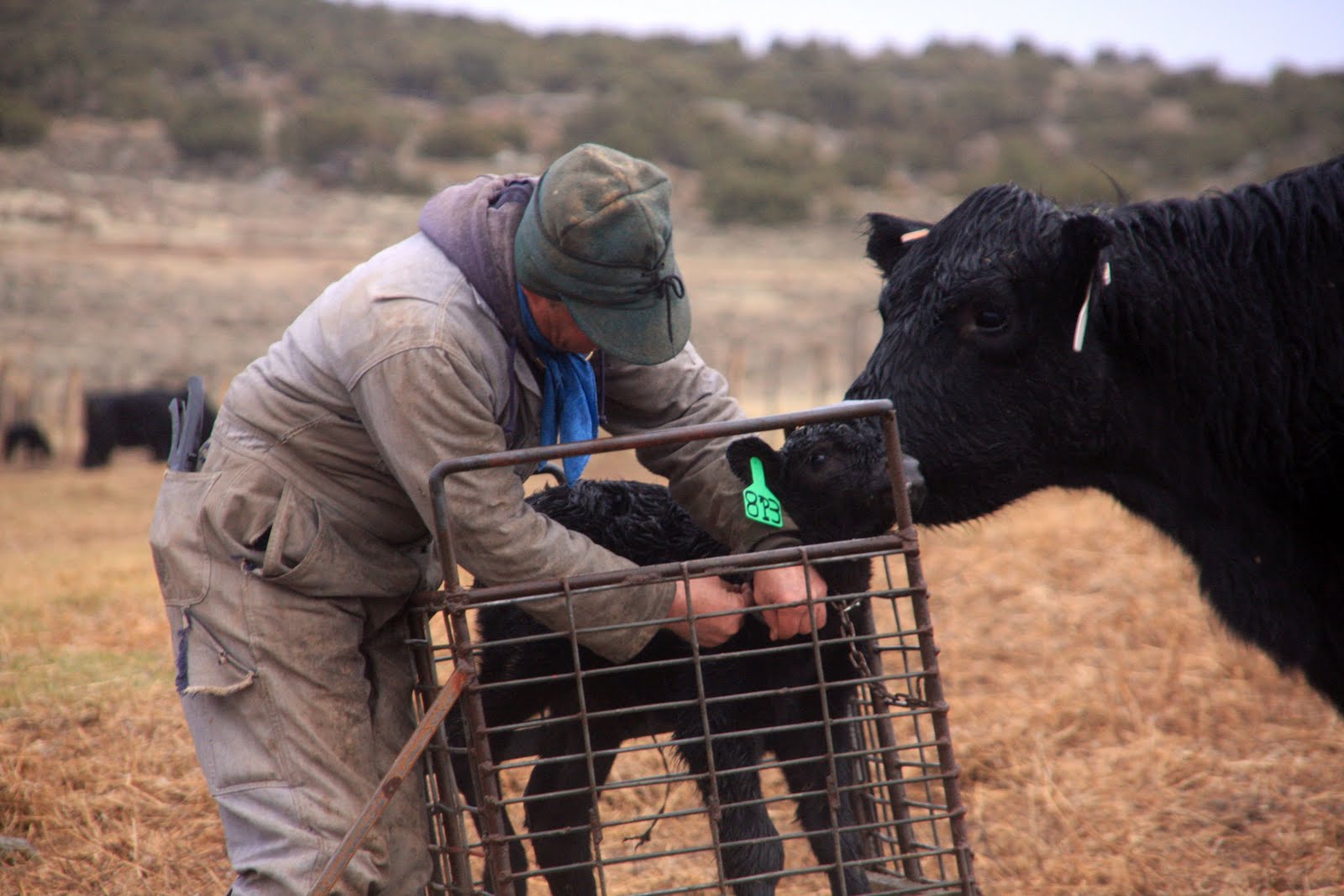
Anyway, at this place a cane is used to grab calves, then maneuver them into this sled. This is much easier when calves are younger and less coordinated, just like tagging is where I'm from.


A chain is secured around the calf's neck, much like a dog collar. This prevents the little guy from trying to jump out, and potentially hurting himself or getting away.


Then you pull the sled with a 4-wheeler to the pair pasture. Ideally the cow follows along, like here. (I had to use pictures from a few different trips to get the whole process, hence there being both red and black cows)


Upon arrival, the calves are tagged, banded, and given their shot. Just like where I'm from, tag, gender, and mother information is recorded in a book for future reference. Ranchers actually keep an incredible amount of data on their livestock, crops and daily activities.


This isn't always a job for the faint of heart, and since calves are handled so much more than where I'm from, (we don't touch a cow's calf until branding, when he's a couple months old) cow disposition is a really big deal for this operation. This guy doesn't want to get run over every time he leans over the sled to tag a calf.


But, it's a fine line in many ways, because he still wants his cows to be good mothers. Most of them stay very close and keep a good eye on the proceedings. This cow also bellowed and blew a little snot a couple times.


After everything is done, the calf is released from the sled. He bands bull calves at this time because he's already handling them, and it will make branding day go faster, as there won't be any bull calves to castrate. It's always about maximizing efficiency in whatever ways possible.


You always want to keep one eye on the mother cow, who is right in the middle of the whole process.


If he couldn't get it banded while in the sled, he finishes that up, then the calf is released.


Except for a miffed mother, no one is the worse for wear, and this calf's chances of getting scours is greatly reduced through these management practices.


The pair joins other newborn calves, and we go back for another one after everything is recorded in the book.
By the way, this post is linked up over at Verde Farm's Farm Friendly Friday too, which is a fun place to check out a lot of great blogs!

Monday, March 14, 2011

Sorting out pairs

After tagging calves, we sort all the pairs out of the calving lot. Doing this reduces confusion - trying to match up cows and calves, especially in the dark, can get very complicated as more and more calves are born for both the humans and the cows. This also gets the cows back out on pasture, which is better for the overall health and happiness of both the cow and calf, and reduces the chances of scours from occurring, in addition to a number of other things.

We write down how many we sort out, after they're physically out of the lot. Here are Holly and I starting on round two. We head any pairs that are ready toward the nearest gate. We also keep things as calm and low-stress as possible.


It's typically a slow process, involving lots of mooing and concern every time a cow loses sight of her calf for an instant. These heifers are good mothers, and very concerned about their babies. They stop a lot and make sure they have their calf, and he's alright. Then you go a little further and repeat. Add in a couple other pairs, like here, and everyone has to sort through the calves every few steps too. It's cute, and fun, so long as you're not in a hurry. If you're in a hurry, you might as well go do whatever you're hurried over, then come back to this.
This is one of my favorite things to do, and my dad was kind enough (or hurried enough) to leave the last three days worth of pairs in the lot for Holly and I sort out Saturday morning.


Then there are the ones that attempt a getaway, or think you want them to head off in another direction. Or, sometimes a calf just feels good and takes off, running and bucking across the pasture. This will cause at least his mother, and possibly all the mothers, to take off after him.


In these instances we stay with the calf, and bring him back to his mom, then get everyone lined back out and headed in the right direction again. This is another task that gets more difficult as the calf gets bigger and more coordinated.
This little guy was just feeling good, and was easy enough to turn back to his anxiously awaiting mother. Young, uncoordinated calves prevent a lot of good mothers from running off or getting away. If she cares about her baby, you can use that to your advantage when sorting or moving pairs.


I was enjoying it. Holly was perturbed he was attempting a runaway.


The cow gathers him back up and heads out. If a calf keeps this up, we might take him on a little lap, and take some of the fun out of running away from his mom. This guy was one attempt away from that, but decided to quit his antics just in time.


We get everyone back in a bunch, and if they haven't made it through the awaiting open gate, start them that way again. Some will just gather up their calf and walk on down the fenceline, find the open gate, and continue on. Others need a little more encouragement. Nobody ever blamed a first calf heifer of being too intelligent either, so you have to that in mind.


We give them lots of space if they're heading the right way. This lessons the confusion and concern over whose calf is whose.


Calves typically follow, and have a tendency to get hung up at gates. Sometimes this is easily fixed, like here, and sometimes you have to go get the cow if she just runs off.


Once out of the calving lot the cows have access to a really high quality alfalfa hay bale. This prevents them from losing condition as they produce milk for their calf and deal with being a young mother. The key thing is getting your first calf heifers to breed back, and if they lose a lot of weight after calving the chances of that are significantly reduced.
This heifers were raised on grass, and know how to graze. They typically head out and graze most of the day, then stop by and eat a little of the bale on their way in for a drink. But, there are also the gluttons, who are camped out by the hay bale 24-7. Once green grass makes its appearance, and they can get adequate nutrition through that grass, they won't get any more hay.

Holly and I had lots of fun. Here we are going after another bunch. It's typically a one, two or three pair at a time deal, and was a great way to spend part of our Saturday.