We are finally finished with our fall cattle work as of Nov. 8. This run of weaning, shipping, preg-checking and hauling off drys usually takes 3-4 weeks. It took three months this year. Above is a photo from August 27 - the day we weaned our first calf heifers. Also the earliest my father ever remembers weaning April born calves.
Why is it all so spread out this year? The response typically starts with, "this is an odd year," and I'm sure people who don't understand ag, and even some who do, are sick and tired of hearing farmers and ranchers say that around here.
Perhaps a better way to say it is the unusual weather resulted in altered management practices in an effort to do what was best for our livestock and land longterm.
For example, we did not wean in August, when it was over 100 degrees, just for kicks and giggles. We did that because we had very little grass for the cows to consume, and with the increased energy they use to produce milk for their calf, we thought it may be most effective to wean the calves and feed them a high quality diet, rather than expect the cow to feed him on a limited, poor quality diet. This was also thinking ahead because if the cow doesn't have enough nutrition, she will absorb her new pregnancy before she stops producing milk for her current calf, and we didn't want to reach that point and have a bunch of our young cows come up open (not pregnant) which means they're sold on our outfit.
We also started supplementing the cows in August, which is also incredbibly early, to help them get as much as they could out of the available grass. By "we" I mean my mother and I. The other half of the "we's" around here were already booked solid hauling hay over twice as far per load as last year, trying to get as much accomplished as possible before winter set it. That is also unusual, and a direct result of the weather. All ranchers are concerned about winter, and want to make sure they are in a position to care for their livestock regardless of what happens in the next several months.
Then, as September rolled along, we were feeding the weaned calves every day. As soon as possible after pulling the bulls out their mothers were preg-checked, and any that were open were immediately sold to conserve as much grass as possible for those that were bred. Our yearling heifers were also pregged as early as possible, via ultrasound, and turned out with the other young cows. The guys literally took those days off, then climbed back in their trucks - either to haul hay or have repairs made.
From there we dove into the older cows, who spent the summer on far better grass 200 miles north of our home place at a grazing association. This always involves a day of gathering, weaning and shipping calves home, followed a few days later with gathering and shipping the cows home. This is all done for two separate bunches of cows - my father's and my uncles, so you can take that list and double it.
The calves were all shipped to the feedlot, in two separate bunches because some were at home and some went straight from the grazing association. Hay was also hauled to the feedlot. The last two yeras we haven't gone to a feedlot, and that switch took extra days to vaccinate the calves based on the feeder's health program and to load them out. Prior to that our management resulted in the calves all being together, which meant one day of shipping, not two.
Then, I called the vet, and scheduled our last pregging based on his next available date, which was three weeks out at the time. So, from the time the cows were hauled home from the grazing association until last week they were fed every bite they ate. This was because it was a toss up which was more efficient - feeding them near the house where there was no feed, or trailing them to the far end of the place, then gathering and trailing them back a week later. We chose to feed them, and on a nice morning with lots of help, we finished up the last cow, shipped off the last drys, counted out the last bunch, and trailed them to their winter home.
One thing I've noticed this fall is that for taking so long, I don't know how it could have gone any better. I don't remember ever having better weather for every single day. With a couple exceptions it was sweatshirt weather. Just last year I was hobbling around on my first, and very well done sprained ankle, on days with freezing rain and dust all at the same time. Plus, I have doctored a significantly smaller percentage of calves than in recent years, which always makes me happy.
Did all our plans to do what was best for our land and livestock work perfectly - no. The early weaned calves looked tough when they headed to the feedlot and we came to the conclusion that we would rather feed the cow with the calf on her than wean early and feed the calf. However, for the most part we consider the extra time and effort well spent. Things look rough around here, and there aren't any fat cows on this place this year. But, there aren't very many overly thin cows either, and those that are thin are picking up fast. Plus, we have managed to stretch what we have to the point that we're going to make it work for this winter, much like our friends and neighbors.
Showing posts with label aluminum cattle pot. Show all posts
Monday, November 12, 2012
Wednesday, March 7, 2012
Did you know: trucking statistics, rules and regulations?
Last week I wrote an article from a presentation given at the Wyoming Farm Bureau Legislative Meeting, on current issues in the trucking industry. The lady had a pile of facts and figures included, and since trucking has a major impact on most industries, agriculture included, I feel they are relevant.
The trucking industry is a major U.S. employer, with 7.3 million people employed in the trucking related jobs in 2008. Nearly 3.4 million of those people were actual truck drivers.
Ninety-six percent of trucking companies operate fewer than 20 trucks, and 88 percent operate six trucks or less. It's a small business industry.
In 2011, over 69 percent of Wyoming commodities relied exclusively on trucks to move their goods, and more than 80 percent of the commodities in the U.S. depended solely on trucks for the delivery of their goods.
Truck movement of manufactured freight at the national level is 81.76 percent. In 2010, Wyoming saw 16.3 million tons of inbound manufactured freight, and trucks moved 13 million of those tons.
In 2009, commercial trucks accounted for about 10 percent of all vehicle miles driven nationwide. In Wyoming, trucks drove 2,064,000 miles, about 22 percent of all miles driven within the state that year, and paid 66 percent of all the taxes and fees owed by Wyoming highway users.
The trucking industry deals with anti-trucking groups. The one that stood out the most to me is called "Parents Against Hired Truckers." This group, along with several others, has been causing serious efforts in the Department of Transportation's (DOT) efforts to revamp the Hours of Service Rules, a critical component of any trucking business, for years.
Wednesday, October 26, 2011
The Fall Work is Done!
In reality the work on a ranch is never done. But, we wrapped up the last of our "fall work days" Monday, when we preg-checked the last of our cows.Every cow and calf has been shipped or trailed home from their summer pastures, the calves have all been weaned, their weights are entered in the computer, and the cows have all been preg-checked. For the last six weeks or so it has been a crazy mix of driving, riding, gathering, sorting, hauling, driving, riding, unloading, weaning, preg-checking, fencing, fixing water, etc... Did I mention driving and riding? And picking up gallons of milk as you blew through a town, learning which little espresso huts will make a coffee the fastest at 6:00 a.m. (I NEED my caffeine, and if we drove by a coffee shop would accomadate a horse trailer or semi, we stopped), wishing for a coffee shop on all the mornings (especially the cold ones) we didn't drive, or drive by one, keeping enough clothes in every pickup to ensure you're covered if it's 95 degrees or 10 below zero, and swapping my camera and computer equipment from outfit to outfit so that I can get as much work done as possible whenever we hit a town, or stay at a house, with Internet.
It's a unique time of year that's hard to explain unless you've lived it. I like to think of it as a whole lot of fun packed into a short period of time. We were blessed with beautiful weather for almost every task this year, and that always makes it so much nicer!
Now we are settling into the routine of feeding and doctoring calves, writing articles again, and getting ready for winter.
I am also going to the doctor tomorrow for an incredibly swollen ankle that has been plaguing me all fall, and which I "finished off" while gathering cows Sunday. I had to run a cow down and turn her back, which she was opposed to, and when it was all over I was one hurting unit. Hoping it's nothing serious, but have a feeling it could be.
Hope everyone else's fall has also been a busy, productive few months of working at tasks you enjoy, with people you love! I am so very blessed to have such a jam-packed schedule of things that I love to do, with my family and friends as the other people I get to do them with!
Thursday, October 13, 2011
Loading a Cattlepot
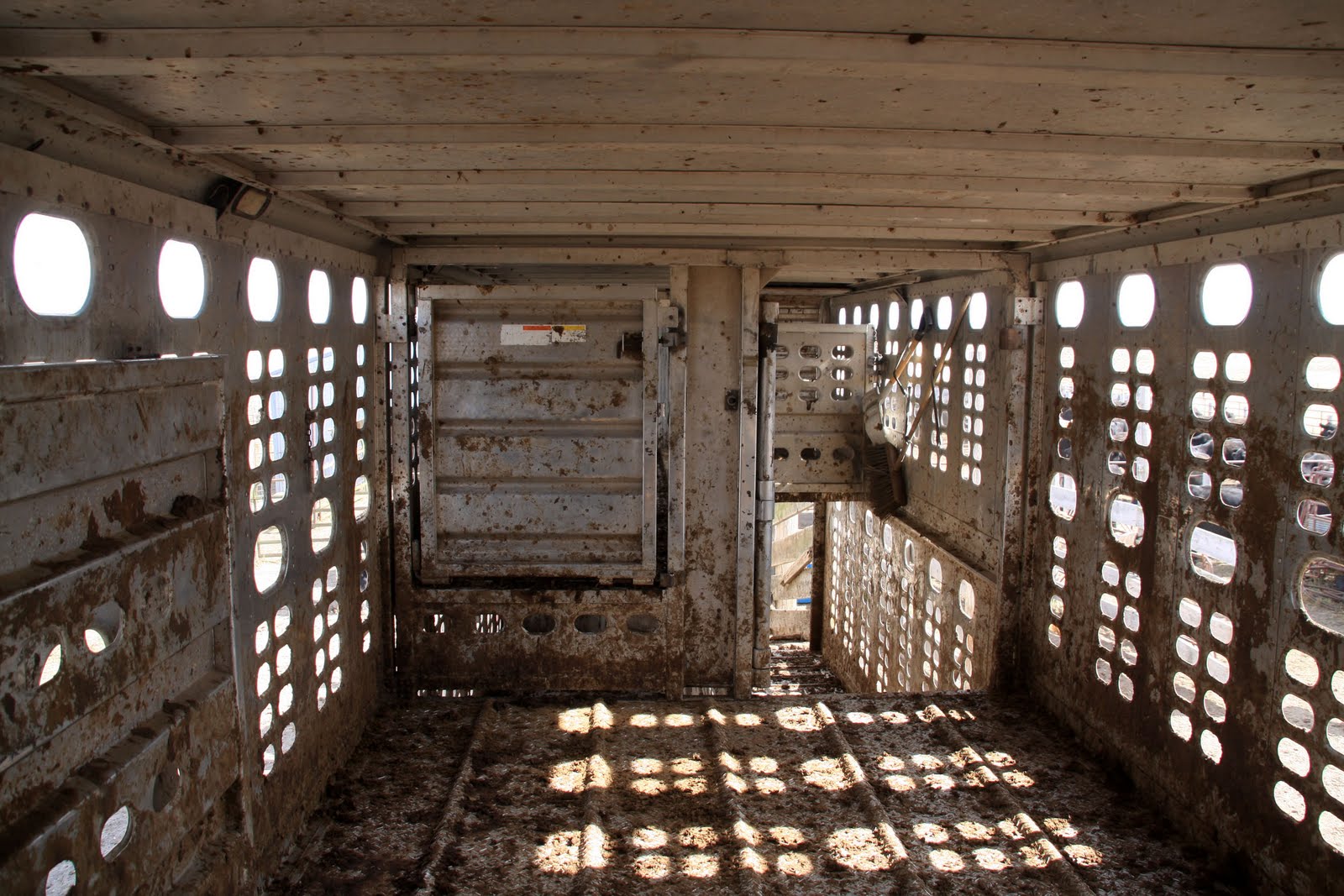
I've shown pictures of loading our cattle onto a cattlepot before. But, I thought it might be interesting to show you the inside, and how it all works as cattle are put on the truck. It's not a matter of just filling it up until the trailer is full. Oh no, it's much more complex than that.
The first picture shows how the standard cattle pot is arranged inside. Trailers come in different lengths, and more modern pots have four axles on the trailer, so the middle is smaller, and the ends are bigger.
I've also heard that no two Wilson (that's a brand name) Cattlepots are made the same. Considering there are thousands of them in use, that's a very interesting tidbit to me.
There are also trailers with spread rear axles (the axles are spread apart, and there are two on a trailer), or closed tandem axles (the axles are all close together, and there are two to four of them). Truckers can haul a certain amount of weight on every axle they have on their truck and trailer. It's 12,000 lbs for the front axle on the truck, 36,000 lbs in Wyoming ( it's 34,000 lbs in most states) on closed tandem axles, which are on the back of the truck, and possibly the trailer. If the trailer isn't a closed tandem axle, it will be a spread axle, and can haul 20,000 lbs. As you add more axles to a trailer, you can haul more weight, but the amount you can haul per axle becomes much more complex to determine.
So, if you have a truck and a spread axle trailer, you can haul 54,000 lbs, which is what my dad can haul.
Truckers load trailers to make sure they are at a proper weight on every individual axle. To help them do this, and to keep the livestock sorted and safe, are two floors and a number of pens/compartment within the cattlepot.

Here's how a cattlepot is generally divided up inside. Some pens you can only put smaller animals in, like calves (the doghouse), and others have removable floors so a trucker can either haul a single deck (decks are like stories in a house) of cows, or two decks of calves (the nose).
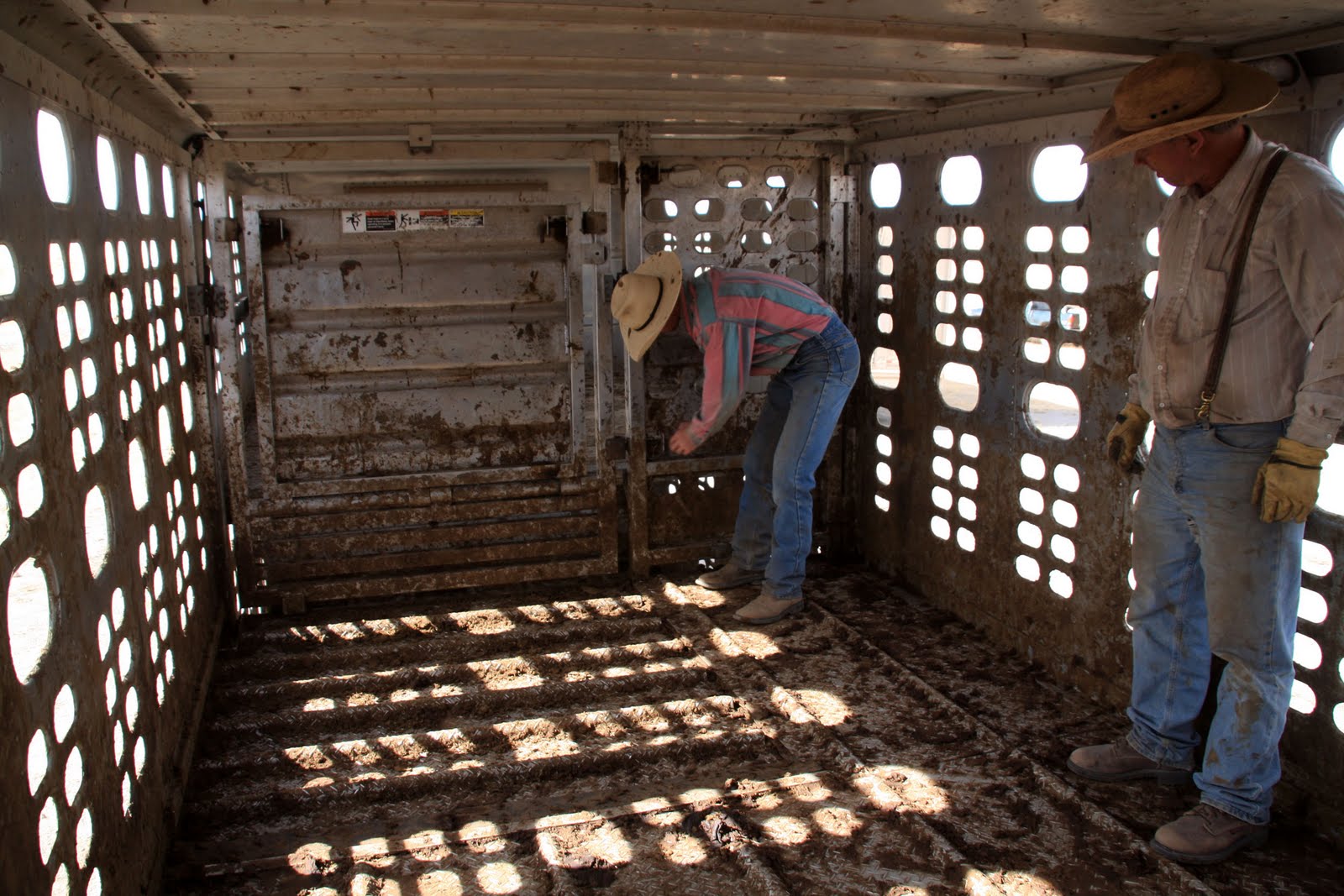
Here's the view inside, on the top deck, looking toward the nose. My dad and brother are busy putting the deck in the nose of a cattlepot, so they can haul two decks of calves. Truckers can haul just cows, just calves, or a combination of both. The holes are for ventilation for the livestock, to keep the pot from being blown over in windy conditions, and to keep it light. These trailers are made of aluminum, which also keeps them light.
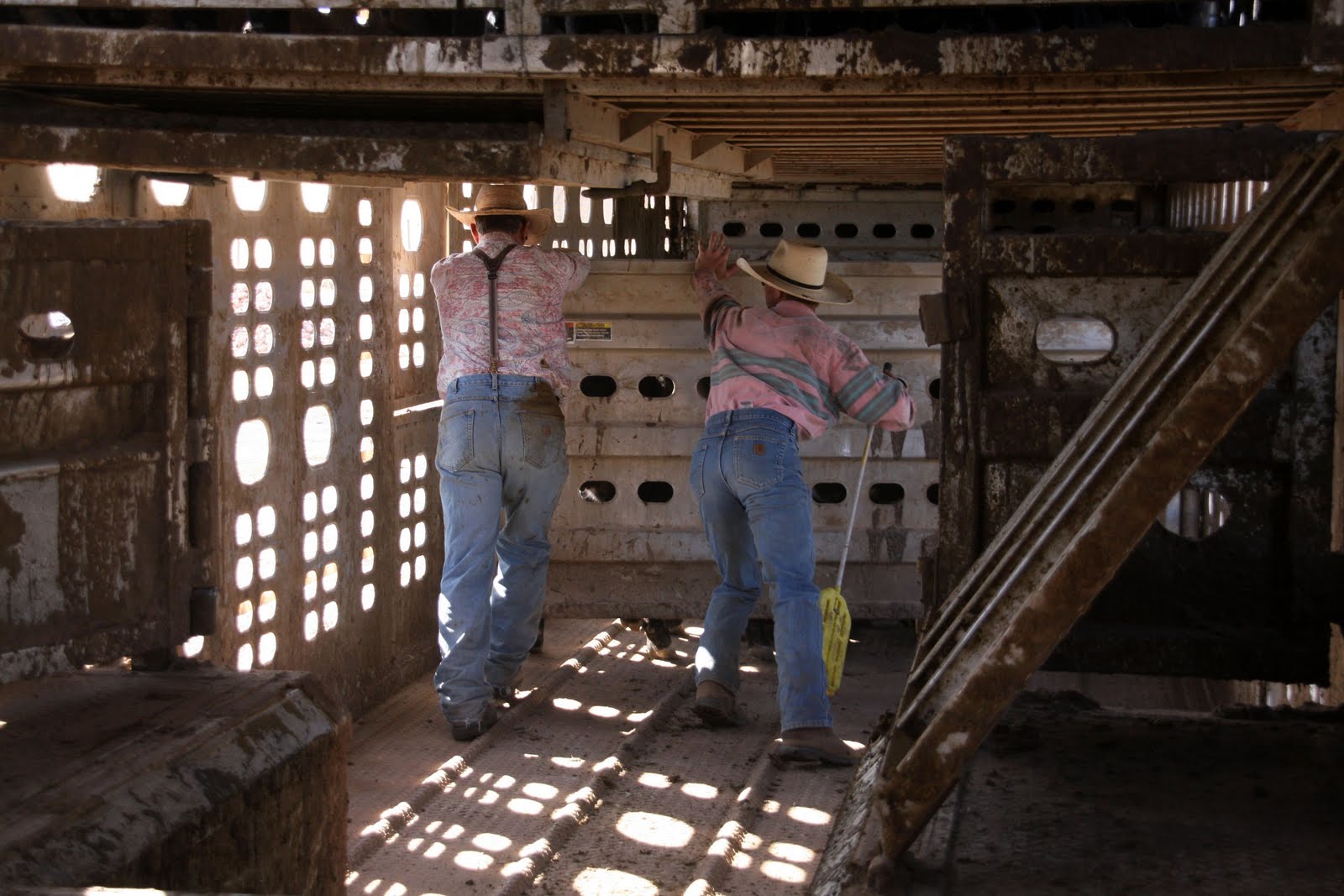
I turned around, and here's the view toward the back of the trailer. To the left is the door to the doghouse, to the right is the ramp down to the door that leads outside. The floors also have a raised pattern on them to provide traction for the livestock. Sometimes truckers put sawdust on the floor also, to keep livestock cleaner or to improve traction. Cleanliness is a huge issue in trucking. You want the livestock to stay as clean as possible - for sanitation, health and presentation reasons. My dad and brother both wash their pots out regularly. The floors are dirty on this day because it was day two of hauling our own cattle, and we hadn't been near a water hose of any kind.
Here they are putting the deck in the nose of one of their pots. The floor stores within the trailer when you take it out. You take it out when hauling cows so the pen is tall enough for them. When hauling calves you put it back in.
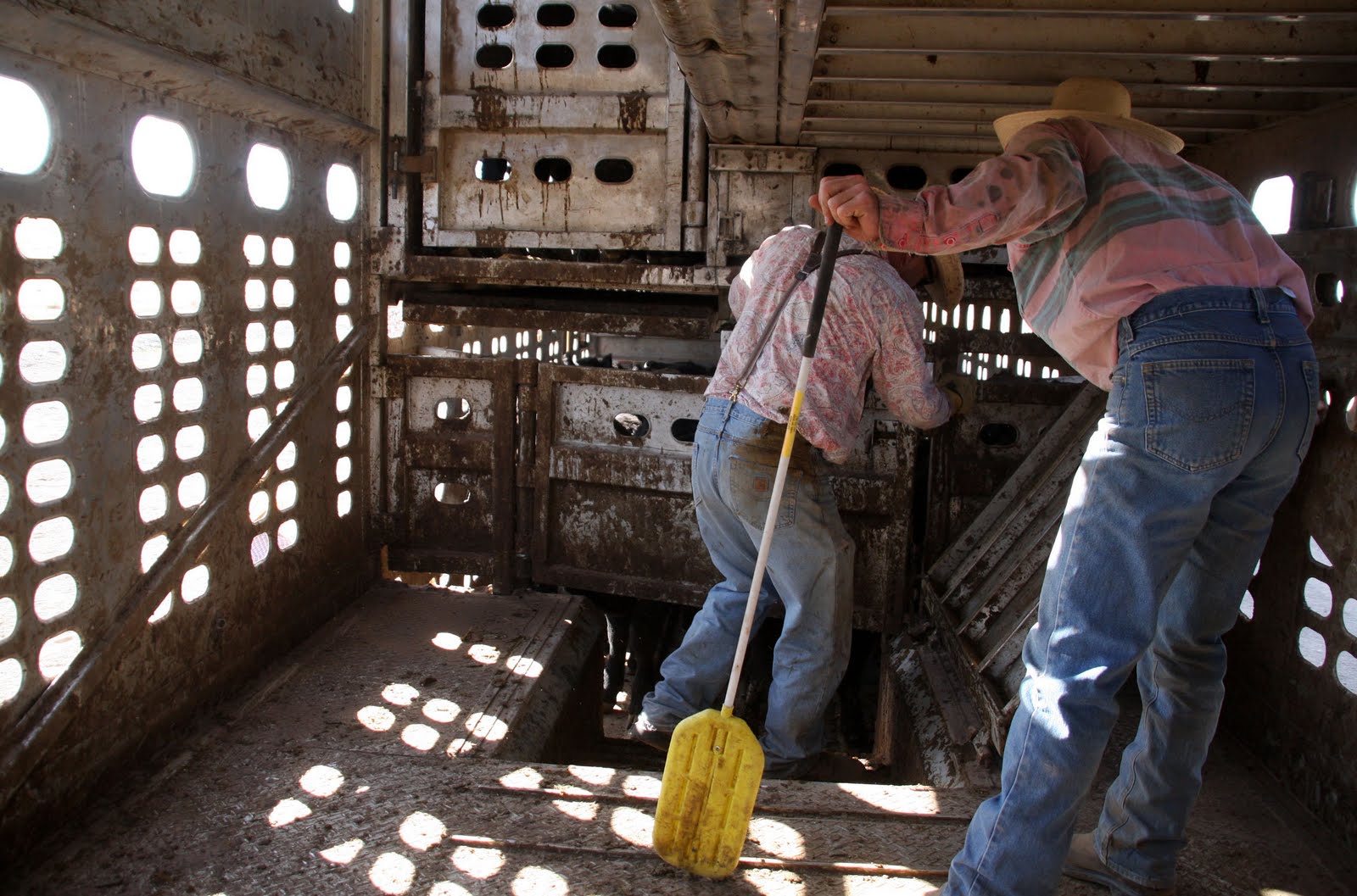
Then they prepare to start filling the pot with cattle, cows and calves, in this case.
Kyle pulled a pin, and a part of the floor drops down, creating a ramp into the lower deck of the nose. You always load the bottom pen of the nose first. If you load the top first, when you open the gate to load the bottom, calves will fall out of the gap you can see in this picture, and that's not good.
At this point the bottom of the nose is filled, and my dad is filling the top of the nose with a specific number of calves, based on their body size and weight. Cattle are like people in that some are tall and thin, others are short and wide, etc... and different groups fill a trailer differently. In addition to working around weight limits per axle, truckers also must fill each compartment based on animal size. You want to have a snug fit, where animal's aren't overly cramped, but are close enough they can brace against each other and won't fall down. If you put too few in a compartment, they are more apt to fall down, or injure themselves moving around.
The first picture shows how the standard cattle pot is arranged inside. Trailers come in different lengths, and more modern pots have four axles on the trailer, so the middle is smaller, and the ends are bigger.
I've also heard that no two Wilson (that's a brand name) Cattlepots are made the same. Considering there are thousands of them in use, that's a very interesting tidbit to me.
There are also trailers with spread rear axles (the axles are spread apart, and there are two on a trailer), or closed tandem axles (the axles are all close together, and there are two to four of them). Truckers can haul a certain amount of weight on every axle they have on their truck and trailer. It's 12,000 lbs for the front axle on the truck, 36,000 lbs in Wyoming ( it's 34,000 lbs in most states) on closed tandem axles, which are on the back of the truck, and possibly the trailer. If the trailer isn't a closed tandem axle, it will be a spread axle, and can haul 20,000 lbs. As you add more axles to a trailer, you can haul more weight, but the amount you can haul per axle becomes much more complex to determine.
So, if you have a truck and a spread axle trailer, you can haul 54,000 lbs, which is what my dad can haul.
Truckers load trailers to make sure they are at a proper weight on every individual axle. To help them do this, and to keep the livestock sorted and safe, are two floors and a number of pens/compartment within the cattlepot.

Here's how a cattlepot is generally divided up inside. Some pens you can only put smaller animals in, like calves (the doghouse), and others have removable floors so a trucker can either haul a single deck (decks are like stories in a house) of cows, or two decks of calves (the nose).
You also never mix cows and calves in a single compartment, unless they're older calves and there's more room than if all animals are similar in size. Small calves could easily be smashed, and injured or killed, by the much larger cows while in transit.
When they're all in the pen, he quickly lifts the drop down door and secures it in place. Cattle pots have all sorts of handy, space saving design aspects. Some are great, others are hated, but they're all used.
Up it goes. You can see where the other door/ramp to lower compartment is directly under the one he's closing.
Following the nose is the doghouse (the back, on top). This L-shaped pen takes advantage of the space not needed by the ramp that leads to the top deck, and is often used for calves, or sick or injured animals.
The pen extends to the right at the back. It's too short for cows, but calves fit just fine. It's also not adjustable, so unlike the nose, you either haul something short in this pen, or it stays empty.
In they go, then dad closes the gate/ramp just like he did in the nose.
Now that all the shorter compartments are filled with calves, we're ready to fill the taller, larger compartments with their mothers. Here's the view from outside.
Up they go. In the large middle compartment on the top deck is a gate right in the middle. Truckers can either "gate" cattle, which means to separate them into two pens by closing the middle gate, or use it as one larger pen. Weight and cattle size often dictates how this decision is made.
We did not gate the cows on this day, so we filled it up with the carefully counted cows. Truckers also make sure they're always where they need to be to get a cattlepot filled efficiently and correctly. You don't want half the cows to load, then turn around and run off. This wastes time, can cause injury to other cows or humans, teaches the cows a bad habit, and really makes ranchers mad. You can just see my dads feet in the above photo, and his hotshot, which he uses as needed to make sure the cows move into the pen and don't run back out.
As the last cow steps in, he eases the gate shut behind her.
Then he steps down and latches the door shut. If a door were to come open during transit it would be disastrous.
From there, he lifts and pushes the ramp you saw the cows walking up forward into a built-in storage area. Then he unhooks this wing, which was used to create a alleyway up the ramp, and ensure the cows went the proper direction, and swings it out of the way so we can load the bottom.
It has a hinge, and you maneuver it around like so, and say a couple choice words if necessary...
Then secure it to the side of the pot.
Flip up this part of the floor to reveal a ramp to the lower deck,
and swing the gate over, like so. Now they're ready for more cattle.
Now, you'll have to forgive me on this. I had to combine pictures from multiple loads, and these of a load of calves turned out better than those of loading cows on the bottom deck. Typically you would load a truck with either all pairs, in which case there would be cows on this lower deck, or with all calves, in which calves would have been put on the top deck where I showed cows.
You fill each end of the top deck of the cattlepot, then fill up the middle, and largest, compartment last. Then you move to the bottom deck.
Anyway, we gated these calves, so a specific number were loaded into the bottom, then the trucker, and sometimes a helper, go in and close the gate in the middle of the large pen.
Like so.
Then you fill the back half of the pen with more calves in this case (numbers of cows or calves are always changing based on weight, size, number of axles, etc...)
The gate is closed, and latched.
Then the ramp is dropped back into place. Now the only thing left to fill is the compartment at the very back of the cattlepot.
The trucker moves to this position, so he can close the door after the last cow, or calf, has been loaded. He will drop the door, which slides up and down on track, and secure the rope to the side of his trailer.
Then the trucker heads for the unloading location. The cattlepot is unloaded in the exact opposite order it was loaded, so the back is unloaded first (duh, yes, I know), then the belly, and the bottom of the nose is unloaded last.
Subscribe to:
Posts (Atom)