In the last year or two I have noticed the word "farmer" being used more and more as a general term for the face of agriculture From the media covering agriculturalists collectively as farmers, to being asked by other people in our industry if I'm a cattle farmer, I've seen this trend grow and gain popularity across the country.
It's not that I dislike being called a farmer, or feel they're somehow lesser than ranchers, not at all. It's that they have a different job description from mine. Equally important and similar in that both farmers and ranchers raise food, but still very different in what foods they raise and how they produce those foods.
Farmers raised crops, and hog, dairy and poultry producers are also frequently called farmers. They use a lot of machinery that I have never driven, can't tell you the name of, or what specific purpose it has. They are soil and fertilizer experts, seed variety gurus and plant growing geniuses. They maximize their land potential through the crops they grow, and are often located on the most productive lands in the country.
Ranchers raise cattle or sheep. We use horses and/or 4-wheelers, and a farmer would laugh hysterically at our "machinery." We manage our land to do its best job producing native grass species, and are often doing this on lands unsuitable for farming due to lack of topsoil, moisture, or rough topography. We maximize our lands potential through the pounds we put on our livestock. We are fence fixers, cattle genetic researchers, and we put our water in a tank instead of on the ground.
Farms are also smaller on average than ranches, but that doesn't mean their production is less or the workload is lighter. Farmers have to spend a lot more time per acre on their land to plant, grow and harvest a crop. In comparison, ranchers spend their time gathering, moving and working their livestock, and implementing fences and watering systems, in a fashion that maintains or improves the native condition of their land. Farmers divide their operation up by fields or paddocks, ranchers by pastures.
Again, both very important, but not the same.
Sure, there are those who overlap, and do both. But, for the most part in my part of the world people fall more into one category or the other. There are also those foods that require contributions from both farmers and ranchers before they make it to your plate, and those that come straight from a farm or ranch, through processing, and into the human food chain.
It bothers me that these two very important careers are being lumped together in an attempt to make our industry more understandable. I think it's critically important to inform people accurately, and when people within ag can't tell me what the difference between a farmer and rancher is, it worries me that the general public, who knows little about our industry, will also miss the important contributions both groups make to their dinner tables.
Thank a farmer for your dairy, fruits and vegetables, and thank a rancher for your , lamb and steak!

Showing posts with label growing food. Show all posts
Showing posts with label growing food. Show all posts
Thursday, October 11, 2012

Tuesday, July 17, 2012
2012 Summer Grass Report
This year's grass report is short....literally. In case your new, or have missed these in the past, I try to do a post on our grass from time to time to compare the current year to the past few. The idea is to show you what I'm talking about when I say a good year, or bad year, or the grass is great, or doing poorly.
Perhaps you've heard that we are having an odd year out west. It's hot, dry and about as unconducive to growing grass at it gets. We're typically semi-arid where I'm from, and this year calling us arid would be complimentary.
Here's what I mean -


 A close up of the forage on our creek, taken 7-18-12.
Now, let's see how this compares to the last couple years
2011:
 Taken in a pasture on 6-26-11, very similar location to the top two photos from 2012.
 Our creek bottom on 6-18-11. I realize this is a month sooner than this year's photos. But, it never even thought about getting this tall this year.
 Creek bottom on 6-16-11. Same tree in the background as the 7-18-12 photo, I'm just turned slightly more toward the east in this photo.
Now for 2010:
 Pasture photo on 6-28-10. This was a great year.
 And the creek bottom on 6-27-10. No, they aren't standing in a hole or anything, and that yellow spot on the side of that heifer is the head of a shoot of grass. Yes, we can grow grass like that here....on an exceptional year.
So, just in case you don't want to scroll back and forth. That was 2010, and here the same location in 2012 again, which is anything but an exceptional year.
If you want to see how the years prior to 2010 were around here, you can head over to my 2010 June Grass Report post.
Perhaps you've heard that we are having an odd year out west. It's hot, dry and about as unconducive to growing grass at it gets. We're typically semi-arid where I'm from, and this year calling us arid would be complimentary.
Here's what I mean -

Taken in one of our pastures on 7-18-12. This is as tall as it got this year (about an inch on average), and it was only greener than this for a couple weeks.

Another photo, taken on 7-2-12. This is also in the middle of a pasture, in the bottom of a draw, which are typically greener than the tops like what was shown in the previous picture.

Our creek bottom, as of 7-18-12. Anything you see that is green is either Kosha weed or thistle.

Now, let's see how this compares to the last couple years
2011:


Now for 2010:


So, just in case you don't want to scroll back and forth. That was 2010, and here the same location in 2012 again, which is anything but an exceptional year.
If you want to see how the years prior to 2010 were around here, you can head over to my 2010 June Grass Report post.
Wednesday, February 29, 2012
Do you know: Who Farmers Feed?
I have pondering how to improve my blog more than usual lately. With such a busy February, I felt like it slipped backward a little, and I don't like that. I also lost two followers (gasp, sigh). I fully realize that I too add and delete who I am following, and it really isn't that big of a deal, but then again it is.
So, please let me know if you have aspects you particularly like/dislike on here, and any suggestions as I move forward. My most popular posts continue to be the ones that document a task on the ranch with lots of pictures, and those aren't going anywhere. The posts of just photos are also well-received based on number of page views, and I'm not likely to stop taking mountains of photos anytime soon, so those too are safe.
My thoughts are to make a few minor changes that will hopefully make it a better blog to read, and provide me with a few more ways to post regularly. One of these ideas is to start including posts highlighting an interesting ranching/farming/agriculture fact about once a week.
I was given a couple Farm Bureau resources while in Michigan that are jam packed with great facts and figures about agriculture, and I really enjoyed reading them. I also learned a lot. Basically, what Farm Bureau did was take USDA facts and figures, and put them in sentence form. Much more interesting than reading the information as USDA publishes it! I plan to make these the backbone source of information for these new, "Did you know," posts, and throw in additional facts I hear at various events.
So, without further ado, here is the first week of this. Some of these will be things you may already know, and hopefully everyone will learn a thing or two as we go. I know I did as I browsed through the sources I'm pulling these from!

Did you know that today, each U.S. farmer produces food and fiber for 154 people in the U.S. and abroad? This compares to each farmer feeding 19 people in 1940, and 46 people in 1960.
In 1935, the number of farms in the U.S. peaked at 6.8 million. By 1940, there were 6.3 million U.S. farms. Today, there are 2.2 million farms.
Since 1950, the total U.S. crop yield (tons per acre) has increased more than 360 percent. Even though there are fewer farms today, farmers continue to improve their production practices and utilization of modern tools and technologies to increase productivity and maintain their ability to feed a growing world population.
So, please let me know if you have aspects you particularly like/dislike on here, and any suggestions as I move forward. My most popular posts continue to be the ones that document a task on the ranch with lots of pictures, and those aren't going anywhere. The posts of just photos are also well-received based on number of page views, and I'm not likely to stop taking mountains of photos anytime soon, so those too are safe.
My thoughts are to make a few minor changes that will hopefully make it a better blog to read, and provide me with a few more ways to post regularly. One of these ideas is to start including posts highlighting an interesting ranching/farming/agriculture fact about once a week.
I was given a couple Farm Bureau resources while in Michigan that are jam packed with great facts and figures about agriculture, and I really enjoyed reading them. I also learned a lot. Basically, what Farm Bureau did was take USDA facts and figures, and put them in sentence form. Much more interesting than reading the information as USDA publishes it! I plan to make these the backbone source of information for these new, "Did you know," posts, and throw in additional facts I hear at various events.
So, without further ado, here is the first week of this. Some of these will be things you may already know, and hopefully everyone will learn a thing or two as we go. I know I did as I browsed through the sources I'm pulling these from!
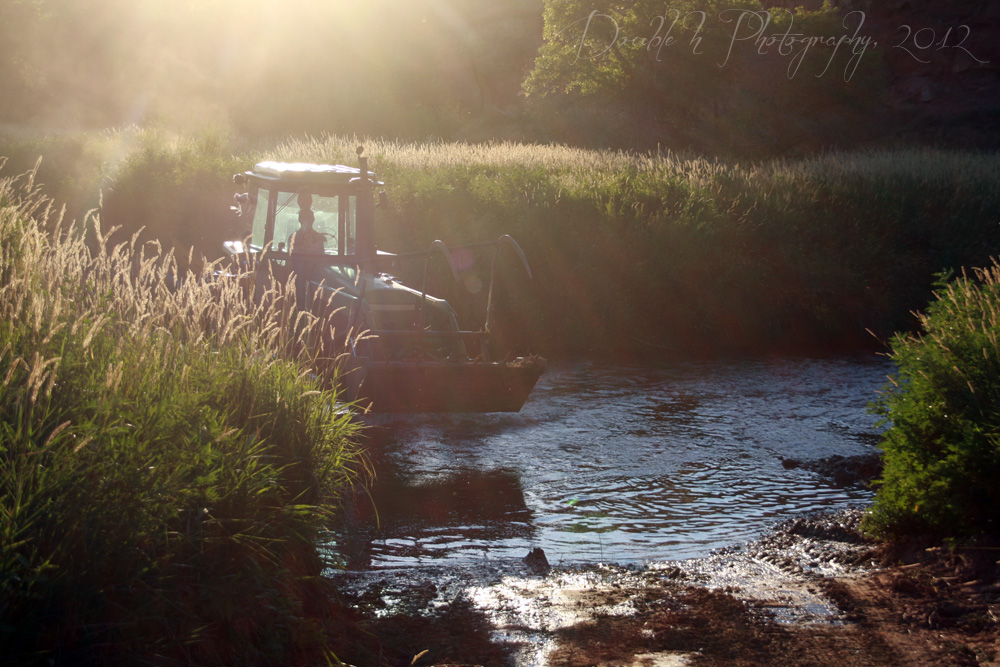
(Tractor equals farming where I'm from, sorry for those of you who are really from farm country)
Did you know that today, each U.S. farmer produces food and fiber for 154 people in the U.S. and abroad? This compares to each farmer feeding 19 people in 1940, and 46 people in 1960.
In 1935, the number of farms in the U.S. peaked at 6.8 million. By 1940, there were 6.3 million U.S. farms. Today, there are 2.2 million farms.
Since 1950, the total U.S. crop yield (tons per acre) has increased more than 360 percent. Even though there are fewer farms today, farmers continue to improve their production practices and utilization of modern tools and technologies to increase productivity and maintain their ability to feed a growing world population.
Subscribe to:
Posts (Atom)