Friday, July 9, 2010

July 4-5, 2010

My brother and sister came to see me for the fourth and fifth of July. Usually our entire family goes on a weekend fishing trip to the Bighorns just before the the Fourth for a mini vacation. But this year my parents are gallivanting across Vienna, Austria and Germany. So Kyle, Holly and I gallivanted around Alcova and Casper.

First stop was Pathfinder reservoir. It's running over for the first time since the 1980s. I don't know all the specifics, but it was a lot of water and my brother loves seeing stuff like that so off we went. I will hopefully have a post dedicated to the photos I took on the two trips I've made to see it.

A very nice guy took a picture of the three of us so there is an actual photo of me from the day!

Usually off to the left of the photo are rocks you can walk on and there is nothing running under this "closed" walkway. We checked out the dam from all angles, literally. We drove to the other side, walked across the bridge visible in the first photo and hiked all over.


Then we had a picnic in my backyard for Holly. After traipsing all over the mountains she was worn out and promptly fell asleep on the couch following lunch. Kyle and I proceeded to rip all the problematic lilacs out of my front yard. Someone had planted them all across my little front step and they were one of my least favorite things about the house. Now they are gone and hopefully another post will show before, another during, and the pretty after flowers.


Some were a little tough and we pulled them instead of using the hydrobed. There were some staring neighbors, but this method was much easier than digging them out by hand or using a chainsaw.
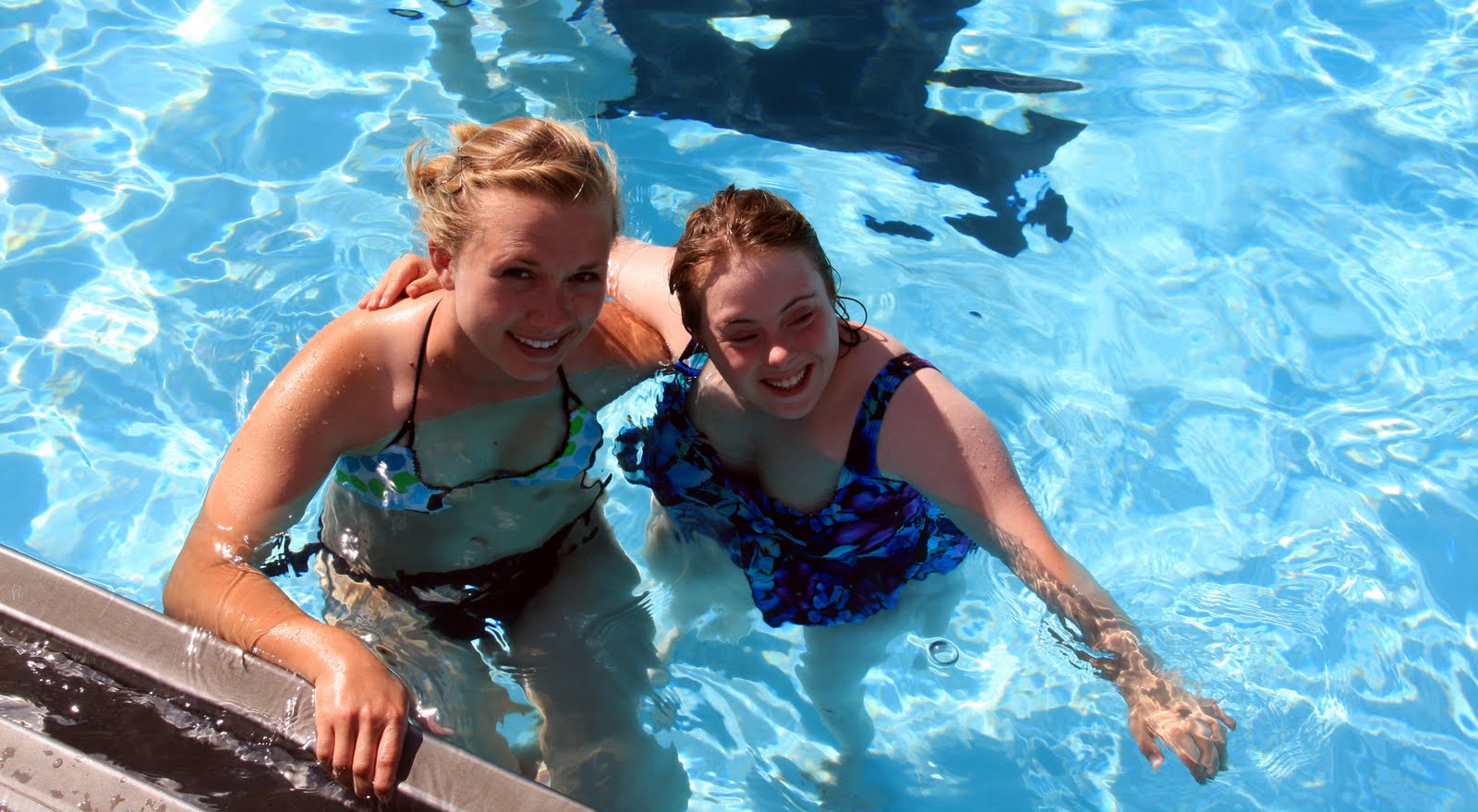
Then we woke Holly up and took her swimming just up the street from my house. Kyle and I aren't much for swimming, but the pool was actually warm and we made it. Holly absolutely loves swimming and would have happily spent the entire afternoon, evening and night in the pool.

I didn't get a photo of the big, loopy slides. Kyle and Holly each went down one at the same time and I was at the bottom to catch Holly. She started out sitting up, facing forward and shot out the bottom on her stomach and backwards. I plucked her out of the 3-foot deep water and between bouts of laughter asked what happened.
As she wiped water from her face tartly replied "I drowned, Heather!"
I almost drowned her again I was laughing so hard.

Thursday, July 8, 2010

Summer in Wyoming

During my flurry of traveling over the past several weeks (I've been everywhere from Riverton to Henry NE, Medicine Bow to South Dakota, and lots of stops in between) I made a pit stop at home to see the parents before they left for a three-week vacation in Europe. As always I had my camera in tow and managed to grab a few pictures.


More June grass

Remember this post on June grass?? If you have the time..or interest.. look at it again then check out the following photos.

First, please ignore my composition, I was driving the 4-wheeler through this tall grass scared to death because I've never not been about to see the ground when driving the 4-wheeler. (The journalist really came out in that sentence)

While not the greatest photos quality wise, these both do a good job showing the June 30, 2010 grass on my family's ranch. This is the same creek as the tractor picture in 2007 and the heifers on June 1, 2008. Also, these heifers are pretty much the same size as those in the June 1, 2008 photo.


Thursday, July 1, 2010

Going to the forest

Going to the forest means a lot of different things depending on who you talk to. For livestock people it typically means they are taking their cattle to a summer forest lease. As is the case with all public lands, livestock producers are the only ones who pay a fee to use the land. Forest leases are based on number of head and/or number of acres. Grazing forest lands reduces standing forages and therefore reduces the risk of fire. Sheep and cattle are a natural form of weed control, their hooves break up packed soils and improve plant germination and they convert a product that is unusable to humans (grass) into a product that feeds people (meat)


I was able to go with my dad to help haul a neighbors cattle to the forest Monday. This trip was postponed for three weeks due to all the rain this spring but nobody was complaining. First the cattle are gathered into the corral.

The cows are sorted off from the calves so they don't hurt their babies during the drive. If they were all mixed the 1300 pound cows could easily injure their 400 pound babies. Everything is inspected and counted by a brand inspector to ensure ownership and headcount prior to being loaded on large trailers called cattle pots. It is required by law to have cattle inspected by a brand inspector if they are traveling outside the county the producer lives in.

From left to right there is a truck driver, the brand inspector, the owner of the cattle and my dad (another truck driver). Inside the cattle pot are pens and a specific number of cows or calves are loaded into each pen. Separating the pot into pens allows for a more even distribution of weight, maximizes the use of the space and reduces the chance of injury. One great thing about where I'm from is the sense of community. We have known the family and used to have share cattle with them. They were running a little behind so we jumped in and sorted the first truckload for them while they brought the remaining cattle in the corral. Working together makes it work more times than not in agriculture.

After the last cow is loaded the door is closed (it drops from above) and we're off. Trucks can only haul so much weight per axle. My dads cattle pot is 53 feet long with two axles and I don't know how much total weight he can haul, but it's somewhere between 35,000 and 50,000 pounds.

We started on the Cheyenne River and hauled the cattle just over 70 miles

We ended in the Black Hills, just into South Dakota, northwest of Newcastle Wyoming. Arguably some of the prettiest country in the nation.


Here is a triple axle trailer backing up to the unloading dock.

Here comes the owner with horses and the extra cows that wouldn't fit on the cattle pots. This is the position I'm typically in, so being on the truck driver side was interesting. The owner, his daughter and a day helper also have horses to move their cattle from these main corrals to his specific pastures on the forest lease.

The cows trail off the cattle pot. After a cow has been hauled a few times she understands the routine and most load and unload with little trouble (Most does not mean all by any means)

The cows are joined by their calves moments later.

Everyone is turned out in a small grass pasture (known as a lot) to mother ( or pair) up. If a mother cow and her calf don't find each other they will return to the last place they saw their baby. Since they were hauled on a truck they wouldn't go all the way home, but they would return to these corrals and moo and moo until they found each other. This instinct is how cattle find each other if they're separated. If they are all paired up when you leave then it typically prevents a wreck and re-gathering on down the line.

Now the owner and his help are trailing the cattle to their pasture and doing any sorting that needs finished up. As part of the truck driving crew we...I mean my dad..is cleaning out his cattle pot. Livestock producers want a clean truck because a dirty truck makes their cattle dirty and can spread disease. It's also just a common form of courtesy to show up with a clean truck.
My dad and uncle have made truck drivers go clean their trucks before they would load them before. Here my dad is brooming out his truck. He will broom out as much manure as possible, then rinse the truck out with a hose later. As you can see the amount of water in the manure makes is a fairly simple task.


The cows settle in and enjoy their summer home. In the fall this entire process will be repeated and they will be hauled home. It snows too much in the winter to leave cattle on the forest.