Hope everyone is ready to celebrate the birth of our Savior this weekend : )
Showing posts with label yearling heifers. Show all posts
Thursday, December 22, 2011
Friday, December 9, 2011
Friday Photos
Today I checked the water for our yearling heifers and two-year old cows, who are wintering together. Here are a few photos from my "trip." It's about three miles to their water, and it takes over 30 minutes one way to drive the two-track, very rough road, if you can call it a road. In the winter, our primary responsibility is feeding and checking water for the livestock, and I enjoy the job a lot! Hope you have a great weekend.
Also, don't forget to enter my giveaway if you haven't yet!
Wednesday, September 14, 2011
Ultrasounding Heifers
Last week we preg-checked our heifers, using ultrasound technology. You can read more about why we preg-check our cows here.
We chose to ultrasound the heifers because we wanted to be able to sort them based on when they will calve. Using ultrasound can also tell ranchers the sex of each calf, and is accurate almost to the day of when a heifer or cow will calve. If a vet is "arming" (using his hand) to preg-check, he can only tell you if she's pregnant or open, and if she's early or late. Exact calving dates and calf sex aren't possible that way.
Here's what we did:
We gathered, and loaded about half of them in the alleyway. That bright yellow extension cord provided power to the ultrasound machine.
About six at a time were brought down to our tub. That stick on the right side of the picture is my uncle bringing a bunch down.
From the tub they were loaded into a single-file alleyway. This alley is also adjustable, which means you can make it wider or narrower, depending on what you're working on a given day.
The view facing the other direction. From this alley they are loaded into the chute, where each heifer is preg checked and worked.
Here's my mom loading one into the chute. The lady in the blue is the vet, who was really nice to work with. Our heifers were really loose (that means their manure had a lot of moisture in it, and made a big mess). You can see how much of a mess they made on the vet. Once in the chute, she would open that door in front of her to gain access to the back of the heifer.
Here comes one. My dad and brother converted our old Powder River chute to hydraulics, which are run off a feed pickup that has a hydraulic hay feeder on it. Holly was holding the vaccine gun for dad, who was running the chute. He just had surgery about three weeks ago, and has to be careful how much he lifts and strains.
He caught each one, like so...
and the vet quickly and efficiently went to work. First she opened the gate, and secured it so the next heifer in the alley couldn't run her over. Then she inserted the reader tip of her ultrasound machine into the heifers rectum, and looked at her computer screen (it's in that black box by the chute), to see if there was a calf in the heifer's uterus.
Here is the reader on her ultrasound machine, and how she holds it when preg-checking.
She covers the cord to prevent manure from getting on it. The cord is attached to her computer screen...
Which looks like this. She would slide the tip around until she saw the picture she needed, then she would call if the heifer was early, late or open. We gave her a set of dates, based on our breeding dates, and that's what she based early or late on. Open means the heifer wasn't pregnant.
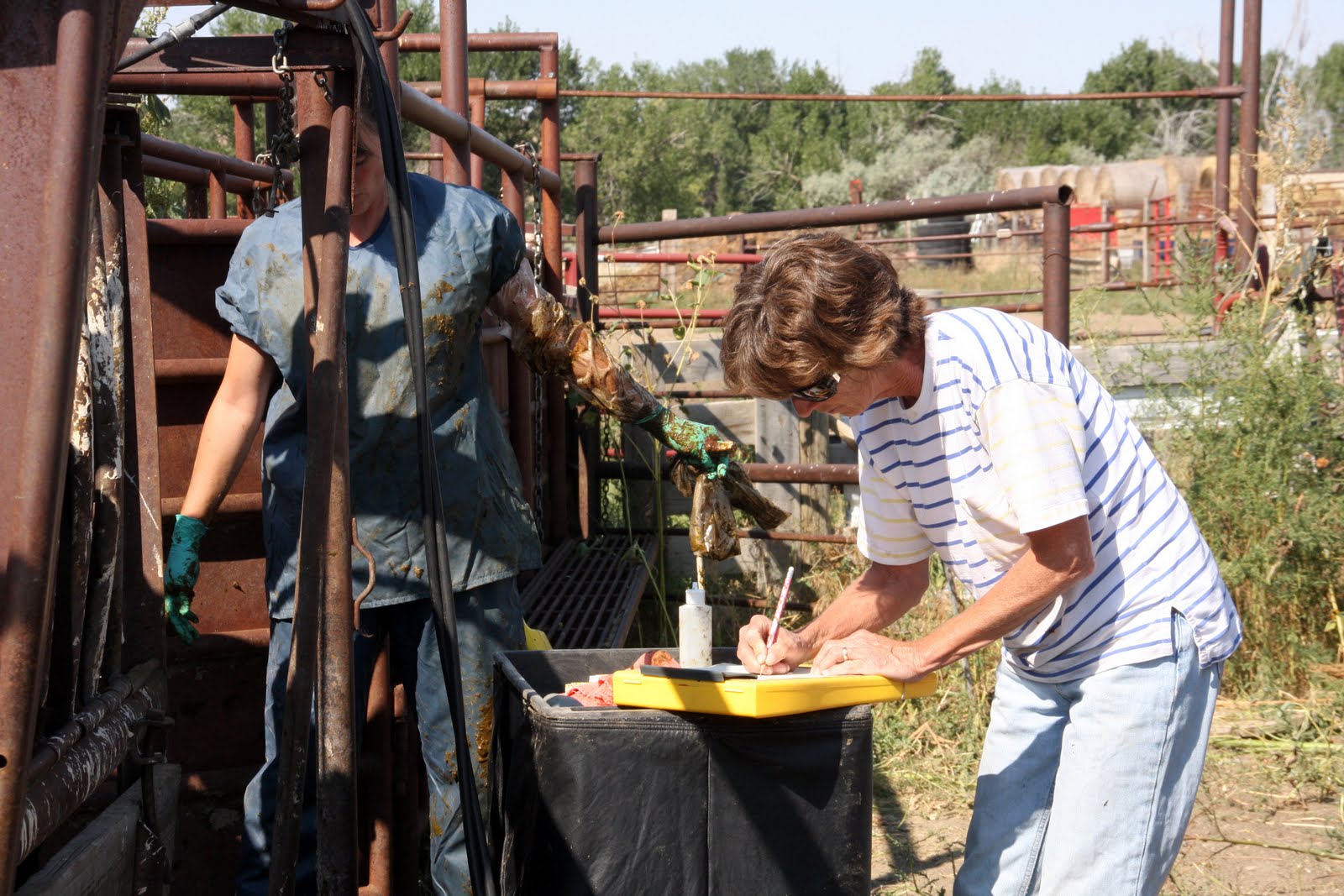
My mom and I swapped out between pushing them up the single-file alley and recording each heifers information. Here's mom writing down a heifers ear tag number and when she will calve.
We were all very interested in how everything worked, since this was our first year ultrasounding. Here's my dad watching the computer screen and asking the vet about different things that were showing up on it. A good vet is a great source of information for ranchers.
If a heifer was called pregnant, a flurry of activity occured. First, she was given a shot to protect her pregnancy against multiple diseases. The ones we're most concerned about are Vibrio (Vibriosis), a sexually transmitted disease in cattle, and BVD.
These heifers all got a big "O" on their left shoulder, so we know each one was born in 2010. With a year number brand there is never any guesssing on a cow's age, even if she loses her ear tag. We sell any cows over a certain age. This is done for a number of reasons - in part because as cows age they lose and wear out teeth, and cant eat enough to stay in good condition.
After she's branded, dad pours her. Pour-on kills numerous internal and external parasites, flys and other "icky's." You can read more about pouring cattle here.
We chose to ultrasound the heifers because we wanted to be able to sort them based on when they will calve. Using ultrasound can also tell ranchers the sex of each calf, and is accurate almost to the day of when a heifer or cow will calve. If a vet is "arming" (using his hand) to preg-check, he can only tell you if she's pregnant or open, and if she's early or late. Exact calving dates and calf sex aren't possible that way.
Here's what we did:
You do not want to breathe the fumes of this stuff. We had a member of our family almost die from breathing pour-on fumes all day when he was branding and pouring yearlings. Brand first, then pour!
Then the heifer is let out, and the next one comes into the chute. It took us between 2 and 2.5 hours to do 100 heifers, to give you an idea of how long this process takes.
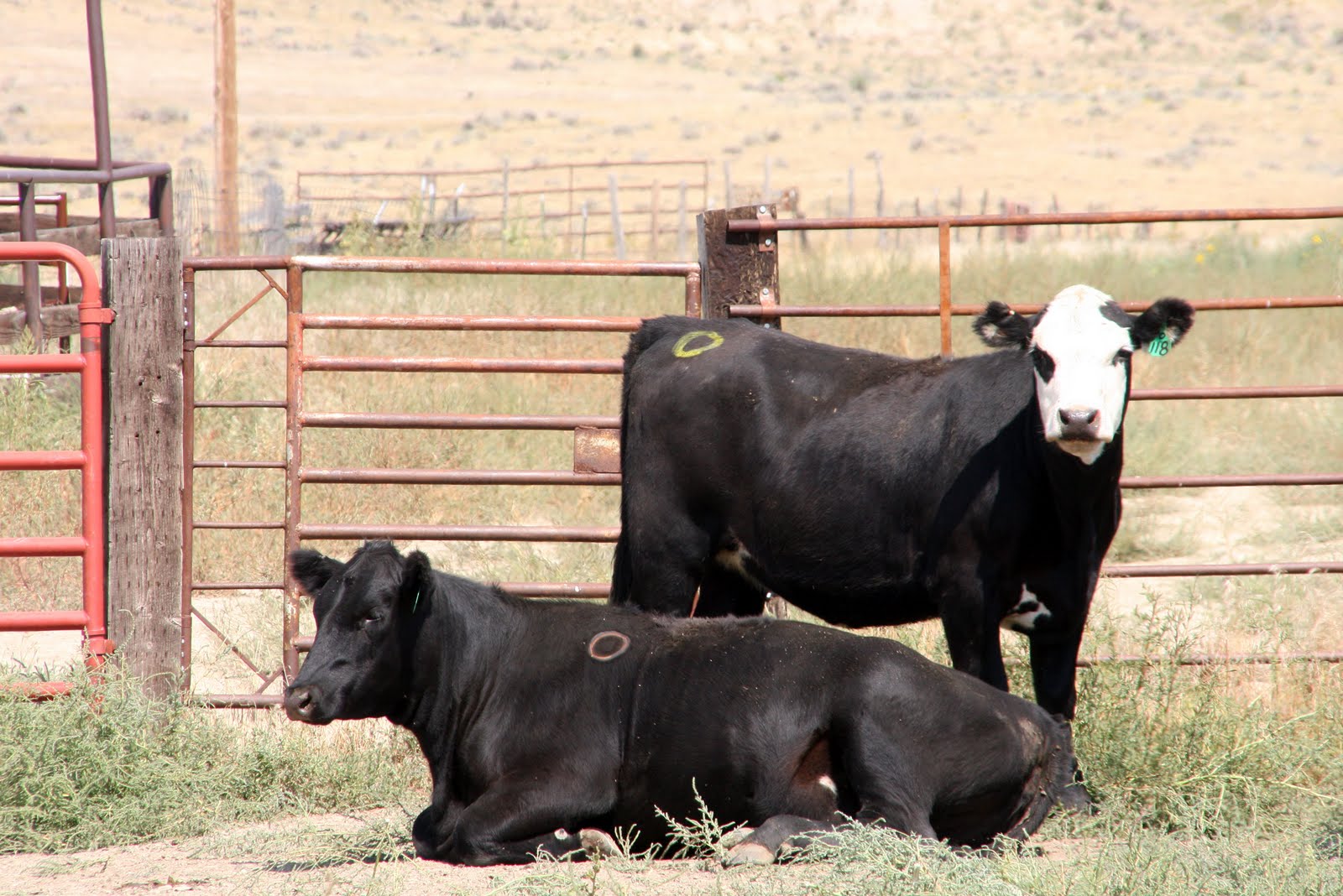
If a heifer is open, she gets a bright yellow "O," for open, on each hip. She doesn't get a number brand, or a pregnancy shot. These heifers will be sold. They failed their first test as a future member of our cowherd, and are the bottom percentage in the area of fertility. The picture shows both a bred heifer, and one that was open.
Following preg-checking, the open heifers were sorted off, and put in another pasture for a few days prior to being taken to the sale. The pregnant heifers were trailed back to their pasture, where they'll stay for another couple months.
Thursday, July 7, 2011
Hauling to the Mountain
This is the time of year when ranchers head to the Wyoming mountains with their livestock. Lots of highways were clogged with cattle, sheep and trucks heading up in elevation over the last week, and after a brief reprieve on the 4th, the move was back in full swing on the 5th. My family doesn't live anywhere near a mountain, but my boyfriend Adam does. While at his place over the 4th of July holiday, I got in on a day of hauling yearling heifers to the mountain.
Some producers trail all the way up to their mountain pastures, while others haul as far up as they can, then trail on in to their pasture(s). Adam's family used to trail, but haul as far as they can these days to save time. Both ways require some planning - when trailing you have to work with everyone else trailing, and keep your cattle moving to the next holding pasture each night so you aren't holding up the show for those behind you. When hauling you have to get trucks, and often work around when they're available.
One difference in going to the mountain versus going to a summer pasture where I'm from is when you go. Our cattle have all been at summer pasture for a month or more, but the cooler temperatures at mountain elevations results in the grass getting a later start in the growing season. Rancher's typically wait until their is enough grass for their livestock before heading anywhere with them. So, while eastern Wyoming, with it's warmer temperatures, has had abundant summer grass for a while, it's just getting tall enough to graze in the cooler Bighorn Mountains.

Here's what we did - first we loaded the heifers, and bulls, onto a couple cattle pots at a feedlot where they have been living for several months.
We stopped and added a little more caffeine to our dwindling iced tea supply in Ten Sleep, then headed for the corrals where we would unload, leading the trucks.
We started on the highway, but soon turned onto the Spring Creek Road, and from there onto a two-track road that lead up the base of the mountain.
And up we went.
The road to the right is the old road, and previously the only route up. Adam told me about a semi load of sheep that tipped over right where the two roads join several years ago. He used to hate that road, and is very happy to have the new one on the left.
Here come the trucks, up the last rise and through the gate to the corrals. Adam and I got the gates set and were ready and waiting when they arrived.
Then, right between the above and below photos, a tragic event occurred. My camera, which I had in it's "work day" bag, fell off the corral fence and made an alarming THUD sound as it hit the ground 8 feet below. I thought I had looped the bag's strap over a corral post, but obviously that wasn't the case. The damage was a busted LCD screen, but fortunately it still took pictures, which I found out for sure when I looked at them on a computer.
Frustrating camera events or not, the trucks arrived and backed up to the decrepit unloading chute, which is on the repair list for later this summer I'm told.
I was put in charge of counting the heifers off the trucks, and guarding a hole in the corral fence (the whole corral is on the 2011 summer repair list). I gingerly snapped a few photos as we went along, hopeful they would turn out.
Some producers trail all the way up to their mountain pastures, while others haul as far up as they can, then trail on in to their pasture(s). Adam's family used to trail, but haul as far as they can these days to save time. Both ways require some planning - when trailing you have to work with everyone else trailing, and keep your cattle moving to the next holding pasture each night so you aren't holding up the show for those behind you. When hauling you have to get trucks, and often work around when they're available.
One difference in going to the mountain versus going to a summer pasture where I'm from is when you go. Our cattle have all been at summer pasture for a month or more, but the cooler temperatures at mountain elevations results in the grass getting a later start in the growing season. Rancher's typically wait until their is enough grass for their livestock before heading anywhere with them. So, while eastern Wyoming, with it's warmer temperatures, has had abundant summer grass for a while, it's just getting tall enough to graze in the cooler Bighorn Mountains.
Here's what we did - first we loaded the heifers, and bulls, onto a couple cattle pots at a feedlot where they have been living for several months.
We started on the highway, but soon turned onto the Spring Creek Road, and from there onto a two-track road that lead up the base of the mountain.Then, right between the above and below photos, a tragic event occurred. My camera, which I had in it's "work day" bag, fell off the corral fence and made an alarming THUD sound as it hit the ground 8 feet below. I thought I had looped the bag's strap over a corral post, but obviously that wasn't the case. The damage was a busted LCD screen, but fortunately it still took pictures, which I found out for sure when I looked at them on a computer.
My camera is currently on it's way to Canon to be fixed : (
1, 2, 3, .....58, 59, .....102, 103, .... you get it....
I should note these heifers were AI'd earlier in the breeding season, and only had one cleanup bull with them in the feedlot. A second bull was added on this day since they were being turned out in a large pasture, where just one bull would have a hard time covering all of them. The bull that had been with them in the feedlot was not happy with this arrangement, and much preferred the idea of him being left alone with his bunch of heifers.
The trucks left, Adam and I did a little sorting on the heifers since a few were going to a separate pasture, then opened the gate you can see above and turned them out.
That evening Adam, his dad and brother went back and trailed them a few miles up the mountain to their summer home. I was in Casper at the Canon store by then, drooling over new camera's and feeling the pain over sending mine away to be fixed.
Subscribe to:
Posts (Atom)


