I have one more great topic that was brought up by an elementary school student during my Ag Books for Kids presentations and activities. A boy in the last class I met with asked how you become a farmer or rancher, and his teacher tagged on what advice I would have for her students to help them succeed if that was their goal. She told me later that she had a few students who wanted to be farmers/ranchers when they grow up.
I was admittedly tired and slightly shell shocked from seeing more young kids in two days than ever before, and my answer wasn't the greatest. When I wrote thank-you's to the class, I included a list of things students could do to help them get a foot in the door of agriculture.
Possibly the wittiest answer I've heard to the question posed is that to have the best chance of becoming a farmer or rancher in today's world is to select your ancestors carefully. But, sardonically true as that answer is, I do believe there are other ways to enter the industry, and am certainly not going to discourage a young person to become in agriculture. Especially when I firmly believe there is no better industry to work in.
Here's a rundown of what I typed up for those interested to consider as they grow up:
1. Consider joining 4-H, which you can do at 9 years old, and FFA when you reach high school. There are numerous animal and crop related projects that will teach you a lot about agriculture. I also feel strongly about joining judging programs, which can be done through both organizations. Plus, 4-H and FFA offer a lot of fun opportunities for kids and in many cases allow them to travel and see agriculture in other parts of the country.
2. When you reach the age where you're looking for a part time or summer job, try to find one with a farmer and/or rancher. They often hire summer help, or extra help for busy days of the year like branding, weaning, shipping, harvest, etc... Nothing will beat the hands-on experience of working within the industry. Plus you'll meet people who can help answer future questions you might have.
3. Attend some meetings. State Farm Bureau and Stockgrowers/Cattlemens, or local weed and pest and predator board meetings. These groups will cover issues that will be what you deal with should you decide to become a farmer/rancher, and they are often very educational. They may not be overly exciting all the time, but they will cover topics that you will be personally faced with as a working part of the industry.
4. Go to college, it's important. You will learn new things, and perhaps more importantly, meet new people. Go into something you enjoy, whether it's an agriculture field, or something totally different. Lots of farmers and ranchers have an additional job on the side in their degree area to supplement their farm/ranch income. This is one thing to consider if you do or don't have a family operation to take over also.
5. Never stop learning. Some people think they've learned it all after college, and this isn't true, especially in agriculture. There's only so much you can learn about gathering cattle, spraying crops and working around weather while sitting behind a desk. Also never stop meeting and learning from successful people you meet along the way.
6. Consider all your talents. As I mentioned above, a lot of farmers and ranchers have an off-farm source of income. One of the great things about agriculture is you often work for yourself, and if you're willing to work that extra job when it fits your schedule, it can help you get started, or pay off the expenses involved in agriculture. It can also allow you to do multiple things you love, which can be fun and rewarding. We didn't discuss that I am a writer and a photographer in addition to having cattle while I visited the class, but I included that in my letter to let them know what I have to do in this stage of my life as a rancher.
I also mentioned that being a farmer/rancher is a lot of hard work (they asked that too), but also very rewarding and a lot of fun. The work never stops, but you get to be outside, working with your family, at a job that is different every day.
Did I miss anything? What advice would you give a second or third grader who asked you this question? I would love to hear your thoughts before I go back into the classrooms next year, so that I can do a better job of encouraging young people to go after being a farmer/rancher if it's what they want to do.

Showing posts with label summer ranch work. Show all posts
Showing posts with label summer ranch work. Show all posts
Monday, May 7, 2012

Wednesday, August 17, 2011
Fighting Fire
We fought fire for the first time last week, which is amazingly late for our area. There have been other fires, but none were within the vicinity that warrants us helping.
The first thing I think of when I think of fighting fire is community. When there's a grass fire in our area, everyone combines their efforts, and works tirelessly until it's done in an effort to minimize losses. One of my huge pet peeves is to see the government fire fighters only fight fire from 9-5, or 8-5 (soap box moment).
 We cruised down a county road, turned onto a two-track trail, crossed a creek, and jostled across a pasture and over a hill to be greeted by this sight. The great grass year we're having in Wyoming means there's a lot more fuel for a fire, and a greater potential for large fires that will devastate range lands.
 The first thing we always do is get on the black. You can't get burned up where the fire's already consumed all the grass. The above picture shows a county fire fighting pickup. The county has various fire fighting pickups, trucks and tankers scattered across the county with various ranchers. This is because the nearest town is 56 miles away, so the rancher's are always who spot the fires and are the first ones on them. The county maximizes its resources through keeping some of their fire fighting units in areas of high concern, with persons who will most likely be at a fire in the most time efficient manner.
 The other half of the equation are the ranchers. This is our fire fighting rig, housed on our winter feed pickup. My mom was the driver on this particular day. You will see all sorts of pickups/water tanks/pumps/motors/hose combinations on these homemade, rancher rigs. The important thing is they all spray water, and they're all ready to go the moment a fire needs fought.
 Here I am "cleaning up" behind a country truck that can spray more water than I can. He is moving quickly, knocking down the flames before they can consume any more grass. My job in this instance is to follow behind and put out any areas that flare back up behind him, and to spray more water on things like smoldering sagebrush that are near the fire line.
You also never know what may go wrong. On this particular day the reason I'm not spraying much water is because the filter on our rig plugged with an algea type plant that sometimes grows in our tank. It will make you very excited if your fire fighting rig stops spraying water at a critical moment!
 This was the view from the pickup, where my mom was. The driver has to pay attention to where they drive, and make sure they don't stop on top of a burning sagebrush, drive into a hole or draw they can't get out of, and work with the person spraying to ensure they're reaching the flames.
 Here I am again. You also want to work forward, ensuring there is no fire left behind you. I was practicing this, despite what the photo looks like. Here I skipped over a couple inches of flames to douse a sagebrush. The fire can smolder in a sagebrush, and they are a real concern on the fire line, so I made sure to stop the fire before it reached a sagebrush in this instance.
 It may be hard to tell in this smoky picture, but that is a draw you can't drive across with a pickup. We have to navigate around these natural obstacles when fighting fire, and they add an even more exciting/scary aspect in the dark. I have seen a six-by-six tanker (very big) fall into a sink-hole before, and all you could see was the blinking light on top of the truck.
 When the fireline has been secured, and no more flames are visible, people congregate to visit and wait to make sure the fire really is out. A change in wind, stray spark, grasshopper that caught on fire, and any number of other things can result in the flames reappearing and blazing forward.
 The county tankers may join the group, or refill at the nearest well so they're prepared more action. This is a good time for everyone to make sure they have water. If they're out, additional six-by-six tankers will be available on larger fires to re-fill everyone. Everything gets checked, repaired if necessary and possibler, refilled, etc.. during this down-time.
 A few ranchers have air planes around here, and on big fires they may fly, and communicate to fire fighters below if there are any additional flames, areas of concern, etc... This guy circled the fire several times, only a few feet off the ground at times. He would dive his plane in any areas there were flames to alert those of us on the ground where they were. He too had a CB radio, and would also talk to us.
A smoke filled sky always makes for a beautiful sunset, made even prettier by the fact that we had contained, and put out, the entire fire before dark in this instance!
The first thing I think of when I think of fighting fire is community. When there's a grass fire in our area, everyone combines their efforts, and works tirelessly until it's done in an effort to minimize losses. One of my huge pet peeves is to see the government fire fighters only fight fire from 9-5, or 8-5 (soap box moment).
 This fire was during the day, which is less common than fires occurring at night. The vast majority of grass fires are started by lightning. So, whenever you see a summer storm moving over Eastern Wyoming, you can guess we're sitting on the tallest hill, watching for smoke during the day or an eerie glow at night.
That is how we spotted this fire. Almost every rancher has a homemade fire fighting rig they've put on a ranch pickup, and are ready 24-7 to help their friends and neighbors in the event of a fire. Everyone also has CB radios, which are used to relay information on lightning strikes, fires that have been spotted, how to get to a fire (you can't drive a pickup across much of this area, and it gets really hard at night), if the county fire fighting trucks are on the way, etc...
We gathered enough information, and deemed it safe to leave our area (you don't want to drive 20-40 miles to a fire, then have one start on your place behind you), and raced to help our neighbors.
 We cruised down a county road, turned onto a two-track trail, crossed a creek, and jostled across a pasture and over a hill to be greeted by this sight. The great grass year we're having in Wyoming means there's a lot more fuel for a fire, and a greater potential for large fires that will devastate range lands.
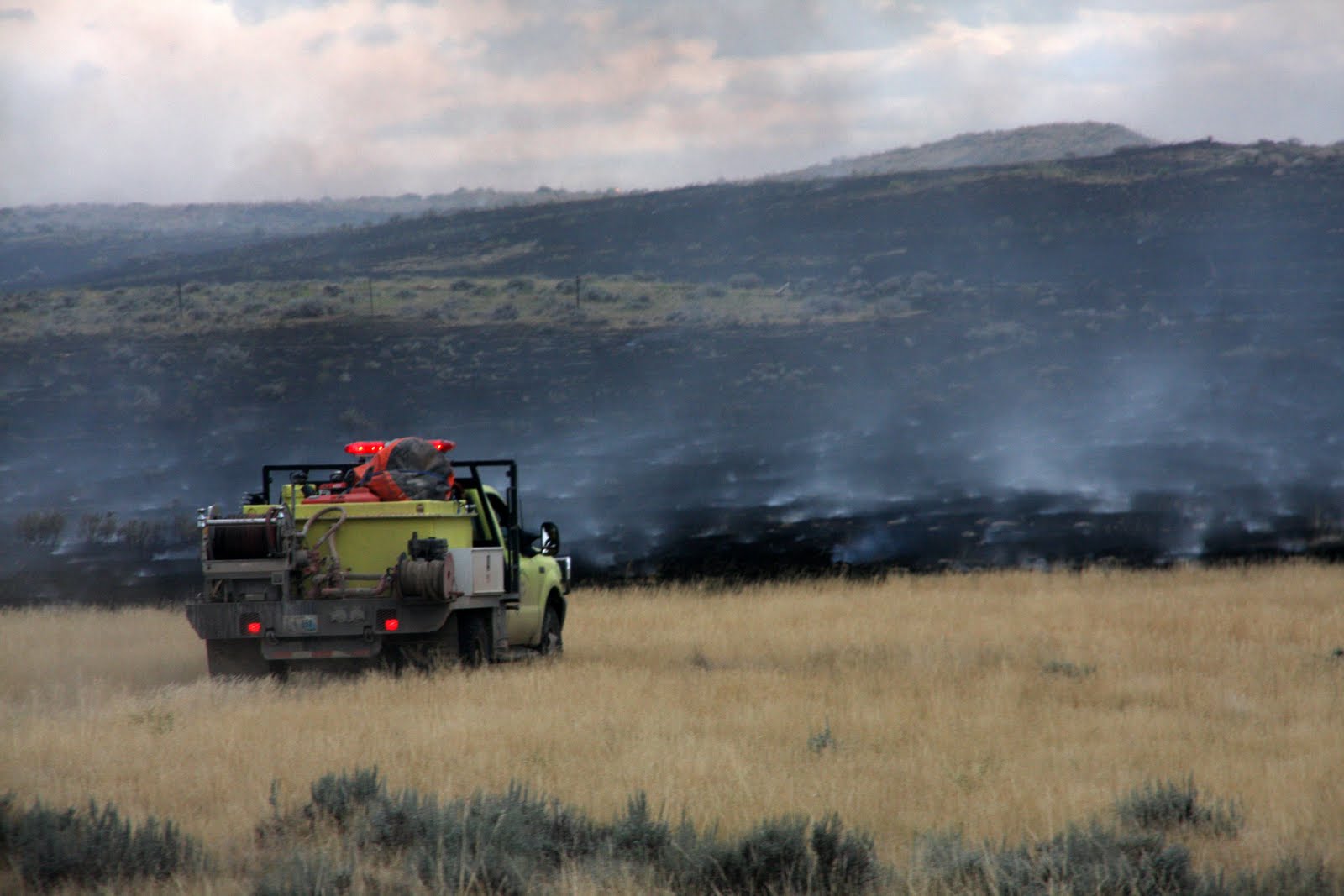 The first thing we always do is get on the black. You can't get burned up where the fire's already consumed all the grass. The above picture shows a county fire fighting pickup. The county has various fire fighting pickups, trucks and tankers scattered across the county with various ranchers. This is because the nearest town is 56 miles away, so the rancher's are always who spot the fires and are the first ones on them. The county maximizes its resources through keeping some of their fire fighting units in areas of high concern, with persons who will most likely be at a fire in the most time efficient manner.
 The other half of the equation are the ranchers. This is our fire fighting rig, housed on our winter feed pickup. My mom was the driver on this particular day. You will see all sorts of pickups/water tanks/pumps/motors/hose combinations on these homemade, rancher rigs. The important thing is they all spray water, and they're all ready to go the moment a fire needs fought.
 Here I am "cleaning up" behind a country truck that can spray more water than I can. He is moving quickly, knocking down the flames before they can consume any more grass. My job in this instance is to follow behind and put out any areas that flare back up behind him, and to spray more water on things like smoldering sagebrush that are near the fire line.
You also never know what may go wrong. On this particular day the reason I'm not spraying much water is because the filter on our rig plugged with an algea type plant that sometimes grows in our tank. It will make you very excited if your fire fighting rig stops spraying water at a critical moment!
 This was the view from the pickup, where my mom was. The driver has to pay attention to where they drive, and make sure they don't stop on top of a burning sagebrush, drive into a hole or draw they can't get out of, and work with the person spraying to ensure they're reaching the flames.
 Here I am again. You also want to work forward, ensuring there is no fire left behind you. I was practicing this, despite what the photo looks like. Here I skipped over a couple inches of flames to douse a sagebrush. The fire can smolder in a sagebrush, and they are a real concern on the fire line, so I made sure to stop the fire before it reached a sagebrush in this instance.
 It may be hard to tell in this smoky picture, but that is a draw you can't drive across with a pickup. We have to navigate around these natural obstacles when fighting fire, and they add an even more exciting/scary aspect in the dark. I have seen a six-by-six tanker (very big) fall into a sink-hole before, and all you could see was the blinking light on top of the truck.
 When the fireline has been secured, and no more flames are visible, people congregate to visit and wait to make sure the fire really is out. A change in wind, stray spark, grasshopper that caught on fire, and any number of other things can result in the flames reappearing and blazing forward.
 The county tankers may join the group, or refill at the nearest well so they're prepared more action. This is a good time for everyone to make sure they have water. If they're out, additional six-by-six tankers will be available on larger fires to re-fill everyone. Everything gets checked, repaired if necessary and possibler, refilled, etc.. during this down-time.
 A few ranchers have air planes around here, and on big fires they may fly, and communicate to fire fighters below if there are any additional flames, areas of concern, etc... This guy circled the fire several times, only a few feet off the ground at times. He would dive his plane in any areas there were flames to alert those of us on the ground where they were. He too had a CB radio, and would also talk to us.
There was also a road grader at this fire, who put in a fireline to stop the flames. This is when he peels a thin layer of dirt, that includes the grass over, creating dirt path several feet wide. The idea is it creates a line with no fuel for the fire to feed itself with. They work well, but aren't a guaranteed method of stopping flames, as a fire will jump the line in some instances.
 After a few hours of exhausting, smoke filled work, the fire was out. The smoke you see above are smoldering cow pies (they can smolder for days too) and sagebrush. You may also have noticed the cut fence, which is sometimes a necessity on range fires. Most people make every effort to cut fences as infrequently as possible, because the more you cut them, the more work the owner has to repair his place (he will already have to replace all the burnt wood posts).
 After everything has cooled off, most people leave. The owner, and a few other rigs will stay and "babysit" the fire for anywhere from a few more hours to days, depending on the location, how it acts, and several other determining factors. This county tanker is spraying back along the fire line in an effort to prevent any additional flames from flaring up.
 To give you an idea of how fast it was burning, that green tub is a thin plastic. These fires can consume prairie at up to over 100 mph. This one wasn't moving nearly that fast, but it's only because of a change in the wind that we got it out when we did.

 After a few hours of exhausting, smoke filled work, the fire was out. The smoke you see above are smoldering cow pies (they can smolder for days too) and sagebrush. You may also have noticed the cut fence, which is sometimes a necessity on range fires. Most people make every effort to cut fences as infrequently as possible, because the more you cut them, the more work the owner has to repair his place (he will already have to replace all the burnt wood posts).
 After everything has cooled off, most people leave. The owner, and a few other rigs will stay and "babysit" the fire for anywhere from a few more hours to days, depending on the location, how it acts, and several other determining factors. This county tanker is spraying back along the fire line in an effort to prevent any additional flames from flaring up.
 To give you an idea of how fast it was burning, that green tub is a thin plastic. These fires can consume prairie at up to over 100 mph. This one wasn't moving nearly that fast, but it's only because of a change in the wind that we got it out when we did.

A smoke filled sky always makes for a beautiful sunset, made even prettier by the fact that we had contained, and put out, the entire fire before dark in this instance!
Monday, August 1, 2011
Dozer Work
You may have noticed a lack of cattle related posts in recent weeks. That's because our cattle are busy eating, drinking, growing (the calves) and dealing with the summer heat. We aren't working, moving, hauling or doing a whole lot of anything else with them in the summer months. During this time of year we keep ourselves busy with other tasks, which are designed to improve our ranch for our livestock.

 I stopped by to briefly help with this project, and grab some pictures. Here is my brother sawing a piece of pipe to length. He uses different angled, end, valve and other pieces to maneuver the straight pieces of pipe the direction he needs it to go.
 Each piece is cleaned, then glued together. If you don't clean each piece well, the glue may not adhere to the surface, and it will leak. When you're talking about a pipeline that's five feet underground, you don't want to dig it up and redo it any more than is absolutely necessary. Pictured above is the jar of pipe cleaner he used.
 He thoroughly cleans each piece he is gluing together with the solution.
 See the difference cleaning it makes?
 Then he cleans the cap he glued to the top of each pipe, which were plumbed into the storage tank later. He temporarily glued these caps on so they could pressure up the line and make sure nothing was leaking before they filled the hole you see in the first picture. Like I said, it's hard to fix a leak that's five feet underground.
 Here's the glue he used.
 First you have to get the lid off - it's a can of glue, it seals up, and you don't want to run the risk of it leaking all over, so the lid is securely replaced after each use. You apply the glue to both pieces immediately after cleaning - you don't want dust to get it dirty again.
 You need to be fast and efficient at this point, so your glue doesn't set up before you shove the pieces together. You also don't want any dust or other matter to get on the glue and potentally prevent it from adhering.
 He securely holds each piece in place for several seconds.
 Then cleans off the excess glue.
 Here it is, all ready to be pressured up and tested.
 Kyle gathers up the dozer, and heads to the next job, which was a washed out side hill where another pipeline is located. Without the five feet of dirt over it, these lines would freeze in the winter months, so it was important to get it covered back up this summer.
One of these tasks is referred to at our place as, "dozer work." This includes such tasks as putting in new water tanks, repairing old water tanks, moving dirt to prevent washouts, blading trails for new fencelines, and repairing pipelines.
We have around 15 miles of underground PVC pipe on our ranch. This pipe is used to transport water to all our water tanks (we have around 30), from water wells. We strategically place our tanks in areas where they will be add the most benefit to our cattle and grass. A general rule with livestock is you should never make a cow walk more than one mile to water. We try to follow this idea, and also put water tanks in additional areas to encourage cattle to graze there. Cattle tend to graze hardest in areas nearest a water source, and in our semi-arid part of the world, we can control our grazing by turning water tanks on and off, and consequently moving cattle from area of a pasture to the next. Wildlife also utilize these tanks.
Water is a huge deal in Eastern Wyoming, and we don't like to haul it, and run the risk of running out on a hot day, so we installed all the pipe to ensure a continual water source for our livestock, no matter how hot and dry, or cold, it gets.
Here is one such dozer project. My dad and brother put a 1,500 gallon (which is small in ranch/livestock terms) above-ground water storage tank in this location. They did this because on down this line is a tank, and the well pumps water into it at a rate of five gallons a minute. This isn't enough water to keep up with a bunch of thirsty cows or calves.
The storage tank will fix this issue.
It will work like this: when the water tank down the line is full, water will flow on by and fill the storage tank. Then, when all the livestock come and drink a large volume of water out of the tank in a short period of time, water from the storage tank will gravity-flow back down the line at a rate of 30 gallons a minute, keeping the tank full, and ensuring every thirsty creature gets a drink. When everything is done drinking, and the tank is full again, the well will pump more water up the line and re-fill the storage tank.
 I stopped by to briefly help with this project, and grab some pictures. Here is my brother sawing a piece of pipe to length. He uses different angled, end, valve and other pieces to maneuver the straight pieces of pipe the direction he needs it to go.Each piece is cleaned, then glued together. If you don't clean each piece well, the glue may not adhere to the surface, and it will leak. When you're talking about a pipeline that's five feet underground, you don't want to dig it up and redo it any more than is absolutely necessary. Pictured above is the jar of pipe cleaner he used.
 He thoroughly cleans each piece he is gluing together with the solution.
 See the difference cleaning it makes?
 Then he cleans the cap he glued to the top of each pipe, which were plumbed into the storage tank later. He temporarily glued these caps on so they could pressure up the line and make sure nothing was leaking before they filled the hole you see in the first picture. Like I said, it's hard to fix a leak that's five feet underground.
 Here's the glue he used.
 First you have to get the lid off - it's a can of glue, it seals up, and you don't want to run the risk of it leaking all over, so the lid is securely replaced after each use. You apply the glue to both pieces immediately after cleaning - you don't want dust to get it dirty again.
 You need to be fast and efficient at this point, so your glue doesn't set up before you shove the pieces together. You also don't want any dust or other matter to get on the glue and potentally prevent it from adhering.
 He securely holds each piece in place for several seconds.
  Then cleans off the excess glue.
 Here it is, all ready to be pressured up and tested.
 Kyle gathers up the dozer, and heads to the next job, which was a washed out side hill where another pipeline is located. Without the five feet of dirt over it, these lines would freeze in the winter months, so it was important to get it covered back up this summer.
Since I took these pictures, they pressure tested the line for a couple days, installed the tank and filled the hole back up.
Now all our livestock, and any resident wildlife, will have a sufficient water at any time at the tank located down the line from this location.
Ranchers all over the west are busy this summer, on similar projects that will benefit their livestock year-round.
Thursday, July 28, 2011
Cleaning Corrals
Since returning from Canada, most of my time has been spent typing typing typing. But, I have been out and about to help with a couple summer ranch projects between articles. One of my tasks this summer was to clean out our corrals.
 Cleaning corrals removes manure and hay and anything else that has built up while livestock are held and/or fed in them. Keeping them clean is done for both sanitation and efficiency reasons. If you don't clean all this old manure and cellulose matter, it makes a big mess to drive and walk through, and can hold organisms that will make your livestock sick.
 Another perk to this mixture is once you put it in a pile, and let it set and do it's thing, it's the equivilant of a giant compost pile. Considering we live in an area with an inch or less of topsoil, we get really excited about things like composted manure, and use it on our lawns, in our windbreaks, and in a variety of other ways.
Cleaning corrals removes manure and hay and anything else that has built up while livestock are held and/or fed in them. Keeping them clean is done for both sanitation and efficiency reasons. If you don't clean all this old manure and cellulose matter, it makes a big mess to drive and walk through, and can hold organisms that will make your livestock sick.  Another perk to this mixture is once you put it in a pile, and let it set and do it's thing, it's the equivilant of a giant compost pile. Considering we live in an area with an inch or less of topsoil, we get really excited about things like composted manure, and use it on our lawns, in our windbreaks, and in a variety of other ways.
 Ranchers that live near farmland often put their manure on their crops, as it is a natural form of fertilier. We're all about recycling, and efficiently using everything possible on our operations, even manure.
 Kyle had already pushed some of the manure in this pen into a pile. I made another pile, then hauled it all out of the corral, one bucket full at a time.
 Here is our compost pile, where I dumped everything. My dad also mentioned leveling it out in this location, and planting a garden next year if my mom is interested. Gardens like topsoil too!
 Then you back into the corral, turn around, and do it again. Repeat until the corral is down to bare dirt, then move on to the next pen. I also used some of this to fill the washed out areas in the corral from all the rain we've had this year. Like I said, you have to be efficient and resourceful every day as a rancher.
 My dad was kind enough to grab the camera and snap these pictures for me. Did I mention that tractor has AC?! Not a bad job on a hot day.
 Here is the pile after day one. It's about eight feet tall. Once everything has settled, and we get around to it, we'll pull those boards out and throw them in our dump, if the Termites don't eat them first.
 Here's the correl after. Nice and smooth, without any mucky manure/old hay to sink and stumble through every time it gets wet!
 Gates are back to swinging like they should, and next on my list is moving this feeder I welded during my 4-H years out of the way. Then I'll continue with my cleaning in the rest of the correl.
 Kyle had already pushed some of the manure in this pen into a pile. I made another pile, then hauled it all out of the corral, one bucket full at a time.
 Here is our compost pile, where I dumped everything. My dad also mentioned leveling it out in this location, and planting a garden next year if my mom is interested. Gardens like topsoil too!
 Then you back into the corral, turn around, and do it again. Repeat until the corral is down to bare dirt, then move on to the next pen. I also used some of this to fill the washed out areas in the corral from all the rain we've had this year. Like I said, you have to be efficient and resourceful every day as a rancher.
 My dad was kind enough to grab the camera and snap these pictures for me. Did I mention that tractor has AC?! Not a bad job on a hot day.
 Here is the pile after day one. It's about eight feet tall. Once everything has settled, and we get around to it, we'll pull those boards out and throw them in our dump, if the Termites don't eat them first.
 Here's the correl after. Nice and smooth, without any mucky manure/old hay to sink and stumble through every time it gets wet!
 Gates are back to swinging like they should, and next on my list is moving this feeder I welded during my 4-H years out of the way. Then I'll continue with my cleaning in the rest of the correl.
Thursday, July 7, 2011
Hauling to the Mountain
This is the time of year when ranchers head to the Wyoming mountains with their livestock. Lots of highways were clogged with cattle, sheep and trucks heading up in elevation over the last week, and after a brief reprieve on the 4th, the move was back in full swing on the 5th. My family doesn't live anywhere near a mountain, but my boyfriend Adam does. While at his place over the 4th of July holiday, I got in on a day of hauling yearling heifers to the mountain.
Some producers trail all the way up to their mountain pastures, while others haul as far up as they can, then trail on in to their pasture(s). Adam's family used to trail, but haul as far as they can these days to save time. Both ways require some planning - when trailing you have to work with everyone else trailing, and keep your cattle moving to the next holding pasture each night so you aren't holding up the show for those behind you. When hauling you have to get trucks, and often work around when they're available.
One difference in going to the mountain versus going to a summer pasture where I'm from is when you go. Our cattle have all been at summer pasture for a month or more, but the cooler temperatures at mountain elevations results in the grass getting a later start in the growing season. Rancher's typically wait until their is enough grass for their livestock before heading anywhere with them. So, while eastern Wyoming, with it's warmer temperatures, has had abundant summer grass for a while, it's just getting tall enough to graze in the cooler Bighorn Mountains.

Here's what we did - first we loaded the heifers, and bulls, onto a couple cattle pots at a feedlot where they have been living for several months.
 We stopped and added a little more caffeine to our dwindling iced tea supply in Ten Sleep, then headed for the corrals where we would unload, leading the trucks.
 We started on the highway, but soon turned onto the Spring Creek Road, and from there onto a two-track road that lead up the base of the mountain.
 And up we went.
 The road to the right is the old road, and previously the only route up. Adam told me about a semi load of sheep that tipped over right where the two roads join several years ago. He used to hate that road, and is very happy to have the new one on the left.
 Here come the trucks, up the last rise and through the gate to the corrals. Adam and I got the gates set and were ready and waiting when they arrived.
Then, right between the above and below photos, a tragic event occurred. My camera, which I had in it's "work day" bag, fell off the corral fence and made an alarming THUD sound as it hit the ground 8 feet below. I thought I had looped the bag's strap over a corral post, but obviously that wasn't the case. The damage was a busted LCD screen, but fortunately it still took pictures, which I found out for sure when I looked at them on a computer.
 Frustrating camera events or not, the trucks arrived and backed up to the decrepit unloading chute, which is on the repair list for later this summer I'm told.
 I was put in charge of counting the heifers off the trucks, and guarding a hole in the corral fence (the whole corral is on the 2011 summer repair list). I gingerly snapped a few photos as we went along, hopeful they would turn out.
Some producers trail all the way up to their mountain pastures, while others haul as far up as they can, then trail on in to their pasture(s). Adam's family used to trail, but haul as far as they can these days to save time. Both ways require some planning - when trailing you have to work with everyone else trailing, and keep your cattle moving to the next holding pasture each night so you aren't holding up the show for those behind you. When hauling you have to get trucks, and often work around when they're available.
One difference in going to the mountain versus going to a summer pasture where I'm from is when you go. Our cattle have all been at summer pasture for a month or more, but the cooler temperatures at mountain elevations results in the grass getting a later start in the growing season. Rancher's typically wait until their is enough grass for their livestock before heading anywhere with them. So, while eastern Wyoming, with it's warmer temperatures, has had abundant summer grass for a while, it's just getting tall enough to graze in the cooler Bighorn Mountains.
Here's what we did - first we loaded the heifers, and bulls, onto a couple cattle pots at a feedlot where they have been living for several months.
 We stopped and added a little more caffeine to our dwindling iced tea supply in Ten Sleep, then headed for the corrals where we would unload, leading the trucks.
 We started on the highway, but soon turned onto the Spring Creek Road, and from there onto a two-track road that lead up the base of the mountain.
 And up we went.
 The road to the right is the old road, and previously the only route up. Adam told me about a semi load of sheep that tipped over right where the two roads join several years ago. He used to hate that road, and is very happy to have the new one on the left.
 Here come the trucks, up the last rise and through the gate to the corrals. Adam and I got the gates set and were ready and waiting when they arrived.
Then, right between the above and below photos, a tragic event occurred. My camera, which I had in it's "work day" bag, fell off the corral fence and made an alarming THUD sound as it hit the ground 8 feet below. I thought I had looped the bag's strap over a corral post, but obviously that wasn't the case. The damage was a busted LCD screen, but fortunately it still took pictures, which I found out for sure when I looked at them on a computer.
My camera is currently on it's way to Canon to be fixed : (
 Frustrating camera events or not, the trucks arrived and backed up to the decrepit unloading chute, which is on the repair list for later this summer I'm told.
 I was put in charge of counting the heifers off the trucks, and guarding a hole in the corral fence (the whole corral is on the 2011 summer repair list). I gingerly snapped a few photos as we went along, hopeful they would turn out.
1, 2, 3, .....58, 59, .....102, 103, .... you get it....
 Then the bulls did what men will do - duked it out as to who was the head honcho and who was not.
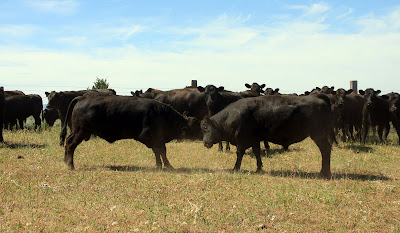
 Then the bulls did what men will do - duked it out as to who was the head honcho and who was not.
I should note these heifers were AI'd earlier in the breeding season, and only had one cleanup bull with them in the feedlot. A second bull was added on this day since they were being turned out in a large pasture, where just one bull would have a hard time covering all of them. The bull that had been with them in the feedlot was not happy with this arrangement, and much preferred the idea of him being left alone with his bunch of heifers.
 The trucks left, Adam and I did a little sorting on the heifers since a few were going to a separate pasture, then opened the gate you can see above and turned them out.
 The trucks left, Adam and I did a little sorting on the heifers since a few were going to a separate pasture, then opened the gate you can see above and turned them out.
That evening Adam, his dad and brother went back and trailed them a few miles up the mountain to their summer home. I was in Casper at the Canon store by then, drooling over new camera's and feeling the pain over sending mine away to be fixed.
Sunday, June 19, 2011
Pouring Steers
A few weeks ago we poured our steers and shipped them to summer pasture. I took pictures of the entire process for you, so we're going with the, "better late than never" mentality with this post.
We pour our cattle in the spring with a parasiticide that will kill roundworms, lungworms, grubs, sucking lice, biting lice, mange mites and horn flies. While not every one of these parasites are commonly found each year, the idea is to treat any that are present on a given year, and to be more preventative in the treatment method than reactive.
This is done at certain times of the year, based on parasitic life cycles. Spring is a key time as the frost goes out of the ground, and number of parasite's life cycles kick into high gear.
Here is a picture of a parasite's life cycle, using a sheep instead of a cow. The concept is the same as far as life cycles go.
 First we gathered the steers, and Kyle took a few minutes to scratch his favorite. This steer will let Kyle scratch him all over - it may be hard to tell in the photo, but Kyle is scratching his tail, and the steer is sticking it straight out for him, and licking at it, much like some dogs do when you give them a good scratching.
 We got the pour-on ready to go. See that hose he's holding? It attached the bottle of pour-on to the applicator gun, which automatically refills via the hose after each animal.
 Here's the gun, which is adjusted based on weight. Pour-on and medicine dosages in cattle are almost always based on weight.
 We used our same corrals, and my dad brought the steers, a few at a time, down the alley and into the tub.
 Kyle often ducked down so the steers couldn't see him, and would load into the single-file alley.
 When the steers started up the alley, Kyle moved into position.
 Most of the steers walked or jogged up the alley, and I ran a gate to slow them up, ensuring Kyle had time for his gun to reload after each steer, ensuring every animal got the proper dosage of parasiticide.
 As the steer walks by, Kyle squirts the pour-on down his back. The back is the most ideal place to apply the pour-on, because then it can soak through the skin and into the animal's blood system, offering long-term relief from the parasites listed at the beginning.
We pour our cattle in the spring with a parasiticide that will kill roundworms, lungworms, grubs, sucking lice, biting lice, mange mites and horn flies. While not every one of these parasites are commonly found each year, the idea is to treat any that are present on a given year, and to be more preventative in the treatment method than reactive.
This is done at certain times of the year, based on parasitic life cycles. Spring is a key time as the frost goes out of the ground, and number of parasite's life cycles kick into high gear.
Here is a picture of a parasite's life cycle, using a sheep instead of a cow. The concept is the same as far as life cycles go.
 First we gathered the steers, and Kyle took a few minutes to scratch his favorite. This steer will let Kyle scratch him all over - it may be hard to tell in the photo, but Kyle is scratching his tail, and the steer is sticking it straight out for him, and licking at it, much like some dogs do when you give them a good scratching.
 We got the pour-on ready to go. See that hose he's holding? It attached the bottle of pour-on to the applicator gun, which automatically refills via the hose after each animal.
 Here's the gun, which is adjusted based on weight. Pour-on and medicine dosages in cattle are almost always based on weight.
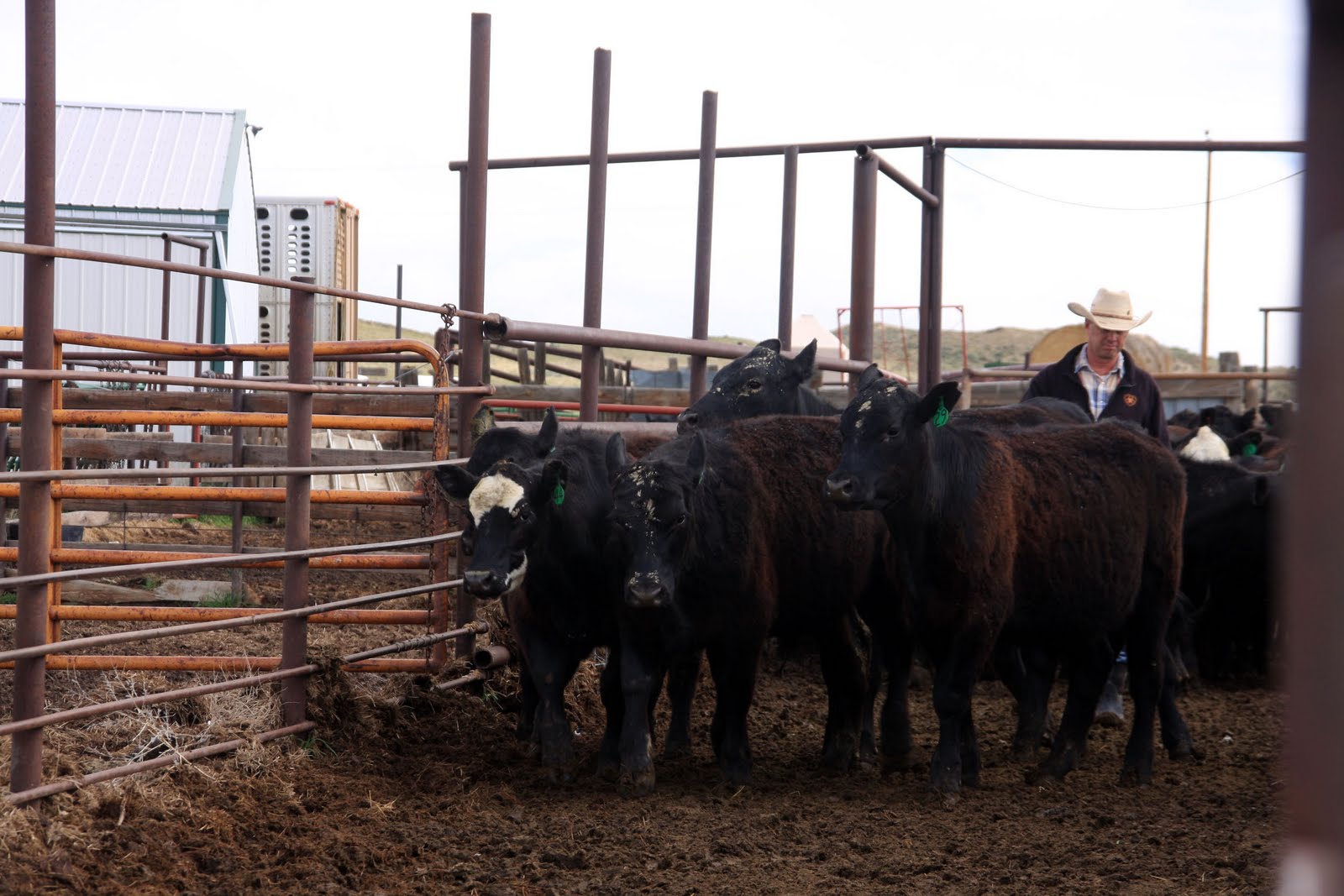 We used our same corrals, and my dad brought the steers, a few at a time, down the alley and into the tub.
 Kyle often ducked down so the steers couldn't see him, and would load into the single-file alley.
 When the steers started up the alley, Kyle moved into position.
 Most of the steers walked or jogged up the alley, and I ran a gate to slow them up, ensuring Kyle had time for his gun to reload after each steer, ensuring every animal got the proper dosage of parasiticide.
 As the steer walks by, Kyle squirts the pour-on down his back. The back is the most ideal place to apply the pour-on, because then it can soak through the skin and into the animal's blood system, offering long-term relief from the parasites listed at the beginning.
If it doesn't soak in, it doesn't do any good.
 Then the steers walked out the gate just behind the chute, and joined their compadres.
 After all the steers were poured, we counted them to make sure they were all present for the trip to summer pasture.
 Then we put them back in the big alleyway, and sorted out specific numbers to load on the cattle pot. The gate Kyle is opening leads to the loading alley, and cattle pot.
 Kyle brought a bunch for one compartment of the cattle pot. We jog our cattle up to the truck because it's uphill, and the momentum of jogging keeps them moving forward and onto the cattle pot.
 There they go up the loading alley and onto the truck.
 And into their specific compartment on the cattle pot. As I've mentioned before, the cattle pot (big, multiple level trailer used to haul cattle and pulled by a semi) is divided into different pens to keep weight distributed properly, and to keep the cattle safe. If you just fill the trailer full, and didn't have cattle separated into pens, the cattle would be more likely to squish and hurt each other during turns and changes in speed. With these separate pens, only a few cattle are in each area, and they are far less likely to be injured. This is especially critical when hauling cows and their baby calves. You always separate these when hauling so the cows don't accidentally step on, squish, or smother their babies.
 There is the last bunch, which were put in the very back pen. When they're all on, the trucker (my dad in this case) closes the trailer door. Then the steers were hauled about an hour from our house, and turned out on their summer pasture.
 Then the steers walked out the gate just behind the chute, and joined their compadres.
 After all the steers were poured, we counted them to make sure they were all present for the trip to summer pasture.
 Then we put them back in the big alleyway, and sorted out specific numbers to load on the cattle pot. The gate Kyle is opening leads to the loading alley, and cattle pot.
 Kyle brought a bunch for one compartment of the cattle pot. We jog our cattle up to the truck because it's uphill, and the momentum of jogging keeps them moving forward and onto the cattle pot.
 There they go up the loading alley and onto the truck.
 And into their specific compartment on the cattle pot. As I've mentioned before, the cattle pot (big, multiple level trailer used to haul cattle and pulled by a semi) is divided into different pens to keep weight distributed properly, and to keep the cattle safe. If you just fill the trailer full, and didn't have cattle separated into pens, the cattle would be more likely to squish and hurt each other during turns and changes in speed. With these separate pens, only a few cattle are in each area, and they are far less likely to be injured. This is especially critical when hauling cows and their baby calves. You always separate these when hauling so the cows don't accidentally step on, squish, or smother their babies.
 There is the last bunch, which were put in the very back pen. When they're all on, the trucker (my dad in this case) closes the trailer door. Then the steers were hauled about an hour from our house, and turned out on their summer pasture.
Subscribe to:
Posts (Atom)