Today I checked the water for our yearling heifers and two-year old cows, who are wintering together. Here are a few photos from my "trip." It's about three miles to their water, and it takes over 30 minutes one way to drive the two-track, very rough road, if you can call it a road. In the winter, our primary responsibility is feeding and checking water for the livestock, and I enjoy the job a lot! Hope you have a great weekend.
Also, don't forget to enter my giveaway if you haven't yet!
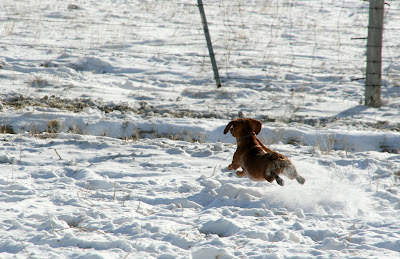 My dogs are cheap entertainment. One prime example of this is Pearl's obsession with chasing birds. She is all about it, regardless of weather, geographical or physical obstacles.
 See the little elusive buggers out in front of her?This is a regular site at our house, and accompanied by vigorous barking. Last summer my mom said she could always tell where my dad was spraying weeds, because Pearl went with him and spent the entire time barking and chasing birds.
 You will see her go streaking across the yard, first one way, then the other.
 After each burst of chase, she will pause, and listen for where the sneaky birds are located.
 Then off she goes again, full force.
 Kyle says it's like watching a slinky stretch and contract.
  If the birds are perched up high, on the tractor or in a tree, Pearl will perch on her hind legs and bark at them.
 It's a very serious thing for her.
 Emmie isn't as dedicated to bird chasing...
I just mentioned in a recent post that we adjust our feeding schedule based things like bad weather. Today I was busy preparing for what is forecasted to be a nasty winter blizzard starting around midnight tonight.The radio was saying they expect 30+ mph winds, 6-10 inches of snow, temperatures ranging from zero to 30 below zero...it doesn't sound fun. The first thing I did was gather these 26 cows out of the pasture neighboring where they are supposed to be. After preg checking we just turned the cows into this pasture, and they typically make their way to the next one out of habit. If they don't, most come when you start feeding. The gates between the two pastures are left open, because when we're feeding usually the cows come every day and it isn't an issue.But the nice weather this year...and the questionable intelligence level of these individuals...resulted in them never coming to feed. This wasn't a big deal with the very nice temperatures we've had so far this winter. The abundant left over grass was more than enough for these cows to thrive on so far.
 But the impending blizzard, and the fact that we want these cows to come to feed along with everyone else, meant I gathered and trailed them through this gate to the proper pasture. Then I closed the gate, trailed them down to water, and fed everyone a double ration to get their energy levels up before the cold weather hits.As I also mentioned the linked post, we feed our cows every other day. I just fed these cows yesterday, but gave them more hay today so they'll be ready for the wind, snow and cold.
 Here they are trailing into feed.
 I also briefly mentioned that a cow has a ruminant stomach, which allows them to utilize forages, or feedstuffs, over 24, or 48, hour periods.This ruminant stomach is separated into four compartments.
 When the cow swallows a mouth full of hay, it has two choices. Heavy, or big, pieces of hay will drop into the Reticulum. From this compartment the cow can regurgitate the feed and chew on it again. This is called chewing her cud, and is something cows do regularly, and is typically done when they're calm and relaxed. This unique ability allows a cow to eat a whole bunch in one sitting, like when I'm feeding a bale of hay, then regurgitate it later and chew it more thoroughly before digesting it. It's like a built in storage/recycling system for food, and is one reason you can feed them a couple days apart.Smaller, and lighter, pieces of feed go into the Omasum. While the picture doesn't really show it, the cow's stomach will sort the bigger and heavier pieces of feed from the lighter, smaller pieces at the junction of Omasum and Reticulum.From that point the feed goes on through the Abomasum, to the Rumen, then into the intestines.Another key aspect of ruminant digestion are the microbes, which are just microscopic bugs, present in a ruminant's stomach. Most of these microbes are in the Rumen compartment. These microbes are what allow the animal to digest feedstuffs. For example, one group of microbes found in the Rumen are called Cellulolytics, and they break down Cellulose, which is the primary component in forages. Humans and other single-stomached creatures lack the efficiency, and often the ability, to break down roughage's, specifically Cellulose, into a usable energy source. This is why cattle, sheep, and other ruminants are so vital to society. They take the forages found all over the country, and world, that we cannot utilize as humans, and they eat it, and because of their unique stomachs, they are able to convert it to energy to grow and produce a usable food for humans - meat.
 Here's what it looks like from the outside. The other thing all this digesting creates is heat. The coarser the forage they're eating, the longer it takes the microbes, or bugs, to eat and process it. The longer it takes the microbes to break it down, the more heat they generate during the process.
 So for those reasons I fed the cows a couple older, coarser bales. This means it was forage with bigger stems. While not the highest quality hay we feed, it has a definite place when we want to keep our cows warm.Grass hay is an example coarser hay, that takes longer to digest. Alfalfa hay, is finer, and microbes can attack and process it faster. So Alfalfa creates energy faster, but it is much shorter lived, while grass is a slower starting, longer lasting form of energy.We also feed hay that is a combination of the two, to maximize to the benefits of both.
...is feeding at our outfit. Christmas Eve morning everyone was busy feeding so we didn't have to feed Christmas day.Cattle have a ruminant stomach that is separated into four compartments and is designed to maximize the utilization of the conversion of forages and grains to energy. A ruminant's stomach contains bacteria that allows them to adjust to digesting feed over a 24, or 48 hour period. We feed our cattle every other day, and that allows us to dedicate one day to feeding, and one day to something else. It's a matter of time economics, and the cattle are used the routine and it meets their energy needs. If it gets cold we will adjust our feeding schedule accordingly to ensure our livestock have enough additional energy to stay warm and maintain their body condition in the colder weather.Where my family lives there is rarely enough snow to cover all the grass, and they can fill up on the old grass. We are responsible for providing them with the nutrients the dead grass is lacking, and that's why we feed a lot of cake. It's a good way to provide that energy in a way that is easy to feed.But, where my uncle lives in the black hills, the grass is almost always under snow this time of year, so he feeds them hay to both fill them up and meet their energy requirements.There is a lot of science, economics, humanities, weather watching and dietitian aspects to feeding cattle. We have to make sure their energy and nutrient requirements are met, they stay healthy, and we don't go broke feeding them. We feed our cattle on this schedule no matter what, and Christmas is no exception. We feed before we eat our Christmas dinner, open presents, or play games. Christmas Eve morning I went with my uncle to feed his calves and yearling heifers hay. We pull out to the feed ground, where the snow is packed down, after loading two round bales of hay onto the pickup.
 Here is the hay feeding pickup. He uses a hydrabed, which will be demonstrated a little further down. Here we are adjusting where the arms are gripping the bale - you want the arms in the center of the bale, because you pull the bale behind the pickup and it unrolls. If you don't grab it in the middle it doesn't unroll well, and causes problems.
 The calves arrive and wait patiently for the bales to be unrolled.
 First is getting the twine strings off the bales. This is what holds the round bale together. Some bales are also wrapped with net wrap instead of twine.
 All the strings are cut, then you pull them out. You want to have the bale picked up off the ground for this step, because trying to drag strings out from under a 1,200 pound bale is difficult at best.
 A recent rain storm on top of the all the snow froze some of the strings to the bale. So my uncle used his axe, and pitchfork, to break up the ice, and free the strings.
 Here is a chunk that is still caught in the ice. After freeing all string, it's looped and tied in a knot and secured in the pickup. A loose batch of twine string can make an awful mess, and mad ranchers.
 Then my uncle gets in, lowers the bale to the ground, and takes off. The other bale just sits on the back of the pickup, and will ride there unless you try to go up a steep hill.
 As the bale unrolls, you use manual controls in the cab to lower the hydrabed arms further to keep the bale on the ground and unrolling.Sometimes you will pick up a bale backwards, and have to back up to unroll it.
 Then you drive, and lower the arms as needed, until your bale is completely unwrapped.
 Those two knobs are the controls for the hydrabed. One raises and lowers the arms, and the other moves the arms back and forth to grip or release the bale.
 He just let the first bale go, and is raising the arms to grab the next one.
  Pearl was supervising.
 He will set the bale on the ground, get the arms centered on the bale, re-grab it, raise it off the ground, cut the strings, knock all that ice off, pull, loop and tie the strings in a knot, set the bale back down, then unroll the bale.We fed these calves five bales, and repeated the same process for each one.
 The calves fall in behind and eat. After every cow, horse and other creature on the ranch has been feed their ration, we go in the house, eat our dinner, open our presents, and thank the Lord for the birth of his Son, the food, our family, the cows and horses and other creatures we are responsible for, and the gifts we received.


 My dogs are cheap entertainment. One prime example of this is Pearl's obsession with chasing birds. She is all about it, regardless of weather, geographical or physical obstacles.
 See the little elusive buggers out in front of her?
 You will see her go streaking across the yard, first one way, then the other.
 After each burst of chase, she will pause, and listen for where the sneaky birds are located.
 Then off she goes again, full force.
 Kyle says it's like watching a slinky stretch and contract.
 It's a very serious thing for her.


 Couldn't decide if I liked this last one better in color or black and white, so I put both on here so you can choose for yourself.
 The first thing I did was gather these 26 cows out of the pasture neighboring where they are supposed to be. After preg checking we just turned the cows into this pasture, and they typically make their way to the next one out of habit. If they don't, most come when you start feeding. The gates between the two pastures are left open, because when we're feeding usually the cows come every day and it isn't an issue.
 But the impending blizzard, and the fact that we want these cows to come to feed along with everyone else, meant I gathered and trailed them through this gate to the proper pasture. Then I closed the gate, trailed them down to water, and fed everyone a double ration to get their energy levels up before the cold weather hits.
 Here they are trailing into feed.
 When the cow swallows a mouth full of hay, it has two choices. Heavy, or big, pieces of hay will drop into the Reticulum. From this compartment the cow can regurgitate the feed and chew on it again. This is called chewing her cud, and is something cows do regularly, and is typically done when they're calm and relaxed. This unique ability allows a cow to eat a whole bunch in one sitting, like when I'm feeding a bale of hay, then regurgitate it later and chew it more thoroughly before digesting it. It's like a built in storage/recycling system for food, and is one reason you can feed them a couple days apart.
 Here's what it looks like from the outside. The other thing all this digesting creates is heat. The coarser the forage they're eating, the longer it takes the microbes, or bugs, to eat and process it. The longer it takes the microbes to break it down, the more heat they generate during the process.
 Christmas Eve morning I went with my uncle to feed his calves and yearling heifers hay. We pull out to the feed ground, where the snow is packed down, after loading two round bales of hay onto the pickup.
 Here is the hay feeding pickup. He uses a hydrabed, which will be demonstrated a little further down. Here we are adjusting where the arms are gripping the bale - you want the arms in the center of the bale, because you pull the bale behind the pickup and it unrolls. If you don't grab it in the middle it doesn't unroll well, and causes problems.
 The calves arrive and wait patiently for the bales to be unrolled.
 First is getting the twine strings off the bales. This is what holds the round bale together. Some bales are also wrapped with net wrap instead of twine.
 All the strings are cut, then you pull them out. You want to have the bale picked up off the ground for this step, because trying to drag strings out from under a 1,200 pound bale is difficult at best.
 A recent rain storm on top of the all the snow froze some of the strings to the bale. So my uncle used his axe, and pitchfork, to break up the ice, and free the strings.
 Here is a chunk that is still caught in the ice. After freeing all string, it's looped and tied in a knot and secured in the pickup. A loose batch of twine string can make an awful mess, and mad ranchers.
 Then my uncle gets in, lowers the bale to the ground, and takes off. The other bale just sits on the back of the pickup, and will ride there unless you try to go up a steep hill.
 As the bale unrolls, you use manual controls in the cab to lower the hydrabed arms further to keep the bale on the ground and unrolling.
 Then you drive, and lower the arms as needed, until your bale is completely unwrapped.
 Those two knobs are the controls for the hydrabed. One raises and lowers the arms, and the other moves the arms back and forth to grip or release the bale.
 He just let the first bale go, and is raising the arms to grab the next one.
  Pearl was supervising.
 He will set the bale on the ground, get the arms centered on the bale, re-grab it, raise it off the ground, cut the strings, knock all that ice off, pull, loop and tie the strings in a knot, set the bale back down, then unroll the bale.
 The calves fall in behind and eat. After every cow, horse and other creature on the ranch has been feed their ration, we go in the house, eat our dinner, open our presents, and thank the Lord for the birth of his Son, the food, our family, the cows and horses and other creatures we are responsible for, and the gifts we received.
