


This is Larry, who is one half of our new Hereford bull duo (the other is Moe) that are going to make us some black baldy calves : ) He has been hard at work.


 This is what I look like right now, and this picture was taken just a couple hours ago. I am only on my computer because I am thawing out hamburger, so I can take hamburgers back to the fire when I go (people fight fire round the clock, and get hungry. Local ranch wives do the majority of the feeding.)
 To make things even more exciting/nerve wracking, several funnels came across one of the larger blazes this afternoon, sucking the flames up into it. Made for an interesting photo if nothing else.
 This fire was during the day, which is less common than fires occurring at night. The vast majority of grass fires are started by lightning. So, whenever you see a summer storm moving over Eastern Wyoming, you can guess we're sitting on the tallest hill, watching for smoke during the day or an eerie glow at night.
That is how we spotted this fire. Almost every rancher has a homemade fire fighting rig they've put on a ranch pickup, and are ready 24-7 to help their friends and neighbors in the event of a fire. Everyone also has CB radios, which are used to relay information on lightning strikes, fires that have been spotted, how to get to a fire (you can't drive a pickup across much of this area, and it gets really hard at night), if the county fire fighting trucks are on the way, etc...
We gathered enough information, and deemed it safe to leave our area (you don't want to drive 20-40 miles to a fire, then have one start on your place behind you), and raced to help our neighbors.
 We cruised down a county road, turned onto a two-track trail, crossed a creek, and jostled across a pasture and over a hill to be greeted by this sight. The great grass year we're having in Wyoming means there's a lot more fuel for a fire, and a greater potential for large fires that will devastate range lands.
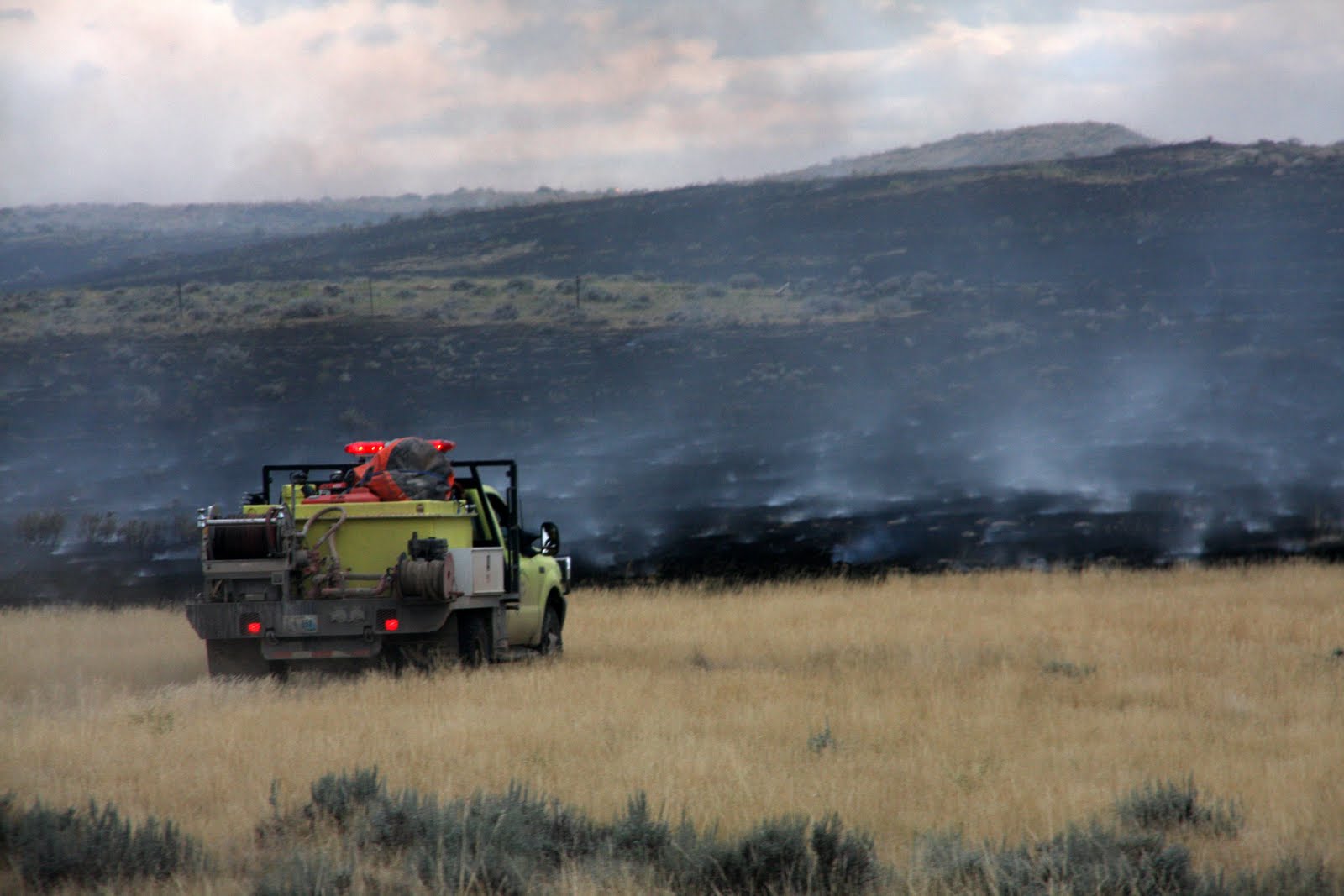 The first thing we always do is get on the black. You can't get burned up where the fire's already consumed all the grass. The above picture shows a county fire fighting pickup. The county has various fire fighting pickups, trucks and tankers scattered across the county with various ranchers. This is because the nearest town is 56 miles away, so the rancher's are always who spot the fires and are the first ones on them. The county maximizes its resources through keeping some of their fire fighting units in areas of high concern, with persons who will most likely be at a fire in the most time efficient manner.
 The other half of the equation are the ranchers. This is our fire fighting rig, housed on our winter feed pickup. My mom was the driver on this particular day. You will see all sorts of pickups/water tanks/pumps/motors/hose combinations on these homemade, rancher rigs. The important thing is they all spray water, and they're all ready to go the moment a fire needs fought.
 Here I am "cleaning up" behind a country truck that can spray more water than I can. He is moving quickly, knocking down the flames before they can consume any more grass. My job in this instance is to follow behind and put out any areas that flare back up behind him, and to spray more water on things like smoldering sagebrush that are near the fire line.
 This was the view from the pickup, where my mom was. The driver has to pay attention to where they drive, and make sure they don't stop on top of a burning sagebrush, drive into a hole or draw they can't get out of, and work with the person spraying to ensure they're reaching the flames.
 Here I am again. You also want to work forward, ensuring there is no fire left behind you. I was practicing this, despite what the photo looks like. Here I skipped over a couple inches of flames to douse a sagebrush. The fire can smolder in a sagebrush, and they are a real concern on the fire line, so I made sure to stop the fire before it reached a sagebrush in this instance.
 It may be hard to tell in this smoky picture, but that is a draw you can't drive across with a pickup. We have to navigate around these natural obstacles when fighting fire, and they add an even more exciting/scary aspect in the dark. I have seen a six-by-six tanker (very big) fall into a sink-hole before, and all you could see was the blinking light on top of the truck.
 When the fireline has been secured, and no more flames are visible, people congregate to visit and wait to make sure the fire really is out. A change in wind, stray spark, grasshopper that caught on fire, and any number of other things can result in the flames reappearing and blazing forward.
 The county tankers may join the group, or refill at the nearest well so they're prepared more action. This is a good time for everyone to make sure they have water. If they're out, additional six-by-six tankers will be available on larger fires to re-fill everyone. Everything gets checked, repaired if necessary and possibler, refilled, etc.. during this down-time.
 A few ranchers have air planes around here, and on big fires they may fly, and communicate to fire fighters below if there are any additional flames, areas of concern, etc... This guy circled the fire several times, only a few feet off the ground at times. He would dive his plane in any areas there were flames to alert those of us on the ground where they were. He too had a CB radio, and would also talk to us.
 After a few hours of exhausting, smoke filled work, the fire was out. The smoke you see above are smoldering cow pies (they can smolder for days too) and sagebrush. You may also have noticed the cut fence, which is sometimes a necessity on range fires. Most people make every effort to cut fences as infrequently as possible, because the more you cut them, the more work the owner has to repair his place (he will already have to replace all the burnt wood posts).
 After everything has cooled off, most people leave. The owner, and a few other rigs will stay and "babysit" the fire for anywhere from a few more hours to days, depending on the location, how it acts, and several other determining factors. This county tanker is spraying back along the fire line in an effort to prevent any additional flames from flaring up.
 To give you an idea of how fast it was burning, that green tub is a thin plastic. These fires can consume prairie at up to over 100 mph. This one wasn't moving nearly that fast, but it's only because of a change in the wind that we got it out when we did.

