Showing posts with label humane treatment of livestock. Show all posts

Tuesday, May 8, 2012

HSUS Targets Wyoming Pig Farm

The Humane Society of the United States (HSUS) is at it again with another undercover video allegedly shot at a Wheatland, Wyoming pig farm. I just watched it, and there were instances were handling the hogs wasn't done appropriately. I am saying this as a person who just watched an extreme video, not someone who was actually present at the facilities and was involved in the entire situation the video shows quick blurbs of. I'm also not condoning or defending the people and actions shown in the video as they were mistreating the animals in some of the scenes.
I did also notice a few things that I'm guessing are in the animal's best interest. One example is they showed a sow with an iron ring holding her mouth still, and she was naturally squealing. The video then showed her feet being roped, and her being laid on her side while a voice talked about hurrying to pull the piglets (or something like that). It appeared the workers were trying to help that sow deliver her babies, and had her mouth controlled because a sow weighing several hundred pounds knows how to use her head and teeth on humans. Especially when she's in labor, I'm guessing. That wasn't to hurt her, it was to prevent injury to the people who were helping her deliver her litter of piglets, and to keep her piglets alive and her from suffering any health related issues that would arise if she didn't deliver them (like death...)
Furthermore, I noticed several situations that likely occurred despite any management efforts, like a prolapsed sow. Prolapses just happen, and nobody purposely makes them happen, or can do anything in advance to prevent an animal from prolapsing. The video says she was allowed to live like that for several days, but do we really know if that's the case based on a 3 second blip - no.
It also showed a dead baby piglet in the aisle, with the placenta over his head. This means he died at birth because he couldn't get oxygen, not that someone killed him or beat him. Unfortunately that happens within seconds following birth, and can occur even when you're watching things super close.
Then there was the mother pig eating the dead piglet, which is a perfect example of why sows who are about to farrow (have their piglets) are put in small pens (farrowing crates) where they cannot move around a lot. Some sows will kill their young intentionally, and others will accidentally lay on and accidentally suffocate them. As can also be seen in the video, when a sow is in farrowing crate, there are bars on the back and at least one side that are spaced so the piglets can walk under them. They are a certain length so the piglets are born out the back of the pen, and therefore as the sow continues to deliver her young and move about, she doesn't squish those who have already arrived. Through the bars on one side will be a heatlamp and some straw to keep the piglets warm and safe. Then they can move back under the bars to drink their mother's milk. Farrowing crates are carefully designed for the comfort and safety of both mother sow and baby piglets, and are a temporary pen for the sows during late pregnancy and labor.
One blaring question continues to burn in my mind whenever I watch one of these undercover videos: If the person shooting the video truly cares about animals, how can they simply allow mismanagement or neglect to continue while they film? The HSUS folks are all about attacking animal agriculture, not actually helping the few animals and situations they are able to find where everything is not taken care of in a top notch fashion. To me there is no better example of this than the videos they shoot, edit extensively, add music too, then release in dramatic fashion days, weeks, months (does anyone know the turnaround time?) while the same animals may be in need of help. That puts them at the same level as the person doing the actual abuse.

Here is what the attacked farm had to say in response to the video, and the undercover spy:


The video of a Wyoming Premium Farms sow barn posted online this morning by HSUS shows some practices that are not and will not be tolerated. The owners and managers of the farm are investigating the incidents shown in the video and wish to assure everyone we will take action to correct all problems and to deal appropriately with any employees that were involved.

I was first made aware of the situation when I was contacted on Friday by the Wyoming Livestock Board regarding a video the board had received. On Monday, I drove to Cheyenne to meet with the board and to view a video from the HSUS. Evidently, HSUS had placed an undercover spy in our workforce.


I was told that the undercover spy had pointed out certain items that she had noticed while working there to different people at the farm. However, never once did she express any concerns to me, the general manager and the person responsible for hiring her.
The video I saw at the Wyoming Livestock Board yesterday was troubling, but it did not contain some of the disturbing scenes shown in the video HSUS put online this morning. While still sitting at the Livestock Board’s conference table on Monday, I called the farm manager and asked him if he was made aware of comments from the employee we knew as Whitney Warrington. He said because she was new she always seemed to have new-person type of questions. He said he could not recall everything she said, but added he definitely would have remembered if anything about animal abuse had come out of her mouth.
After my meeting in Cheyenne, I contacted the farm managers and instructed them to conduct a meeting immediately to once again stress with our workers the importance of animal welfare. I then contacted our consulting veterinarian and asked him to join me for an unannounced herd visit. That visit occurred this morning. Our veterinarian also suggested we retain an independent 3rd party to review everything we do on our farm to give us comments and recommendations. We are doing that.

I take these allegations seriously. I am disappointed I did not hear them directly from Whitney Warrington while she was working on our farm so we could have addressed any concerns immediately. We take the pork industry’s We Care initiative seriously and are committed to the well-being of all our animals and to the safety of our workers.
Once again, we will swiftly address any problems that are identified.
Doug DeRouchey

Hopefully Mr. DeRouchey takes care of the problems present in his operation immediately and the final result of this is improved handling and management of the hogs, and hopefully HSUS's delight in releasing a shocking video instead of taking immediate action didn't result in any more hogs being mistreated during the interim.
Here is a link where the video can be watched, and additional statements found. 
For those not familiar with HSUS, you can read about how they spend the dollars raised from videos like this one and through other extreme fundraising efforts here

Sunday, January 15, 2012

Cows of Note, Number 2

I am back with some more Cows of Note this winter. In case you weren't reading my blog last winter, and don't have any idea what I'm talking about, here is a link to the first Cows of Note post I did.
Well, the link isn't working for me, so in case it isn't working for you either - The reason I do these is because I read in PETA that all rancher's animals are anonymous and that we don't care about them at all. This is simply untrue, very untrue, and these posts show examples of knowing our animals individually. We know them because we care about them, enjoy caring for them as a profession, and are around them with so much frequency that we know most of them at glance, and can recite a slew of general informatin about her and her offspring, any health related issues she's had, etc....
Specific cows stand out more than others for the various reasons I listed above, both good and bad. Sometimes it's how they look, or act, or the calves they raise. Other times it's a specific event she was involved in. Whatever the reason, these specific cows become Cows of Note, and I share some of them with you here.
The first Cow of Note for this year is number 9/2 (read 9 over 2). The 9 represents the year she was born, and the 2 is her number.
Number 2, as we call her, is everyones favorite cow of her generation. She is a beauty, a sweetheart, and she had a heifer calf her first time around. She's an eye-catching cow, and we've all noticed her since she was a baby calf around here.


She epitomizes what we want in a cow as far as how she's built and how she acts. She's moderate in size, pleasant to be around without constantly being in the way, and a good mother.


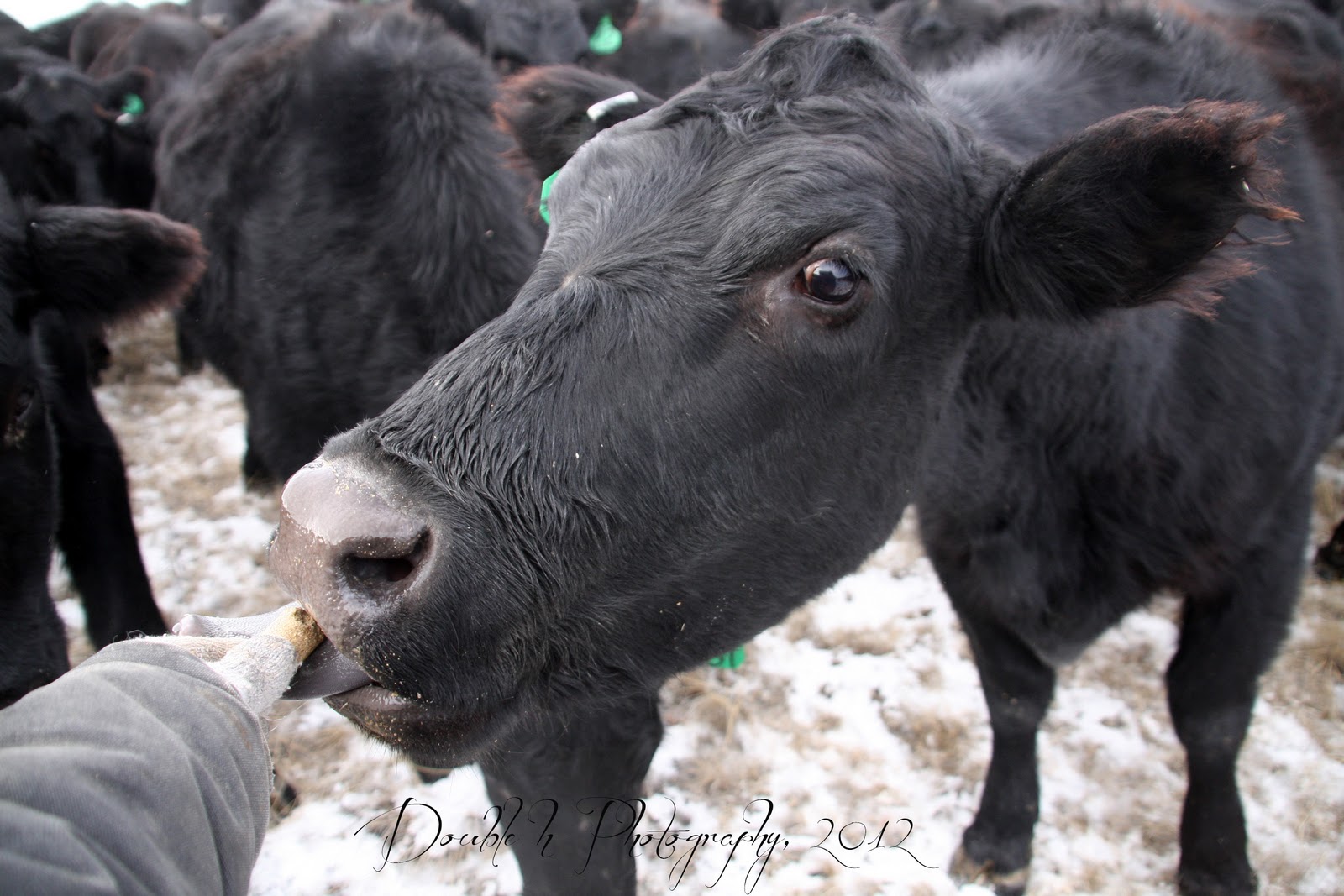
 As everyones favorite, she has also been given a little special attention, which she enjoys. Cows that will eat cake right out of your hand are called cake munchers, and Number 2 is one of our cake munchers.


And here she is with her first calf last spring, which will likely also be a Cow of Note when she grows up.
For more of our Cows of Note, you can go here or here.

Thursday, August 11, 2011

When Being Humane is Hard

Typically being humane to animals involves such activities as feeding, caring and managing them in ways that improves their well-being, and brings feel-good feelings to the person doing the actions. Ranchers are exposed to a lot of these feel-good situations since our lifestyle demands almost constant contact with animals, and we are continuously working to improve their health, performance, environment and anything else that presents itself. We thrive when our animals thrive.

But, not every instance of treating an animal humanely is a feel-good, everything's going to be great for the animal and us, situation. There are times when doing what is best for the animal is difficult, and lots of people shy away from these situations, or don't keep the animal's best interest in mind so they don't have to deal with the attached human emotions.

Ranchers are faced with these same scenarios, when what's best for the animal isn't going to be the easiest emotional choice for them as a person.


I, and later my entire family, was faced with such a situation last night. I was riding a colt, checking water and pairs, when I came upon a down (can't stand up) bull. He most likely got in a fight with another bull, and was shoved off a steep incline.


He was terribly, terribly dehydrated because of the summer heat in Wyoming. I gave him a critical once-over, and couldn't determine what was wrong. There was no swelling, visible broken bones, or other obvious visible signs of what was wrong. I jogged my colt home, grabbed a couple water buckets, and Holly and I immediately returned, and found the bull on his other side.


Can you see his back leg? Something is broken in there, and that's why he can't stand. I knew at that point he would never survive his injuries.


Now, some may rant that we should have a vet look at him, perhaps perform surgery, etc...


We didn't have a vet look at him because the diagnosis was obvious. I honestly do not know if a vet can even perform a surgery to repair a broken leg in a bull. Even if he could, he would never fully recover, and be able to survive in any sort of natural environment. Surgery would also be extremely cost-prohibited and the odds of success are very low. It's just a viable option in this scenario.


Holly and I hauled buckets of water to him by hand, until he had drank his full. Upon returning home I found out that my dad and brother would be home that night, so the responsibility of euthanizing the bull wouldn't fall on my shoulders. No rancher ever wants to put one of their animals down. We realize that we are raising livestock to be harvested for food, but we also care deeply for our animals, and do everything in our power to keep them healthy and thriving during the time we have them. It's also very sobering and sad to see any animal in pain, as this guy was.


I should also clarify that this bull was bought as a breeding animal, which means his primary purpose was not to be harvested for meat. We spent thousands of dollars to purchase him for his physical appearance, genetic potential, and several other criteria we carefully and thoroughly select for in each of our breeding animals. His injury was very expensive to our operation.


But, all emotional and economical investments aside, as the owners of this bull we had to do what was in his best interest. As I previously mentioned, he was not going to survive his injuries, and prolonging the inevitable was only to result in more pain and discomfort for him, and was unfair to him. Putting him down, as quickly and painlessly as possible, was clearly the most humane thing to do, if not the easiest.


So that's what we did. I pondered long and hard whether to share this story, because it isn't an easy one to absorb or understand. But this is the real world of ranching, and I believe people have a right to know the happy and sad aspects of my lifestyle, and the choices we make in order to always do what's in the best interest of the animals we raise, even when they're extremely hard on us.