Showing posts with label agriculture. Show all posts
Tuesday, March 19, 2013
My Favorite Things
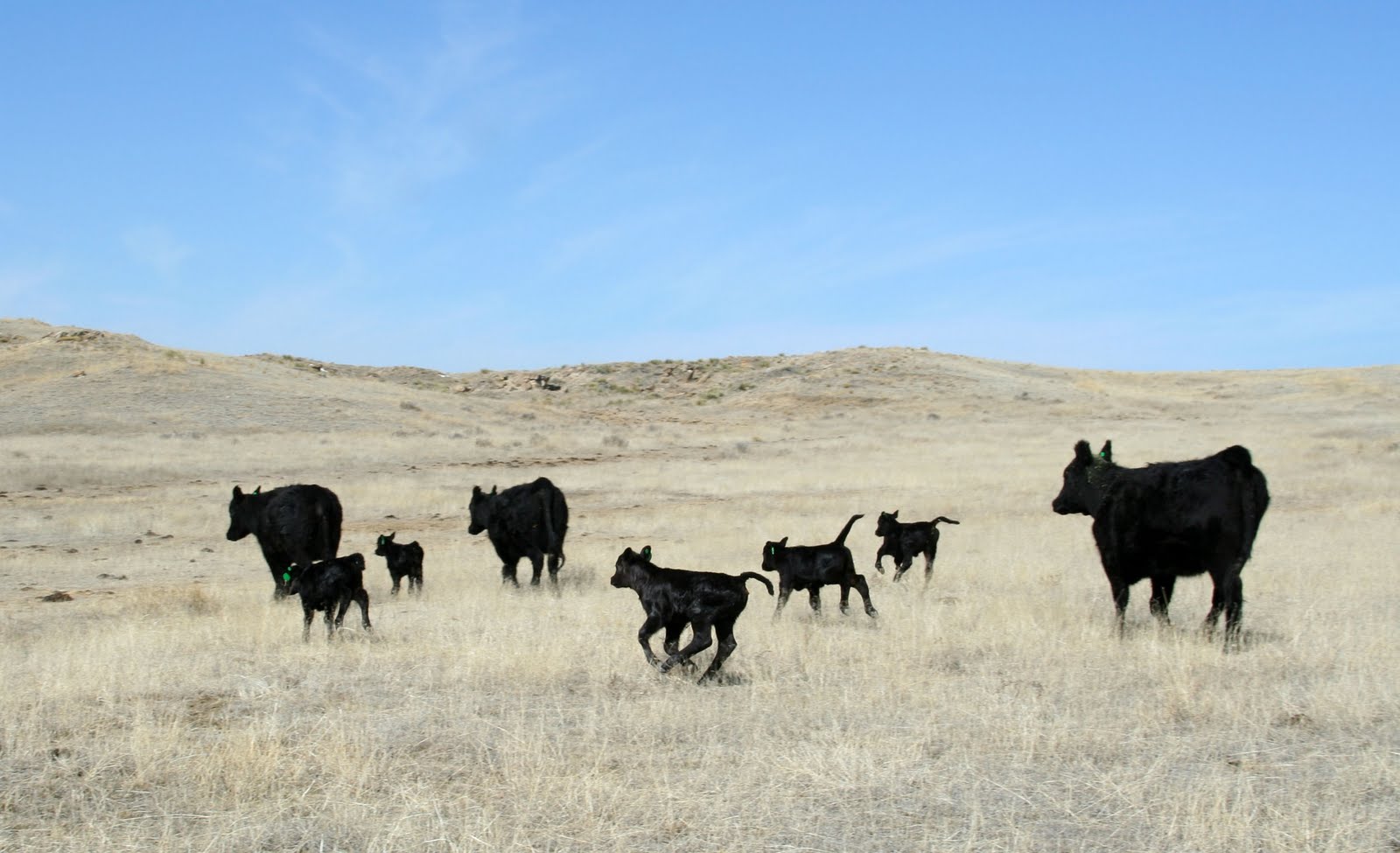
Guess what came to feed this morning?! Yep, the first three beautiful, feisty baby calves of 2013. Here comes one with his mom to check things out. Seeing the baby calves of spring is among my favorite things in life. Having three of them to oooh and aaahh over today was a perfect way to celebrate what is a big holiday in my world: National Ag Day. While I have a jam packed day of ag-related tasks that run the gamete from writing about the industry to feeding the cows that comprise it, I wanted to take a few minutes and share a few of my favorite things about agriculture with you in honor of this holiday. I have been trying to narrow them down in my head, so this post doesn't turn into a novel - we'll see how I do.
I love cows. From feeding them to working them to breeding them to excel and be among the best there are, I have what will be a lifelong fascination with raising exceptional cattle. From watching them trail into feed in the winter and mentally listing the traits they excel at, and what needs done to make them better, to marketing them and watching them exceed your expectations, to days like today, when over a year's worth of work sees its reward in the first new life of the year, there is an unending array of tasks and rewards involved in cattle production that is a key part of my family and I's happiness.
The land. When you're raised on a place, personally involved in improving and upgrading it, and especially when you know what those before you sacrificed, and that they worked harder than you'll ever have to work to give you the chance to have it someday, the land gets in your blood. I have helped build miles of fence that is close to perfect in post and wire spacing, put in numerous tanks and miles of pipeline to provide water and improve grazing, rebuilt corrals after the freshly weaned calves tore them down, bogged a horse down in a snowbank, saved numerous newborn calves lives and watched mother nature at her gentlest and most destructive on this land. You can't buy that, and while it would probably be easier in many ways if the emotional attachment wasn't there from a management standpoint, it's the connection to the land that makes us so good at what we do in many ways.
I love my family. I have the best family out there, and I hope all of you can say that with equal sincerity. They are God fearing, honest, hardworking people who lead by example and do a good job of it. They're perfectionists, and doing a mediocre job because of some excuse like it's a fence no one will see hasn't ever flown, or even flapped its wings, around here. They raised my generation to be nice, sincere and fair, to work hard and help people, to stand up for what we believe in and that no one can take our education away from us. They pray at every meal, and among my favorites is thanking God for putting us so close to his creation and giving us a job on earth that we love so much. It is often said in the middle of a pasture or corral, when we're covered in dust or mud, manure and grime, and it is said from the bottom of our hearts.
The people. In addition to my family, I also get to make my living writing for the people in agriculture. I meet new folks in this industry almost daily on the phone or via email, and they don't come any better. I've interviewed people while feeding cattle, calving heifers, and while stopped along the side of the road while shipping cattle, and have had the folks I'm interviewing take the time to talk to me in many of the same situations. I've sat at tables that hosted famous politicians, celebrities and outlaws, talked to families that can trace their history farther back that you know what to do with, and have been welcomed by all. They are the most gracious people I interview, and almost every one will go above and beyond what I'm asking about to make sure that this reporter that called understands the big picture in relation to whatever specific topic I called for. I love that.
I love the work. I love having the sun rise while driving or riding to gather cows, and I love that it doesn't happen that way every day. I love riding great horses, building good fence, watching it rain and the grass grow, completing annual tasks and having it go smoothly, seeing animals born, caring for an animal and having it make a full recovery, and writing about all the things that make this industry what it is. Even better is that sense of exhausted accomplishment that follows a day spent branding big calves, sheering ewes, installing a tank and watching it fill with no leaks, or riding all day and having your equally exhausted horse step out and stop that cow before she cuts back when you're almost to the barn. Agriculture work is hard work, but it's also the best work.
This is just a glimpse into what I love about this huge, diverse industry that ultimately feeds the world, which is another big perk of the job I do. I am very, very blessed, and very thankful to be a part of the ranching and agriculture industry. Happy National Ag Day!
If you would like to know more about agriculture in my home state, click on this link to get started.
Thursday, August 30, 2012
If you really knew me
I got this idea from The Farmer's Trophy Wife's blog the other day, and thought it was a fun. While this isn't an overly personal blog, it is fun to share a little more about myself from time to time. Plus, I enjoyed reading hers, so hopefully you'll enjoy reading mine.
If you really knew me....
You would know I hate eggs, especially over easy. My dad's version of over easy eggs is warm...and the reason I cannot eat one to this day. I ate plenty of them growing up because we ate what was served, period.
One of my great fears is having someone cook me an over easy egg for breakfast when I'm a guest in their home, and not having the ability to choke it down without gagging. Manners versus gag reflex...scary stuff!
Driving slow drives me nuts
I love coffee, have my own espresso machine, coffee bean grinder, assortment of coffees and flavoring syrups, and make myself a homemade latte almost every morning. Sometimes I make two.
I also love shopping. In the mall, at thrift stores, garage sales, little downtown shops. You name it, I'll shop at it, unless there is a support sign in the window for an anti-ag group, like PETA, Greenpeace, etc... Then you will not get my business.
I have one of the closest families you'll ever meet
If you really knew me...
You would know that I am shy and quiet until I get to know you, then, according to my family, I never shut up. Ok, they're right.
This shyness is more of a one-on-one thing. Speaking in front of crowds, lobbying, discussing agriculture issues with various groups and presenting speeches doesn't bother me. It used to, but doesn't now. However, carrying on a conversation with a single person is an area I can struggle with, and work on.
I largely attribute my ability to speak in front of people without being nervous to giving thousands of sets of livestock oral reasons.
I currently live and work from my childhood bedroom, while renting my own home located 2.5 hours away because I chose to leave a deskjob, return to the family ranch and start my own business over a year ago, and moving back in with the parents is about the only option when they ranch an hour from a town, and rentable house.
I love what I do, all of it (except being a landlord, I just love the check from that), beyond measure, and have never been happier in my life than I am right now.
I am complete home decor and furniture nut, and have tote upon tote of kitchen wares, decorations for every season, bedding, furniture etc... stored all over the ranch, impatiently awaiting the completion of our trailer house repairs so that I can move across the yard from my parents and into my own space again.
And, if you really knew me....
You would know I believe in God, without doubt, and my faith is very important to me.
My family prays together, for each other, at every meal, and at random times when we feel we need to
Being completely covered in dirt/mud/manure doesn't bother me a bit, but I despise getting grease on myself
That I never set out to be a writer, and that the Lord directed my steps to what I do today.
My boyfriend and I were set up by my relative/his friend, and neither of us was excited about being set up at first. We both got over it.
I have a critical eye for livestock, and will see what is wrong with them first
There you have it. Let me know if you decide to do your own, "if you really knew me." I would love to read it!
Labels:
agriculture,
coffee,
Double H Photography,
family,
God,
Heather Hamilton,
personal,
public speaking
Wednesday, August 22, 2012
This Industry
I've interviewed 12 people over the last few days, and visited with several more on the route that lead to those interviews. I've heard the personal accounts of how people across the western states are planning, working and striving to make it through this tough year, how they're recovering from the devastating fires that swept so much of the country in recent months and what their strategies are to survive what are sure to be more challenging months, and possibly years, ahead.
On a year that is setting record high temperatures combined with record low moisture, when the United States Department of Agriculture (USDA) publishes its support of meatless Mondays, when other government agencies including the Forest Service are telling producers in some areas that they won't be able to graze their permits next year either as a result of a fire that burned their permits this year, when corn is shooting through the roof and politicians are continuing to support its use in ethanol production (which costs more to produce than it makes in return...wonder why we're in a budget deficit), when the USDA is reducing meat in school lunch programs, when certain species of wildlife are placed at a higher value than livestock by the public, and when over a million acres have been burned in western states alone, killing thousands of head of livestock, wiping out homes and entire operations in some cases, I saw yet again what makes our agriculture industry so unique, wonderful and powerful in my opinion: God and the farmers and ranchers themselves.
There was resilience, hope, humor and grit surrounded by a solid belief in the Lord amongst the people I spoke to. It's humbling to visit with such people, who in a matter of minutes made my family's situation this year look plumb rosy in multiple instances. There were the stories of help provided by friends, family, acquaintances and in several cases those people who use private lands for recreational and hunting vacations. There were the stories of the sheer workload being taken on by landowners to recover from the effects of 2012, and the fact that I never heard any hesitation, complaints (except for how the government fights fire, which I agree with wholeheartedly) or excuses. Instead, I heard about action, plans, ideas, innovations and answered prayers. I also heard about continued prayers for those who did have to sell out and regroup. People spoke of how good we have it today compared to the 1980's or 1930's. Miraculous moments that occurred during some of the fires were explained, as was how the western cowherd is going to be fed this winter, not if. There was a resigned willingness to dig in and survive, come what may, combined with the ever-present hope you'll always find in agriculture that the weather will become perfect starting tomorrow and the government will back off, and that prices will reach a level we all have in the back of our mind. We are, and always will be the most optimistic pessimists, or most pessimistic optimists, you'll ever meet.
I am proud to not only be a part of this industry, but to be a part of its core; which are the people who raise the food and fiber that feed and clothe the world. The fact that I get to do a part in sharing the stories, ideas and news relevant to agriculture is just a bonus, and this has been a great week on the job for me!
Labels:
agriculture,
agriculture issues,
drought,
editorial writing,
prayer,
range fires,
USDA,
weather,
wildlife
Wednesday, March 21, 2012
Do you know: Where your food dollars go?
Did you know that farmers and ranchers received only 16 cents on average out of every retail dollar spent on food that was eaten at home and away from home in 2011? In 1980, farmers received 31 cents out of every retail dollar spent on food in America.
Off-farm costs (marketing expenses associated with processing, wholesaling, distributing and retailing of food products) account for 84 cents of every retail dollar spent on food in 2011.
Thursday, March 8, 2012
DOL Child Labor Law Revisions
Chad, from Texas, emailed me and asked if I would let you know what I know on the Department of Labor's (DOL) proposed changes to child labor laws. In case you don't know what I'm talking about, here is a link to what the DOL is proposing.
Or, in case you skip the link, here are some of the proposed changes:
The proposed updates include:
What I know may not be any more than you know on this subject, which is incredibly serious and potentially life threatening to many farms and ranches across this country. Basically, this is another attempt by our government to over-regulate its citizens so that they can drag us down to their preferred level of mediocrity through controlling our ability to work. It is ridiculous, frustrating, and completely shocking to me that anyone would even consider proposing these changes.
If you aren't familiar with agriculture, allow me to make a couple points. First, the family structure on a farm or ranch is rarely kids and their parents. It typically involves cousins, aunts and uncles, grandparents, distant cousins, and neighbors who you might as well be related to. Part of the proposed rule would limit a youth's ability to work with anyone but his parents, and maybe grandparents, on a farm or ranch.
Second, tasks like not being able to drive a tractor, not coming into contact with a bull, ride a horse, or be allowed to transport raw farm materials is comparable to saying your child may not come into contact with flour until he/she is sixteen if you own a bakery. Literally is at that level of overkill, with about the same amount of reasoning to back it as you can imagine they would have to keep kids out of contact with flour. Actually it is much the same thing, except it's contact with flour before it's in your kitchen.
I recently sat next to a man who is heavily involved in fighting this proposed rule, and he taught me lot on the subject. First, whoever came up with this idea knows something about agriculture, in his opinion. Why? Because they put the proposed rule out for comment on September 2, which is one of the busiest times of the year for America's farmers, and ranchers, in many cases. They knew our industry wouldn't have time to immediately respond as a whole because we were busy harvesting, weaning, etc... So, as we move forward with this, be aware that timely updates, any future comment periods, and other pertinent information is likely to be released at times when farmers and ranchers are exceptionally busy working, ironically enough.
He also said that one thing he hears a lot in D.C. is that it's okay, they aren't really going to enforce these, but just want to have them updated and current. Really, is anyone buying into that??? No. Don't worry, he isn't either.
He and I also discussed just how safe, or unsafe, our industry is to kids. He had a whole pile of great statistics that I cannot remember, or find at the moment. He mentioned that Hispanic youth who are part of immigrant working families are something like 50-75 percent less likely to suffer an injury working on a farm than they are if they move to an inner-city. So, gangs and other kids are far more likely to result in injury than driving a tractor or riding a horse. He also told me that the most dangerous industry for youth to work in based on data is acting.
In response to eliminating youth under 16 from operating almost all power-driven equipment, he quoted that stock car circuits allow youth to compete, at far greater speeds than a tractor ever dreamed of going, at significantly younger ages. In regard to a component that states youth are unable to manipulate cattle from horseback (ie, ride and move cows). His response is that numerous equine breed organizations, in addition to numerous youth organizations, host contests that prove otherwise.
I apologize for not remembering any more of the very interested and well thought out pieces of information this man had to the rule. The key points here are that there is a lot of data showing agriculture is safe for youth to be involved in, a lot of their proposed rules have no precedence when looking at facts and figures, and basically that it's as ludicrous from that viewpoint as it is from the more emotional standpoint producers often take. The man noted that as a part of the American Farm Bureau Federation, he is fighting on the facts and figures side of the fence, and leaving the emotional side of the battle to the producers.
You can read some additional information on how the ag industry feels about this issue at these links:
Article One
Article Two
Article Three
This is going to happen, in some form. The DOL has mostly ignored the thousands upon thousands of comments sent in by agriculture producers around the country. But, I do feel better after meeting one of the men fighting this rule face to face with our country's lawmakers.
As for the emotional side of this, here's my personal take. I grew up on an operation that included my parents, aunt and uncle and grandparents. We had a lot of work to do, and not a lot of help. So, at a very young age my siblings and I worked, and worked hard. We had our own horse, knew how to drive a manual pickup, the tractor and various other pieces of equipment, and held long hours some days. We were competent children that could be sent to complete a task, and would. Our level of success was questionable at times, but it was never for a lack of trying. I didn't just work with my dad either. On any given day I was as likely to be working under my uncle's supervision as my own parents. People also trade work (kids a lot of the time) with neighbors during certain times of the year.
This law, as currently proposed, would have significantly altered my family's ability to run our operation successfully, not to mention the impact it would have had on me as an individual. Those tasks taught me what work ethic really is, how to be self-sufficient, how to plan, implement and complete a task by myself or in a group setting, and how to work under and/or with a variety of people in both calm and high stress situations. A person's youth is the cornerstone to their adulthood, and lessons learned early tend to stick. I find it frightening to think out government doesn't want another generation to know how to work.
What can we do? There is still time to submit comments on specific sections of the rule, and several of the links I've provided have information on how to do that. I would also suggest contacting your state representatives, especially if they are unfamiliar with agriculture, and the impact this will have within the industry. You can also offer support, comments, and in some instances your time, through various ag affiliated organizations, including your state stockgrowers/stockmans groups, your state and the American Farm Bureau Federation (AFBF) and the United States Cattlemen's Association (USCA) to name a few. I know the USCA is currently looking for participants for their latest D.C. Fly-In, where you can travel to our nation's capital and meet and discuss current issues, like this one, with various groups and individuals involved in our government.
If you would like to send me an email at doublehphoto@live.com with your respectfully written thoughts, comments, personal experiences growing up, or anything else relevant to this rule, I will accept them and do a post of what everyone has to say in a week or so. My thoughts are we can't publicize this enough, through enough venues, using enough concerned people, in our attempt to get the federal government to see reason. If a few people do email me, I too will take the time to write up a much shorter something to include in the post.
Hope this helps Chad, and thank you again for writing me in regard to this issue.
Or, in case you skip the link, here are some of the proposed changes:
The proposed updates include:
- Strengthening current child labor prohibitions regarding agricultural work with animals in timber operations, manure pits, storage bins and pesticide handling.
- Prohibiting hired farm workers under the age of 16 from employment in the cultivation, harvesting and curing of tobacco.
- Prohibiting youth in both agricultural and nonagricultural employment from using electronic devices, including communication devices, while operating power-driven equipment.
- Prohibiting hired farm workers under the age of 16 from operating almost all power-driven equipment. A similar prohibition has existed as part of the nonagricultural child labor provisions for more than 50 years. A limited exemption would permit some student-learners to operate certain farm implements and tractors (when equipped with proper rollover protection structures and seat belts) under specified conditions.
- Preventing children under 18 years of age from being employed in the storing, marketing and transporting of farm-product raw materials. Prohibited places of employment would include country grain elevators, grain bins, silos, feed lots, stockyards, livestock exchanges and livestock auctions.
What I know may not be any more than you know on this subject, which is incredibly serious and potentially life threatening to many farms and ranches across this country. Basically, this is another attempt by our government to over-regulate its citizens so that they can drag us down to their preferred level of mediocrity through controlling our ability to work. It is ridiculous, frustrating, and completely shocking to me that anyone would even consider proposing these changes.
If you aren't familiar with agriculture, allow me to make a couple points. First, the family structure on a farm or ranch is rarely kids and their parents. It typically involves cousins, aunts and uncles, grandparents, distant cousins, and neighbors who you might as well be related to. Part of the proposed rule would limit a youth's ability to work with anyone but his parents, and maybe grandparents, on a farm or ranch.
Second, tasks like not being able to drive a tractor, not coming into contact with a bull, ride a horse, or be allowed to transport raw farm materials is comparable to saying your child may not come into contact with flour until he/she is sixteen if you own a bakery. Literally is at that level of overkill, with about the same amount of reasoning to back it as you can imagine they would have to keep kids out of contact with flour. Actually it is much the same thing, except it's contact with flour before it's in your kitchen.
I recently sat next to a man who is heavily involved in fighting this proposed rule, and he taught me lot on the subject. First, whoever came up with this idea knows something about agriculture, in his opinion. Why? Because they put the proposed rule out for comment on September 2, which is one of the busiest times of the year for America's farmers, and ranchers, in many cases. They knew our industry wouldn't have time to immediately respond as a whole because we were busy harvesting, weaning, etc... So, as we move forward with this, be aware that timely updates, any future comment periods, and other pertinent information is likely to be released at times when farmers and ranchers are exceptionally busy working, ironically enough.
He also said that one thing he hears a lot in D.C. is that it's okay, they aren't really going to enforce these, but just want to have them updated and current. Really, is anyone buying into that??? No. Don't worry, he isn't either.
He and I also discussed just how safe, or unsafe, our industry is to kids. He had a whole pile of great statistics that I cannot remember, or find at the moment. He mentioned that Hispanic youth who are part of immigrant working families are something like 50-75 percent less likely to suffer an injury working on a farm than they are if they move to an inner-city. So, gangs and other kids are far more likely to result in injury than driving a tractor or riding a horse. He also told me that the most dangerous industry for youth to work in based on data is acting.
In response to eliminating youth under 16 from operating almost all power-driven equipment, he quoted that stock car circuits allow youth to compete, at far greater speeds than a tractor ever dreamed of going, at significantly younger ages. In regard to a component that states youth are unable to manipulate cattle from horseback (ie, ride and move cows). His response is that numerous equine breed organizations, in addition to numerous youth organizations, host contests that prove otherwise.
I apologize for not remembering any more of the very interested and well thought out pieces of information this man had to the rule. The key points here are that there is a lot of data showing agriculture is safe for youth to be involved in, a lot of their proposed rules have no precedence when looking at facts and figures, and basically that it's as ludicrous from that viewpoint as it is from the more emotional standpoint producers often take. The man noted that as a part of the American Farm Bureau Federation, he is fighting on the facts and figures side of the fence, and leaving the emotional side of the battle to the producers.
You can read some additional information on how the ag industry feels about this issue at these links:
Article One
Article Two
Article Three
This is going to happen, in some form. The DOL has mostly ignored the thousands upon thousands of comments sent in by agriculture producers around the country. But, I do feel better after meeting one of the men fighting this rule face to face with our country's lawmakers.
As for the emotional side of this, here's my personal take. I grew up on an operation that included my parents, aunt and uncle and grandparents. We had a lot of work to do, and not a lot of help. So, at a very young age my siblings and I worked, and worked hard. We had our own horse, knew how to drive a manual pickup, the tractor and various other pieces of equipment, and held long hours some days. We were competent children that could be sent to complete a task, and would. Our level of success was questionable at times, but it was never for a lack of trying. I didn't just work with my dad either. On any given day I was as likely to be working under my uncle's supervision as my own parents. People also trade work (kids a lot of the time) with neighbors during certain times of the year.
This law, as currently proposed, would have significantly altered my family's ability to run our operation successfully, not to mention the impact it would have had on me as an individual. Those tasks taught me what work ethic really is, how to be self-sufficient, how to plan, implement and complete a task by myself or in a group setting, and how to work under and/or with a variety of people in both calm and high stress situations. A person's youth is the cornerstone to their adulthood, and lessons learned early tend to stick. I find it frightening to think out government doesn't want another generation to know how to work.
What can we do? There is still time to submit comments on specific sections of the rule, and several of the links I've provided have information on how to do that. I would also suggest contacting your state representatives, especially if they are unfamiliar with agriculture, and the impact this will have within the industry. You can also offer support, comments, and in some instances your time, through various ag affiliated organizations, including your state stockgrowers/stockmans groups, your state and the American Farm Bureau Federation (AFBF) and the United States Cattlemen's Association (USCA) to name a few. I know the USCA is currently looking for participants for their latest D.C. Fly-In, where you can travel to our nation's capital and meet and discuss current issues, like this one, with various groups and individuals involved in our government.
If you would like to send me an email at doublehphoto@live.com with your respectfully written thoughts, comments, personal experiences growing up, or anything else relevant to this rule, I will accept them and do a post of what everyone has to say in a week or so. My thoughts are we can't publicize this enough, through enough venues, using enough concerned people, in our attempt to get the federal government to see reason. If a few people do email me, I too will take the time to write up a much shorter something to include in the post.
Hope this helps Chad, and thank you again for writing me in regard to this issue.
Tuesday, November 15, 2011
Would you Work Differently?
Ryan Goodman, at Agriculture Proud, asked the question, How would you work differently if a non-farmer/rancher followed you around for a day?
My answer is nothing would change. Our success in the ranching business isn't based on what we do when someone is looking or watching. Our success is based on how we treat and care for our animals and land day in and day out, and we all know that.
This question was exciting to me because in recent months we have had the opportunity to have several people on our place. We had a good friend of mine from college who was here to record us and get pictures for her work with the Wyoming Stockgrowers (she was "the media"!). She happened to pick a day of preg-checking, and our cows were miserable that day (naturally). She saw that no one lost their temper, regardless of the cows being less than willing to work with anyone. She may have even got a couple choice words on her camera. But, it was interesting to see how a day of working frustrating cows highlighted so many positive things about ranching when you're there to see the entire picture.
We also give a talk on ranching to every single hunter that sets foot on our place, prior to releasing them to hunt. One group of dinosaur bone (that's a topic all its own) hunters happened to show up on a day when we were working our yearlings earlier this fall. I stood with the group at the fence and spent over half an hour answering questions, debunking myths, and reinforcing truths they had all heard. These people were from New York to Florida, and it was their first glimpse into real ranch life. The rest of family continued on with their tasks, and these people were fascinated with what they were watching.
As a media person, I have had the opportunity to be in the "following someone around on their operation" shoes many times. Several of these people had no idea I knew what end of a cow ate, and the vast majority of them were exactly as I've described my family. They put me right in the middle of whatever was going on, explained the hows and whys to each task, and were genuinely happy to have me around and explain things to me. They were also not about to put off preg-checking, shipping, weaning, etc.. (the animals always come first) just to visit with me.
These families would almost always invite me in for lunch, offer a place to stay if I needed one, tell me to please come back if I was ever in the area, and thank me for being there that day. The people in agriculture are amazingly hospitable, open and hardworking people, and that is another thing that doesn't change from day to day.
The only thing that is slightly different is the task at hand can take longer because we will take the time to answer any questions people have. We also always invite people in for lunch and conversation after the task. It has been my personal experience that when people outside agriculture actually do spend a day around farmers and ranchers, it's a very positive, eye-opening experience that goes a long way in showing them the truth about our industry!
Monday, June 6, 2011
Unforseen Opportunities
Today I was parked in the Fresh Start parking lot in Lusk, in our dodge diesel ranch pickup (picture single cab dodge, with hydrabed, one door a bright red, with the rest of the cab sporting an old, peeling silver) pulling our horse trailer, waiting impatiently for the numerous tourists to clear a path wide enough for me to get to the diesel pump. I had just picked my horse up from the vet, but that's a different story.
A little white Toyota backed up to the pump sporting the diesel nozzle just as the nincompoop in front of me finally gathered up his keys, unlocked his pickup, started it, sang three songs, drank a pop, called his mother, and finally finally left.
I was irritated, and getting annoyed less than ten minutes into my first run-in with the thousands of tourists that cruise through Lusk each summer. My attention was drawn to an obviously gay man/woman ??? who was throwing something away. From there it swerved to the slightly over middle-aged man who was power walking in the shortest man shorts I've ever seen, complete with slits up the side in case you couldn't see enough of his legs, and a skin tight bicycle shirt that showed he needed many more miles of power walking to make a dent in his rotund gut.
Then the occupants of the little white Toyota spilled out, and most headed inside the Fresh Start. But the driver headed my way after starting the fueling process (he didn't have far to go, as I was practically sitting on his bumper)
He asks if I have a horse, and I reply yes. He then asks if it will spook the horse if he looks at it, and I reply no it won't. He heads back to the trailer to peer in at Royal, who is as irritated with our delay as I am.
I decide I may as well speak to this person who I had to wait for before I could fuel up anyway.
I get out, and he asks why we're at the vet. This eventually leads to him asking if people still shoot horses when they're hurt, which leads to me explaining that not being able to harvest terminally injured horses is far more inhumane than putting them out of their misery, and a real problem today.
From there we wandered onto the topic of cattle, and he asked about ours. I tried to explain what we did, and I think I got through to him that the longer you keep cattle, the more money you have the potential to make, but the more risk you assume.
We also discussed ethanol, and I mentioned that feeding cattle was a much more expensive thing, due largely to corn prices skyrocketing, due to ethanol. I told him I didn't believe in making fuel and food compete, or having the government fully subsidize using a food source as fuel. I also mentioned that more energy is used making ethanol than is saved by running cars on it, and that it wouldn't work with all that government money.
He asked about AI'ing, noting he had heard people do that so the bull won't hurt the cow. We cleared up that, and explained that people typically AI to gain access to genetics they couldn't otherwise afford, and noted that a poor AI technician could do more damage to a cow than a bull would.
He asked about our grass fed cattle, and if we got a premium for them, what kind of cattle my family raised, where they were marketed, why we sold our sheep, and a few other questions. We dicussed that there is a lot of technology in agriculture today, and that our horses were working horses.
Then Jared, who grew up in Rapid City, but now lives in California, happily said goodbye, went back to his little white Toyota, and moved it. I fueled up and went home, feeling much better about my wait amongst the tourists.
You never know when and opportunity to educate people agriculture will present itself, or who you will meet in the process.
Labels:
A.I.,
agriculture,
corn prices,
ethanol,
horse slaughter,
tourists
Thursday, March 17, 2011
Hello
Hello hello. I have had several new people follow and comment on my blog in the past few weeks. Thank you all so much! I've enjoyed hearing from you, and about where you're from and what you do. I've been to several of your blogs and loved reading your stories and looking at your pictures as well.I recently saw a post where a girl went through the ABC's to describe herself. She had great little questions for each letter, and I didn't save it and can't find it again. But, I thought the idea would be a relatively quick and easy to tell you a little about me if you're new to reading this.
A- Agriculture. It's how I was raised and encompasses my life, as it has generations of my family before me. It's also the primary focus of this blog.
B- Blonde. I'm a natural blonde. (you can take that any way you wish)
C- Cattle. I love cattle, and am especially fascinated with genetics and using them to improve cattle. I head up anything regarding genetic selection on our operation, and raising cattle is my favorite thing to do.
D- Dogs. I have two, a mini Aussie named Emmie Lou and a mini Dachshund name Pearl.
E- Expectations. I expect a lot out of other people. But, no matter who you are and what the situation is, I always expect the most out of myself, in every instance.
F- Family/Faith. I have a very strong family. We are a great team and love and support each other through everything. I also believe in God wholly, and know, without a doubt, that the only way I've achieved what I have is with God's help.
G- Government. I am very conservative, and believe less is more when it comes to government. I also believe if you want to run for president you should have served in our military. If you want to be in charge of our country you should be willing to fight for, and die, to protect it. I also have no sympathy for people who complain about government, but who don't vote. This is the only place in the world with this form of democratic government, if you don't like having that right, feel free to move somewhere where it doesn't exist.
H- Heather Hamilton. That's me, and the name Hamilton encompasses a lot of hard working, ambitious people that I'm proud to be related to. I have a family that keeps track of their history, and we can trace our ancestors back to before they came to America, and tell you what they did, and how we came to be where and what we are. It's fascinating to know where you came from in my opinion.
I- Impatient. I do not have patience.
J- Journal. I keep a journal so I can remember what I've done, where I've been, who I've met and what I've seen when I'm not living this sometimes fast-paced life I currently have. It's just a short entry each day, depicting the days events, and I would recommend trying it. I enjoy glancing back through it from time to time, remembering trips and people.
K- Kids. No, I don't have any, yes I do want them, someday. I would like to have a big family in the future, and, in typical girl fashion, I have names I picked out for both boys and girls.
L- Lattes. I love lattes. Not black coffee - lattes. I have my own (cheap) espresso machine, coffee bean grinder and syrups, and make my own pretty much every day. Making your own is considerably cheaper than making a trip to Starbucks every morning, and I enjoy trying different kinds of beans and syrup flavors.
M- Music. I love music and am much more likely to have music playing instead of the tv at my house. I listen to Texas Country a lot. I also enjoy modern and older country and rock. I listen to the more pop/rap stuff when I'm running. My favorite instrument is the piano.
N- NyQuil. I have an awful time sleeping, especially in town. This is my go-to nighttime sleep aid, when I choose to take something.
O- Occupation. My jobs include being the assistant editor of a statewide weekly ag newspaper in Wyoming, my photography business, and working on the family ranch. Certainly keeps me occupied most of the time.
P- Photography. I truly enjoy it, and after cattle it's my favorite past time. I literally have a camera with me 24-7, except when gathering cattle on a horse.
Q- Quarter Horses. I have two horses, and enjoy using them. I do not trail ride, or anything like that. However, some of my favorite activities include sorting pairs and moving cattle horseback.
R- Reader. I love to read, especially fiction, and anything that deals with cattle reproduction or nutrition.
S- Short. I am 5' 2 1/2" tall, and I am quite proud of that extra 1/2' - at my height you have to take every little bit you can get : )
T-Thrifty. I enjoy thrift store shopping, and hunting for that perfect piece of furniture or decor at a fraction of the cost new. I also enjoy antiques, and other old items, which adds fuel to the fire in this area. While were on it, I pretty much love shopping in any form.
U- University of Wyoming. This is where I got my bachelors degree, in Animal Science.
V- Vacation. Yes please! I've been all over the U.S., to Canada once and Mexico twice. I love to travel and see new places and am hopeful I can plan a trip to somewhere new sometime this year.
W- Wyoming. This is where I was born and raised, and I love it here. As mentioned, I've traveled a lot, and lived in other parts of the U.S. I feel it's important to be well-traveled, to make sure where you end up is where you belong. I've enjoyed seeing many new and exciting places, but this is, and always will be, home.
X- hmm...how about my mom's family. Another example of a hard-working group of people. My grandparents did everything from own trailer courts, gas stations and an excavating company to managing and maintaining now famous ski resorts in Colorado. My grandpa is also a veteran and worked as miner for decades, and my grandma was the secretary at the high school.
Y- Yacker. My dad says my sister is just like me, she gets going and just, "yacks, yacks, yacks." While I'm not that talkative if I don't know you, or around a big group, I talk a lot around my friends and close family, and get teased about it regularly.
Z- I've got nothing, but since it didn't make it anywhere else I would like to mention I am one of those people with lots of acquaintances, but very few really close friends. My best friend is like a sister, and I'm so blessed to have her in my life.
Labels:
agriculture,
cattle,
family,
friends,
God,
Horses,
music,
Photography,
Wyoming
Tuesday, March 15, 2011
National Ag Day
If you want to know more about National Ag Day, you can go here.
If you want to know more Wyoming agriculture, and what we do, go here.
Monday, January 17, 2011
So, there I was...
If you can rattle off the rest of that saying, as told at LCCC in the mid 2000's, at least I gave you a chuckle on your Monday morning.
But, I was actually going to say there I was, at the bar, in the Renaissance Hotel, eating dinner and having a couple rounds during my stay in Denver for the ILC and Stock Show. I don't care for eating alone in restaurants all the time, so I often take in meals at hotel bars.
I'm also pretty shy if I don't know you. I'm still opinionated, but it's hard for me to just waltz into a room and leave with a whole new group of friends...just not that girl.
Anyway, that being said, the bartender made idle small talk with me as I ordered, sipped my drink and ate my Flat Iron Steak. He fancied himself a writer too, and between comments on how very, extremely, seemingly painfully young I looked (I got it after the first statement he said when looking my ID....really I did) he explained his fascination with the written word.
I was bored out of my mind - sentence structure and verb placement conversation will do that to me - and consuming my steak at record breaking pace for a leisurely dinner, to be followed by an evening of doing nothing.
Then a middle-aged business man sat down next to me. He asked what I did, and I gave my standard response of working for a state-wide weekly ag newspaper in Wyoming, running my own photography business, and that I have cattle. God bless him for skipping over the writing part almost entirely, and zoning in on the cattle/ranching aspect.
He asked questions, and I answered - for almost two hours. He was proud that his family had farming background, a couple generations removed. He asked about feeding cattle, breeds, sizes, male vs female, etc...
I was in my element, and explained away. Like I said, I'm shy, but you get me rolling on cattle and I can be your new friend...just stay away from adjectives and Charolais and we'll get along fine.
We covered everything from the always popular, "do you ride horses?" question, to more detailed ones regarding why his steak isn't always good when he goes out to eat, and use of implants in cattle.
Two hours later I jumped off my bar stool...staggered a little as the drinks were a little stiffer than I had realized...and headed to my room.
Before leaving, the man enthusiastically stated that our conversation was the most interesting bar conversation he'd ever had.
Did he believe every word I said..no, he told me so a couple times. But he listened to my reasoning, and I listened to his, and we both learned a few things. He really wanted to know about agriculture, and when I was able to explain things, and back them with real life experiences, science and statistics, common sense, or a combination of all three, he got it for the most part.
You just never know when the opportunity is going to rise to tell your story.
Friday, January 14, 2011
Death
In my last post I commented on the topic of livestock owners being kind and compassionate to their animals. I received some feedback arguing the point that killing animals is actually cruel and in-humane.
I personally separate the raising and death aspects of agriculture into two different areas, but have realized not everyone does.
So, I'm back today to cover the death/killing part. Yes, it happens. Cattle, sheep and other livestock species are raised to be harvested for food. Any meat you eat did come from an animal. They don't "make" meat at the grocery store.
I believe we as humans are charged with caring for animals, and that we also have dominion over them. This is stated in the bible, starting in Genesis, Chapter One, continued in Leviticus, and repeated again in other chapters and versus.
For example:
Leviticus 11:1-3
1 The LORD said to Moses and Aaron, 2 “Say to the Israelites: ‘Of all the animals that live on land, these are the ones you may eat: 3 You may eat any animal that has a divided hoof and that chews the cud
From the New International Version.
That's where my perspective is based. That's why I believe it's okay to raise animals and harvest them for meat. That's why I don't believe in vegetarianism, or veganism, or any other -ism that doesn't believe in meat consumption.
As for the actual part in the process where animals are killed. A vast amount of time, energy and resources have been invested to to ensure the practices used cause the least amount of stress and pain possible for the animal. You may have heard of Temple Grandin, who is one of the most well-known people involved in improving harvesting methods. This is something we're constantly working on and improving. We don't want them to suffer any more than is absolutely necessary.
But, the ultimately, in order to get meat, death occurs.
What would happen if it didn't? What if we let all animals live to a ripe old age, and die of natural causes? This seems to be the most common alternative presented to how animals are managed today.
First, there isn't enough land, grass, hay or grain to feed animals if that situation was allowed to perpetuate. They would starve to death. Even if every person in America tore down their house and moved into high rise apartments and reduced their land footprint significantly, there wouldn't be enough to feed the animals. Personally, I believe that starving to death is a much more gruesome, and in-humane way to die than a quick, almost painless death.
Second, as a species becomes overpopulated, the instance of disease becomes much more prevalent, as do disease carrying bugs, parasites, viruses and bacterias. Again, while the idea of letting everything just live without any management sounds "nice," the reality is that all livestock species would become much more susceptible to disease. This is another thing that doesn't sound very appealing to me when it comes to a way to die. Some diseases can take years to die from, and have serious and painful side effects. Some of these diseases could also be spread to humans much easier, and faster, without the management methods farmers and ranchers keep in place.
If this sounds a little far fetched, consider the parts of the world that overpopulated with humans. Think about the people that starve without food, and the diseases we've haven't in seen America for decades that are still serious threats.
Third, while the idea of not eating meat, or using any animal by-products may also sound "nice," to some, there is more to it than that. There isn't enough plant-based material in the world to feed the human race for one thing.
Some present the argument that people could eat the plants that animals do. That's incorrect, as most of the plant-based materials animals eat, and convert to meat, are indigestible to humans. We lack the ability that animals with a ruminant stomach do at converting them to energy. A cow can eat grass that you or I couldn't get any nutritional value out of, and she can convert it to pounds of meat, which we can eat, and meet our nutritional needs with.
The other side of that statement is that if we are eating all the plant-based materials, what are all the animals we are no longer raising for meat eating?
Fourth is the cost of almost everything you use daily. Did you know animal by-products are in everything from tires to glue to toothpaste to makeup? Adding animal by-products to some plastics help them bio-degrade faster. If animal by-products weren't used, these and countless other everyday items could go up in price, some significantly.
98 percent of an animal is used, and of that percentage between 55 and 60 percent is usually meat. So half of each harvested animal goes into products that aren't meat.
I don't like the thought of animals dying, but I realize it is a necessary part of life. Myself, and other ranchers do everything in our power to keep our animals happy and healthy during their lives, and we also do everything possible to make their death as quick and painless as possible. The alternative to modern agriculture practices are much more painful, harmful and hurtful to all livestock species in the long run than those we currently use to provide our consumers with the safest and most nutritious meat product in the world.
Labels:
agriculture,
Animal care,
animal cruelty,
animal slaughter
Friday, December 31, 2010
Most Popular
I am very surprised, and happily so, that my blog received 458 views in December. I really appreciate everyone who reads my stories and looks at my pictures on here. I have met and emailed a few of you that I didn't know previously, and have thoroughly enjoyed getting to know you!
In case you were wondering, the most viewed blog post to date is:
Preg Checking
Number two is:
Going to the Forest
The vast majority of the people reading this are from the United States. But I've had people from Croatia, Brazil, all over Europe, Canada, and a few other places. Hello to you all : )
As we enter 2011 I want to let everyone know I'm open to suggestions, ideas, questions and comments. If there's something I've covered you want to know more about, or didn't understand fully, let me know and I'll be happy to go more in depth.
If you have a general question about agriculture, food, cattle, or anything else you think I might know about ( if I don't, I'll look into it, or find someone who does for you to visit with), email or comment me and we'll figure it out.
Whether you do, or don't, know about agriculture and have a topic you think should be covered on here, let me know about those too, and I'll add them into the mix.
The purpose of this blog remains the same - to show the true story of agriculture, and provide accurate information on ranching and agriculture from the perspective of someone who lives it.
Of course there will be a little personal information mixed in from time to time to keep things interesting and help explain why I'm going here or doing this, and to show you there are a few things that hold my interest outside the world of raising cattle.
It's a wonderful life and I am very blessed! I look forward to sharing more of it with you in 2011!
My email is doublehphoto@live.com
Labels:
2011,
agriculture,
blogging,
Brazil,
Canada,
cattle,
Europe,
food,
forests,
information,
Preg Checking,
public grazing
Tuesday, December 21, 2010
The cost
End of the year finances seem to be on everyone's mind these days, and people in agriculture are no different.
I often receive comments from people outside the ag-industry saying I must be very rich, because I have a ranch. A lot of people assume if you have a ranch, or cattle, you must be wealthy, in a monetary sense.
This is not the case, not even close.
Yes, we receive $500+ dollars per calf, or $1,000+ plus dollars per yearling. When you multiply that out by 200, 300, or 600 head, it's a big number.
But the other side of the coin are all the expenses that go into raising a $500 calf, or $1,000 yearling.
First there's the land you're running them on. Most ranchers pay for their land with their livestock. When you look at land prices, especially today, you will quickly see where a big chunk of the money goes.
For example, if you're paying $250 an acre for land, and it takes 30 acres to run one cow and her calf for a year, you just invested $7,500 into enough land for one cow. Now, multiply that by the 200, 300 or 600 cows you're running, and that's also a big number.
There are those that have their ranches paid off, and don't have that expense, but often times those producers expand, and incur another land payment.
Then there are the actual cattle. They aren't free either, and you have to pay for them. Some people inherit their cattle, and some have to buy into the family business. Others have to start from scratch, and cattle cost money for us too.
You're going to be buying heifers or cows, and today that means laying down around $1,000 a head for a young cow. Heifers will be more, and short-term cows less, but that's an idea of what it costs to buy into the cow business.
Then don't forget you have to buy bulls, or add an AI program, and bulls are typically over $2,000 in this part of the world. It takes one bull per 25 cows on average, and a bull will last four years, tops. So if you have 300 cows, you will be spending $24,000 in bulls every four years, minimum.
Then there are what we call "operating costs." These are the costs ranchers have for a year of production. They include everything from feed, vet expenses, transportation, labor, etc...
These aren't cheap expenses. Corn has almost tripled in the past five years due to competition with ethanol demand. Transportation costs are rising for us just like everyone else. Vaccines, and other medicines are also expensive. I just bought a bottle of pour-on to treat some calves for grubs, worms and other parasites. A bottle that will treat 50 head cost $240.00.
We add all these costs up, and divide them by the number of calves, or yearlings we're selling, and that's how much each animal needs to make us to break even.
People in ag know all about breaking even, and not breaking even, and usually know within a few cents what their break even is on a given year.
Cows makes us money through her calves. As I've mentioned previously, it takes about 7 years for a cow to pay off all the expenses she will generate in her lifetime. The average cow lasts about 10 years where I'm from, so that means she is making you money for 3 of her productive years, and the first seven you essentially owe money on her.
Then there's fact that some of your cows, and some of your calves will die. This is listed as deathloss, and included in the calculations. Some cows don't breed back either, and if she is under 7, you probably lost money on her.
Add everything up, do a little division, addition, subtraction, and other basic mathematics until your head is swimming, and the average return on investment in agriculture is 3%. The average return on investment in everything else is closer to 6%.
We take half the average to raise livestock, and live the lifestyle we do.
I am in no way complaining, just showing the way things are.
I wouldn't change to something I could make a 6% percent return on if I was given the chance.
But this is why seemingly large-scale ranchers usually aren't rich, in a dollars and cents way. It takes a lot of cows, or sheep, or hogs to make 3% a large enough number to live off of, let alone expand, or put a kid through college...
Another aspect is we get paid once, or twice a year, and have to budget and make that money last an entire year, regardless of any unexpected expenses. There is no 2 week paycheck in ag. You get a check when you sell your calves, yearlings, or other commodities.
A lot of producers diversify their operations and find ways to market different products at different times of the year to increase the number of times they have income.
But we're still talking about four or five checks a year, and that money has to last through whatever might happen until you sell your livestock the following year.
So, the answer is no, I am not rich because I have a ranch in my family. But, if you get past the money part, then the answer is yes, I am rich to have a ranch. It's really all in how you look at it.
: )
Wednesday, December 15, 2010
Important Issues
During the WSGA Winter Roundup, there were a number of general sessions, committee meetings, presentations and discussions about a number of important and relevant topics to agriculture in Wyoming.
The governor elect, Matt Mead, spoke during one lunch session, and updated attendees on what he's been up to, and some of his plans upon taking office.
In very few states is the governor known by almost the entire population. With our small population in Wyoming, we have the unique ability to know and talk to our governors. While I voted for the other Republican candidate, I do look forward to getting our current governor out of office, and agree with Mead on some of the big issues.
The brand meeting covered the topic of using g-forms to take cattle to the Crawford sale barn. This is a topic I'm heavily invested in, as my family is for this idea. We market cattle in Wyoming, South Dakota and Nebraska, and having the option to go to Crawford on a g-form would simplify the process for us. It would save the brand board money, and as we primarily market cull cows at that auction, and it costs a lot of money for a brand inspector to drive out to our place to inspect a handful of cows.
While I'm on my brand board soapbox, I would also like to state that I personally believe the brand board should be elected, not appointed as they currently are. Their job is to represent the brand holders of the state, and I don't think they do that at all. There is no fear of not being rel-elected, so they all take up their personal causes and don't get anything accomplished at their meetings. They also fail to listen to the producers the majority of the time, and as a result of that don't accurately represent the wants and needs of Wyoming's brand holders.
Back on track now that I've let you know how I feel.
During the brand meeting the idea of an in-state beef checkoff was discussed, as there is proposed legislation to make it possible. Personally I feel like we already pay more than enough to different programs and causes every time we market animals, but very few go directly into advertising and promoting our product outside our industry. The Check-off does this, and they take up the slack so many ranchers don't have the time to do when it comes to telling the positive story of beef and ranching. So, while I would want to know how the money will be spent, I am not opposed to pursuing the idea of in-state Check-off.
During a water meeting I heard a heated discussion on proposed temporary in stream flow legislation that would allow producers to be compensated for not using water for irrigation for a set period of time each year.
The issue is that right now, if one producer doesn't use the water, the next guy on the water rights list can use it. (I think, feel free to correct me as my knowledge of irrigation and water rights is very limited)
This legislation would keep the water in the stream and not let it be used by anyone else if the original producer sold their rights into the temporary use program. The problem with that is if water isn't used higher up the stream, the ground water and aquifer supplies aren't re-filled, and pretty soon there isn't any water in the stream. Water rights and appropriation of those rights is a really big deal to a lot of producers, and having access to water that is left over from other producers is often the difference between having a hay crop and not having one on any given year.
The WSGA took a "strongly opposed" stance on the bill.
A Progressive Rancher Forum on Tuesday covered topics ranching from genetic selection in your cow herd to winter nutrition, to market diversification.
A lengthy talk on estate planning tools included a panel of producers from around the state who spoke about their personal experiences in transferring a ranch from one generation to the next. Those of us in agriculture are very negatively impacted by the death tax, and if we don't do very extensive planning we can easily lose our entire operation just from paying the inheritance tax. People are really starting to work on this issue, and learning what does and doesn't work.
I also attended the annual banquet this year, and had a great time drinking and visiting with new and old friends, including a good friend from college who is one of the ladies who puts the whole thing on!
It wasn't all work and no play : )
This is just a brief glimpse into a vast amount of information that was disseminated during the two-day event. While I completely understand being too busy feeding cows in a snow bank this time of year to be able to attend all of these meetings and conventions, I feel it's important to keep yourself educated on current events, especially those that have a direct impact on your way of life. Being well educated also helps in taking an active role in preserving, protecting and enhancing the agriculture industry and lifestyle, which is becoming increasingly important in today's world.
Labels:
agriculture,
brands,
current issues,
politics,
water rights,
WSGA,
Wyoming
Tuesday, September 14, 2010
Busy fall
I am sitting at a meeting just south of Buffalo right now, taking notes for one or two Roundup articles. I was late to the meeting because I misread my map and thought it was just outside Kaycee...not Buffalo. An extra 40 miles down the road I arrived, and just finished an interview to cover anything I may have missed.
It has been a hectic couple of weeks, with no signs of slowing down. Christy is in Pendleton, OR for meetings and the rodeo. I am so glad this trip has arrived and will soon be over. Originally Christy and I were both going, then it was just me going for several months, then out of the blue Christy told me she was going and I was staying. Her fiancee will be joining her later in the week and I'm sure they will have fun.
Last week I was in Fremont County for two days interviewing people for our Fall Cattlemen's edition. Then I went to Wheatland to take engagement photos Saturday morning. From there I drove to Keeline (which is 60 miles from my parent's house), where I met my dad and brother to gather a couple stray yearling steers. It was good to be on a horse again, riding with the people I enjoy most.
Sunday we did a little more riding and some corral repairs. Bright and early Monday morning the whole family drove back to Keeline and gathered the steers for delivery.
A hectic morning later we finally got everyone loaded and the check written. I found out that when someone stole some of our calves earlier this spring they took two of mine instead of just one, as originally thought.
I left the yearling gather and headed back to Casper. About 10 miles out of Casper I had a rear tire explode and got to change it on the side of the interstate. A very nice man stopped to help, which made it go faster.
I arrived at my little house and noticed it sounded like water was running somewhere. So I crawled under my house and discovered a small hole in my main water pipe. I called my dad and scheduled a repair appointment for today. So last night was spent with no water as I had to turn off the main line into the house...
Which brings us back to this morning. After the next session of this meeting I will leave early and head back to Casper to help my dad with the water line repairs. If we have time I will then take the parents to look at one of the vehicles I recently test drove and am considering buying (in a couple months, since my cattle check is much less than originally anticipated, thanks to the worthless thieves)
Tonight I will be writing some articles for this weeks paper and making several phone calls. Tomorrow will be spent in the office catching up. Thursday I will be driving back to Fremont County and attempting to get 4-5 interviews done for the Fall Cattlemen's Edition. I may also interview someone involved in the Nature Conservancy, which I am less than excited about as that organization does not support production agriculture. I have a very hard time writing about people or organizations that have a negative impact on my industry and who take land out of production. I am hoping all my Fall Cattlemen's people follow through and Christy gets to interview the Nature Conservancy idiot...er individual.
Sorry, off my soap box and back on track...Friday will be spent in the office making sure the paper gets out without a hitch. This weekend I will either be going home to ship sheep, or transcribing notes and editing both senior and engagement pictures at my house in Casper. I am hoping to be in Casper, as my plan for that option will possibly get me caught up for next week...which I haven't even looked at yet for fear of being overwhelmed.
Labels:
agriculture,
newspaper,
sheep,
travel,
Wyoming
Friday, May 14, 2010
Deportation
Yesterday Axel was deported. Well, the process started a few weeks ago, but yesterday he boarded a plane for Germany with a one-way ticket.
Today he would find a way to strangle me if he knew I was writing this, with a photo that includes sheep, but that's just too bad.
Axel was born in Germany, or Austria, he is from right on the boarder somewhere. But for the entire story we need to go back in time even farther.My grandparents got involved in an ag. exchange program based out of Chicago several decades ago because they knew the guy who started it. The program brought young men from Germany to the U.S. for one to two years to learn about American agriculture.
My family hosted several of these young men and some great friendships were formed. We have some amazing and hilarious stories about our experiences with them.
Axel is the son of one of these original exchange students. Several children of the original students have been to the U.S., either on vacation or to work for a couple years. One man (maybe Axel's father?) requires all of his children to visit America for a period of time.
So, about 10 years ago a young Axel (around 18 at the time) arrived at my grandma's house to work for our family and learn about America. You could barely understand him and as a 14 (or so) year old at the time he was unique, to say the least, to my cousins, siblings and I.
Since then he has become family, that's the easiest way to put it. He's one of us now. He's worked for my uncle for the majority of his time in America. But he also went to college, first in Sheridan, then at the University of Wyoming and has an associates and bachelors degree.
He's worked for a number of other people across the state and knows everyone. He is my grandmother's 5th grandchild and she fusses over him to the point of irritation.
He is everything you think a German would be. Tall, stout, blonde haired, blue eyed and argumentative. He likes to bark orders at people and would run right over you if you allowed it, but he also has a very nice side, so he would probably gruffly apologize afterward. He can also been seen carrying my grandmother's purse, baked goods and dog regularly (obviously he's all bark) Very sharp and opinionated with a face he almost always tries to keep scowling, but he often fails. He eats oatmeal with cold milk (as in uncooked) and yogurt and coffee when he isn't within distance of my grandmother's cooking.
He hates my horse, teases me about my dogs, complains that my grandmother and I are the most stubborn women on the planet and will never see reason. He also started a bible study group while we were in college together, loves his horses and dogs and truck (all of which he had to sell) and gets up at irrationally early hours.
He has always wanted to be a cowboy. This isn't an easy title to get in my family, but he is one today. Since day one he has been thrown into the mix of riding, doctoring, fencing, farming and everything else involved in ranching both in the Black Hills and on the eastern plains of the state. For the last year he has been in charge of several thousand yearlings on the Laramie plains. To me, a winter spent on the Laramie plains qualifies you as a cowboy in most cases. We often say it either qualifies you or cures you from wanting to be one.
He loves America, he pays taxes, is honest, believes in God and is, in my opinion, the perfect candidate for a Greencard.
But he can't get one, and this is at least in part his own fault for not pursuing some options to obtaining one. He made a couple mistakes there. But then I see that these car bombers from Iraq, Afghanistan and other countries that hate America seem to get their Greencards approved by the dozen and it ticks me off.
Here is the type of individual that can positively enhance our country and he is thrown out while at the same time individuals of obviously questionable character are welcomed with seemingly open arms.
I know God is in control and there is a reason for this, but I still find it frustrating.
Labels:
agriculture,
America,
family,
Germany,
immigrants,
travel
Thursday, April 22, 2010
40 ag-related Earth Day practices
Happy Earth Day! It's the 40th anniversary of Earth Day this year and I've read some wonderful stuff earth and agriculture today. One that stood out was 40 things ag does that are great for the earth. Thought I would make own attempt from a beef producers standpoint. So here are 40 things ranchers where I'm from do that are beneficial to the earth every day!
1. Utilize grass, which is indigestible to humans, and feed it to livestock to create a safe, wholesome product that helps feed the world. 85% of U.S. land is unsuitable for crop production, and ranchers use this land to raise livestock and help feed the world.
There, that should cover it :)
Just kidding, I can think of more
2. Recycle. Everything from old rubber tires being used for tanks to saving absolutely everything and finding another use for it. Ranchers have been doing that for decades. You just try to throw away a plastic sac, container, old pair of jeans etc.. that my grandmother has laid her eyes on.
3. Preserve open space. This is very important to the survival of countless plant and animal species.
4. Protect and manage water resources. Ranchers implement progressive, thoughtful water management on their operations that not only benefits their livestock but many plant and wildlife species too.
5. Pick up after themselves. Man I don't like rolling old, rusty barbwire, but keeping the land clean is important.
6. Utilize pesticides and herbicides in a safe, practical manner to control plant and animal species that have a negative impact on the land, livestock, wildlife and people they come into contact with.
7. Poison prairie dogs. I hate prairie dogs with a passion. They compact soil, spread disease, prevent grass from growing and just destroy range land in general. Their holes provide homes for snakes and spiders and are a potential hazard to livestock who can break a leg in them. I really hate prairie dogs.
8. Manage for other problem rodents and predators to protect livestock and vulnerable forms of wildlife.
9. Utilize wind power. Wind mills have been around for a long time and are still used extensively in the west to secure water.
10. Utilize solar power. A growing number of producers are utilizing solar power for a variety of purposes including water, electric fences and power.
11. Implement grazing systems that maximize efficiency. This requires less feed and encourages the growth of higher quality plants.
12. Feed by-products. One example are distillers grains, which are the leftovers after alcohol production. Feedlots and ranchers feed this grain product to cattle, it would otherwise be useless waste.
13. Feed all sorts of stuff that would otherwise be waste. Last year I met a guy whose family raised and sold watermelons commercially. Cool huh? Well, when they were done harvesting a field they would turn cattle in to eat any melons deemed unfit for sale for any variety of reasons. He said cows quickly learn to smash the melon with their head or foot to get at the good part.
14. Use eco-friendly vehicles. Did you know that making an electric car takes more energy than you will ever save by driving it? Ranchers use horses a lot, and the only gas they need comes in the form of grass and maybe a few oats.
15. Ranchers help feed the world and the entire U.S. cattle herd accounts for less than 3% of carbon emissions.
16. Taking an environmentalist stance, as can be seen over at Belle of the Blog and doing all the things that are deemed environmentally friendly by the general public, because that's what best for the land and everything on it.
17. Loving our animals, and our land. Ranchers really do. If they didn't they would find something easier to do that wasn't a 24-7 commitment.
18. Put up hay. Haying preserves grass for winter months and also prevents that grass from going to waste in some cases.
19. Buy in bulk. I recently read that buying in bulk reduces the amount of packaging included and also increases efficiency in transporting items as there is less wasted space taken up by the packaging. Go check out a ranch wife's pantry, come back when you're full. It will be stocked and you know she bought as much in bulk as she could in case there was a storm, big crew, busy month, and because she can't just run to the store. I grew up an hour from a grocery store.
20. Fix everything. Again, it's a long way to the parts store too, especially if your truck, baler, swather, or tractor is broke. Fixing things on the ranch saves fuel costs and teaches job skills to a lot of ranch kids.
21.Give to others. If something is no longer useful on one operation, it is often passed on to another outfit that has a purpose for it. We got our sheep loading alley from a sheep producer who upgraded his. Since we only use it twice a year it works for us.
22. Share. My family and two other ranchers bought a calf branding table together and rotate it between everyone. There's no point in each outfit having one because it's a piece of equipment that is only used a few days a year and it's easy to schedule around each other.
23. Borrow. Much like sharing everyone lends their equipment to each other and thus prevents everyone from owning something that is only used occasionally. Everyone uses my family's flatbed, Clydes portable unloading chute, Dixon's big stock trailer and so on.
24. Help each other. Being neighborly saves time and money. It prevents us from having to hire someone who would have to drive long distances to help. It also helps get big jobs done, such as building corrals, picking up a big mess after a flood, putting out a fire and so on.
25. Leave a small footprint. Relative to most homeowners, ranchers put improvements on a very small percentage of their land and work hard to keep the rest in grass production. Roads are few and far between and land is taken care of because the operations livelihood is staked on growing grass.
26. Manage livestock numbers. Preventing overpopulation of the land keeps it in the ideal condition. Keeping livestock numbers at a rate the land can adequately handle ensures the rancher will have grass in the future. It also reduces erosion and often prevents invasive plants from moving in.
27. Managing wildlife numbers. Hunting and other forms of wildlife management reduce the likelihood of a disease outbreak. Wildlife like to eat specific types of grasses and managing numbers ensures there is enough feed for the population, thus reducing starvation. It also limits erosion and invasive plant growth as wildlife can overgraze an area too, and often to a far greater extent than livestock since most producers can't move them from pasture to pasture.
28. Create useful products from everything. One example is wool. There are certain parts of the fleece that are useful because they are urine and manure stained or too coarse. My mom uses these parts to insulate baby trees and keep moisture on them.
29. Making the old new. Many ranchers rebuild engines and entire vehicles and continue using them long after the general public would consider them junk. My dad and brother turned an old one and half ton Ford into a front-end loader we use to feed hay, move heavy objects, load wool bales and just about anything else you can think of. The only tricky thing is there isn't a steering wheel, just hydraulic levers. They also turned the frame around so the steering is backwards and to hit first you go over (right) and down instead of over (left) and up.
30. Find a new use for something. This might tie in with the previous one. But there are instances where ranchers take something and find a completely new use for it, thus extending it's life and eliminating the need to buy something new, drive to town and pick it up, drive home, find out it doesn't fit/work/look right/?/, drive back, get another one....
31. Teach. This is a big one. Ranchers teach their children to care for and preserve the land for future generations. They welcome school groups and anyone else onto their operation to show how it really works and why. It's important to learn about something from a reliable, honest, knowledgeable source and ranchers can do that on a variety of topics including land, water, forestry, livestock, wildlife and anything else mentioned on this list.
32. Get involved. Agriculture is under constant pressure to change from people who have no comprehension of how it works. To show how things really are and why they're done the way they are ranchers are getting involved and that's important, because ranchers do save, protect and preserve more land, water and wildlife than anyone else in my opinion.
33. Produce All Natural. It's a choice and I've touched on this topic before. But some rancher somewhere produces all-natural pretty much anything you can think of. My family produces all-natural wool and we do it an environmentally friendly way. When you choose all natural consider this, it takes 2-3 times more energy to produce an all natural steer than it does to produce one utilizing modern methods. This is because he is around for a longer period of time, eats more feed and requires more care, water and everything else you can think of. It's not a wrong choice, but it's not always the most environmentally friendly choice either.
34. Car pool. Gosh I don't know how many times I have been crammed in a single cab pickup with 4-5 other people for a long drive (we're talking several hours) We also had a horse for everyone in the trailer, now that's carpooling. I was so impressed when we got our first extended cab pickup, it was amazing!
35. Eating right. Ranchers eat their own product. It doesn't get much more "locally grown" than that. Beyond that several garden and most that do take any extra produce to church or school or the post office and "share" it with everyone else in the community.
36. Never stop learning. The more you know the better you are. That goes for land management, raising crops and anything else associated with agriculture. Farmers and ranchers know what's new and what works and what doesn't and they are constantly looking for and learning new ways to do something better and more efficiently.
37. Increase efficiency. For example the U.S. had 37 million fewer head of cattle in 2008 than in 1975, but still produced the same pounds of beef. This is due to improved management as a result of increased knowledge and the constant desire to be better.
38. Flexibility. You have to be flexible to manage land and other resources in the best way possible and most ranchers work hard to continually improve their management system, thus improving their range conditions.
39. Utilize modern technology. There are certainly environmental benefits to be found through using modern technology in some instances. Farmers can improve application practices through using GPS systems in their machinery. Beef producers use Electronic ID tags to increase consumer confidence and to provide traceback and age and source information on animals.
40. Do these things every day. It's one thing to celebrate earth day on April 22, but all of these things I've listed are done on ranches across the country on a daily basis. Every day is earth day in agriculture!
Labels:
agriculture,
all natural,
car pooling,
Earth day,
environmentalist,
family,
hay,
healthy eating,
technology,
water,
wildlife
Tuesday, March 23, 2010
It's only Tuesday
I love my job some days, and some days I grumble at the mere mention of the Roundup.
This week I love my job. I'm not sure why; it's been crazy, stressful and demanding with multiple deadlines, people that won't call back and a couple sleepless nights (I don't sleep well and am sure there will be a blog dedicated to this annoying problem someday).
But, I have written three articles on topics I am personally very interested in, and I've visited with several knowledgeable people about each topic. I got the latest low-down on the Growsafe system, which measures individual animal feed efficiency and is pretty cool. Definitely cutting edge technology, and to think they use it in a feedlot, very neat.
Then there is the article on replacement heifer development. Definitely some good, practical stuff to consider. Probably not anything people didn't already know as far as options go, but some of the research findings put things in a new light. This is my sister's heifer in the photo and she loves her cows, all of which sport a yellow tag with her name on it.
The third article covers synchronizing heifers or cows then turning a bull in instead of AIing. Love this idea, planning to use it on our place this spring and now I know the guy to call with any questions. Took me forever to write and I finally finished last night at 7:00pm because I kept reading all the information instead of getting the article finished.
It's only Tuesday, who knows what I'll learn by the end of the week. If you have any article ideas or questions regarding anything ag-related, let me know. I really enjoy finding information and possible answers, and I get to write about this stuff which is usually fun too.
This week I love my job. I'm not sure why; it's been crazy, stressful and demanding with multiple deadlines, people that won't call back and a couple sleepless nights (I don't sleep well and am sure there will be a blog dedicated to this annoying problem someday).
But, I have written three articles on topics I am personally very interested in, and I've visited with several knowledgeable people about each topic. I got the latest low-down on the Growsafe system, which measures individual animal feed efficiency and is pretty cool. Definitely cutting edge technology, and to think they use it in a feedlot, very neat.
The third article covers synchronizing heifers or cows then turning a bull in instead of AIing. Love this idea, planning to use it on our place this spring and now I know the guy to call with any questions. Took me forever to write and I finally finished last night at 7:00pm because I kept reading all the information instead of getting the article finished.
Subscribe to:
Posts (Atom)