I have started this post numerous times the last couple weeks. I am determined to press "publish" when finished typing this time, overcome my writer's block and get back to blogging.
The first two months of married life have flown by, and have been crazy. No one really told me about the crash landing that occurs when your honeymoon is over. How, about three days after being home, you're exhausted from sharing a bed the size of one you comfortably occupied alone prior to being married. How you have both been able to go to bathroom, start your car, run errands and accomplish countless other everyday tasks just fine for years, even decades, without this new spouse unceasingly telling you how to do every little thing. I naïvely believed we would float on bliss for a couple months at least until we started to deal with this sort of thing. Not so!
Then there are dealing with all the life events that don't stop, slow down, or have any consideration at all to the fact that you have been slammed into a whole new world, feel permanently separated from anything resembling a comfort zone, and are not finding anything lie is throwing at you the least bit amusing.
When your life involves being responsible for hundreds of other living things, all the feed to keep them full and happy during the upcoming winter and a return on investment ratio that would make a "real" businessman run for the hills, and when you're both use to being in charge of the day to day operations of such a place, it adds a whole new level to the adjustment period and the stress included in building the foundation of a strong marriage.
This has been our life for the last two months. We are incredibly happy one moment, and ready to attack the other with the closest blunt object the next (I mean that figuratively for the most part). We're completely worn out, very much still in love, determined to make this work in a way that includes us both getting some sleep, and actually starting to make a little headway some days.
We've discussed all this, and both believed, again naïvely, that seeing as how we are both responsible adults who maintain super busy schedules and multiple businesses, that blending our lives together would go fairly well. Oh I'm sure God got a good chuckle out of that thought.
Truth is, he has presented us with challenges right out of the gate that would be incredibly difficult at any point in life for one or the other, or both, of us to deal with right. For example, we had pinkeye sweep through our cows not once, but twice this summer. Every one of my cows but one has had it so far, and that was devastating to me. Seeing an animal, my animal especially, hurting or otherwise unhealthy or unhappy will put me in the worst mood, and has been very hard at times.
There have been other serious animal and crop issues. Our house was a complete disaster for well over a month after moving my stuff here, and you really did not want to attempt a trip through to the bathroom in the dark if you valued your toes. We have had multiple vehicle issues and breakdowns, I missed recording a couple checks in my register at one point (you can imagine the rest) and a raccoon pooped on the roof of my car!
But, through it all we have been working steadily on building the cornerstone of our relationship with Christ, as the man who married us explained was so important prior to and during our wedding. We feel stronger as a couple, are getting much better at running full-tilt with little to no sleep and have worked some things into our routine to make it easier for both of us. We've started to learned how to compromise, to enjoy the fact that we both love our lifestyle and have all these ideas on how things should be done, and to realize how much the other is trying to make this go as well as possible.
We're to the point where we very cautiously say "bring it on" with tired determination and a sincere hope it won't be brought on right away.
I can't wait to share it with you, as soon as I get my camera repaired and the memory card with everything from the last few weeks and our honeymoon on it to a tech person so they can hopefully recover all the images. I wasn't kidding when I said we were hit with challenges from every direction.
Here's to starting month three of marriage, farming, ranching and writing in Western South Dakota.

Showing posts with label animal agriculture. Show all posts
Showing posts with label animal agriculture. Show all posts
Thursday, September 5, 2013

Thursday, April 26, 2012
DOL Child Labor Law Withdrawn!
Today the Obama Administration and the Department of Labor withdrew their proposed child labor law, which would have significantly limited what farm and ranch work a person under 16 years of age could participate in. This is a HUGE win for agriculture and rural communities across the country!!
The Labor Department's statement:
“The Obama Administration is firmly committed to promoting family farmers and respecting the rural way of life, especially the role that parents and other family members play in passing those traditions down through the generations. The Obama Administration is also deeply committed to listening and responding to what Americans across the country have to say about proposed rules and regulations. As a result, the Department of Labor is announcing today the withdrawal of the proposed rule dealing with children under the age of 16 who work in agricultural vocations. The decision to withdraw this rule – including provisions to define the ‘parental exemption’ – was made in response to thousands of comments expressing concerns about the effect of the proposed rules on small family-owned farms. To be clear, this regulation will not be pursued for the duration of the Obama Administration. Instead, the Departments of Labor and Agriculture will work with rural stakeholders – such as the American Farm Bureau Federation, the National Farmers Union, the Future Farmers of America, and 4-H – to develop an educational program to reduce accidents to young workers and promote safer agricultural working practices.”
How much of this is genuine concern over the nation's reaction to the proposed rule, and how much is election year hype, is a little questionable. But, at least it happened. I was thrilled to hear it, and sincerely hope they meant what was said about not ever pursuing it again during the Obama Administration.
Yay for good news on the political front! Hasn't been a whole lot of that recently. Also a huge thank you to all the people who wrote comments, contacted their elected officials, worked on the political front lobbying against it, worked on it through their careers, or helped in any other way!
I'm so glad I won't be breaking the law when I make my kids work someday.
The Labor Department's statement:
“The Obama Administration is firmly committed to promoting family farmers and respecting the rural way of life, especially the role that parents and other family members play in passing those traditions down through the generations. The Obama Administration is also deeply committed to listening and responding to what Americans across the country have to say about proposed rules and regulations. As a result, the Department of Labor is announcing today the withdrawal of the proposed rule dealing with children under the age of 16 who work in agricultural vocations. The decision to withdraw this rule – including provisions to define the ‘parental exemption’ – was made in response to thousands of comments expressing concerns about the effect of the proposed rules on small family-owned farms. To be clear, this regulation will not be pursued for the duration of the Obama Administration. Instead, the Departments of Labor and Agriculture will work with rural stakeholders – such as the American Farm Bureau Federation, the National Farmers Union, the Future Farmers of America, and 4-H – to develop an educational program to reduce accidents to young workers and promote safer agricultural working practices.”
How much of this is genuine concern over the nation's reaction to the proposed rule, and how much is election year hype, is a little questionable. But, at least it happened. I was thrilled to hear it, and sincerely hope they meant what was said about not ever pursuing it again during the Obama Administration.
Yay for good news on the political front! Hasn't been a whole lot of that recently. Also a huge thank you to all the people who wrote comments, contacted their elected officials, worked on the political front lobbying against it, worked on it through their careers, or helped in any other way!
I'm so glad I won't be breaking the law when I make my kids work someday.
Friday, April 20, 2012
A Rough Start
It's been busy around here lately, and I just haven't had any time to keep things updated on here. I apologize for my lack of posts over the last week. Today I am sharing one of the events that combined with numerous others to keep me so busy.
Last Saturday night my parents were up from 1:00 a.m. to 3:00 a.m., waiting on a heifer to calve. She finally did, without help, and they headed back to bed. On their way, Parent A told Parent B (names withheld for my protection, lol) to just leave the gate open between the calving lot and our yard area.
Later, Sunday morning, my dad left to feed, and found a heifer laying behind our horse trailers, were no one would see her or think to look, in the yard area. She had been trying to calve for several hours based on how things looked, which wasn't good. He and I immediately pulled the calf right there, and were thankful to find him alive.
We went on about our feeding and left mother and baby alone to do their thing. When we returned a while later, the cow still hadn't gotten up, and wouldn't. This was due to a nerve being pinched during birth - my dad compared it to a human getting a spinal tap. We managed to get her up, and my dad helped her balance by pulling on her tail, but she just staggered around the yard and went down again.
A cow will also be unable to get up if a calf gets hip locked during birth, but fortunately that is not what happened in our case.
The cow needed to get up to get blood flowing back into her rear legs to help her regain control of her back half. The calf also needed to eat, and a calf's first meal of colostrum is especially important in life. Here is what we did to help the cow and her calf on Sunday:
 We fabricated a strap in the shop from old hay straps and chains.
 Then we got the tractor, and prepared to pick her up and help her stand until she got blood flowing and regained control of her rear end. There was no guarantee our efforts would work, but this is a case where you do everything you can to give the animal the best chance of recovery possible. Sometimes, you have to do this over and over for several days until the cow regains enough strength and coordination to stand by herself. Sometimes they don't ever regain that strength.
 Thank goodness she was a nice, gentle heifer, and we worked slow and gently around her so she wouldn't get excited. My dad eased the chain and strap partway under her.
My mother thought she might like a drink, which is why the water is there. My mother was also kind enough to take these photos, so I could share this with you. As you can see, photo taking wasn't very high on my list when this was going on.
 Then he pulled her hips over and I grabbed the chain and pulled the strap the rest of the way under her.
 We positioned the strap under her flank. We used a strap because it is wide, and less likely to hurt the cow when supporting her compared to a narrow chain or rope.
 Then we hooked the chains on the tractor...
 and began to slowly lift her back end up.
 We worked with the heifer until she was standing..sort of.
 We tried to get her back legs positioned so she could, and would, stand on them.
 When it became apparent that she wasn't going to be able to stand on her own right then, and we would have to continue working with her, we milked her as much as we could so we could feed her calf the colostrum she produced.
 Then we gently laid her back down on the ground when her back legs gave out, and unhooked the chains from the tractor. We just left the strap under her for the next time we lifted her.
 Meanwhile, we had moved her calf into our calving shed, because naturally this event occurred on a cold and very windy day. He was never dried off properly and we didn't want him to get chilled. I fed him the colostrum we had milked from his mother, which is far superior to any milk replacer product we had on hand and could have mixed up for him.
 Then, since he was still wet and it was so cold and windy, we put one of our calf coats (dog coats) on the big guy...
 And packed him back outside to this mother so they could be together and not forget about each other.
 Which wasn't a problem. This is how they stayed most of the day. He was worn out from being born, and one of those big and slower moving calves anyway. But, as the day progressed she kept trying to get up, which was encouraging to us.
 That evening I took a bottle of milk replacer out to feed her calf. We had decided to let her rest until the following morning, then lift her up again. About halfway through feeding him, she got up! Though very wobbly, she managed to stay up. Here she is in a photo I grabbed from the house. Her calf is laying behind that pile of hay we fed her.
I am happy to report that after another couple days in the corral, where we could feed her and ensure she didn't have to travel a lot for food or water, she and her calf were turned out, and are doing great! That's the kind of ending we always hope for and work toward when situations like this occur.
Last Saturday night my parents were up from 1:00 a.m. to 3:00 a.m., waiting on a heifer to calve. She finally did, without help, and they headed back to bed. On their way, Parent A told Parent B (names withheld for my protection, lol) to just leave the gate open between the calving lot and our yard area.
Later, Sunday morning, my dad left to feed, and found a heifer laying behind our horse trailers, were no one would see her or think to look, in the yard area. She had been trying to calve for several hours based on how things looked, which wasn't good. He and I immediately pulled the calf right there, and were thankful to find him alive.
We went on about our feeding and left mother and baby alone to do their thing. When we returned a while later, the cow still hadn't gotten up, and wouldn't. This was due to a nerve being pinched during birth - my dad compared it to a human getting a spinal tap. We managed to get her up, and my dad helped her balance by pulling on her tail, but she just staggered around the yard and went down again.
A cow will also be unable to get up if a calf gets hip locked during birth, but fortunately that is not what happened in our case.
The cow needed to get up to get blood flowing back into her rear legs to help her regain control of her back half. The calf also needed to eat, and a calf's first meal of colostrum is especially important in life. Here is what we did to help the cow and her calf on Sunday:


My mother thought she might like a drink, which is why the water is there. My mother was also kind enough to take these photos, so I could share this with you. As you can see, photo taking wasn't very high on my list when this was going on.


I am happy to report that after another couple days in the corral, where we could feed her and ensure she didn't have to travel a lot for food or water, she and her calf were turned out, and are doing great! That's the kind of ending we always hope for and work toward when situations like this occur.
Tuesday, November 15, 2011
Would you Work Differently?
Ryan Goodman, at Agriculture Proud, asked the question, How would you work differently if a non-farmer/rancher followed you around for a day?


My answer is nothing would change. Our success in the ranching business isn't based on what we do when someone is looking or watching. Our success is based on how we treat and care for our animals and land day in and day out, and we all know that.
This question was exciting to me because in recent months we have had the opportunity to have several people on our place. We had a good friend of mine from college who was here to record us and get pictures for her work with the Wyoming Stockgrowers (she was "the media"!). She happened to pick a day of preg-checking, and our cows were miserable that day (naturally). She saw that no one lost their temper, regardless of the cows being less than willing to work with anyone. She may have even got a couple choice words on her camera. But, it was interesting to see how a day of working frustrating cows highlighted so many positive things about ranching when you're there to see the entire picture.
We also give a talk on ranching to every single hunter that sets foot on our place, prior to releasing them to hunt. One group of dinosaur bone (that's a topic all its own) hunters happened to show up on a day when we were working our yearlings earlier this fall. I stood with the group at the fence and spent over half an hour answering questions, debunking myths, and reinforcing truths they had all heard. These people were from New York to Florida, and it was their first glimpse into real ranch life. The rest of family continued on with their tasks, and these people were fascinated with what they were watching.
As a media person, I have had the opportunity to be in the "following someone around on their operation" shoes many times. Several of these people had no idea I knew what end of a cow ate, and the vast majority of them were exactly as I've described my family. They put me right in the middle of whatever was going on, explained the hows and whys to each task, and were genuinely happy to have me around and explain things to me. They were also not about to put off preg-checking, shipping, weaning, etc.. (the animals always come first) just to visit with me.
These families would almost always invite me in for lunch, offer a place to stay if I needed one, tell me to please come back if I was ever in the area, and thank me for being there that day. The people in agriculture are amazingly hospitable, open and hardworking people, and that is another thing that doesn't change from day to day.
The only thing that is slightly different is the task at hand can take longer because we will take the time to answer any questions people have. We also always invite people in for lunch and conversation after the task. It has been my personal experience that when people outside agriculture actually do spend a day around farmers and ranchers, it's a very positive, eye-opening experience that goes a long way in showing them the truth about our industry!

Sunday, July 24, 2011
Lets Take Note America
Talk of how to inform and accurately educate the public about agriculture and it's positive impacts on American society is a discussion that occurs at a multitude of ag-related meetings, conferences and forums. Well, let's take a look at what our neighbors to the north are doing...
 Hello giant tent in the center of Calgary Stampede grounds, which is filled with live animals, a grain bin, computer programs about growing healthy crops, people in the industry to visit with you, posters, interactive activities and more, all with the intention of educating and showing people what Alberta agriculture is all about, why it's important, what they do to produce a safe food source, and countless other facts, figures and examples of ags importance to the country.
One sheep producers that was working in the tent informed us there is a people counter at the entrances, and at or over 35,000 people a day go through this during the Calgary Stampede.
That's over half of Wyoming's population that walks through this educational tent over the course of the Stampede.
Wow! That's a lot of people not tied to agriculture getting a realistic, positive look at what ag is all about, and what the people involved in ag do to put food on their tables. I'm thinking we Americans should take a look at what they're doing, so I took pictures of some of the things in the tent to show you.
 There were educational charts that explained the value of agriculture produced foods, like beef, in a health diet. We use this same ZIP acronym here in America. There were also drawings for beef related prizes.
 Interactive activities taught people about their food, like this one that showed where different cuts of meat were located on the animal.
 The live animals were a huge hit with people of all ages. Here is the milk cow exhibit, which featured cows of different breeds, history of milk cows, differences between breeds, and other general information. At each animal station were producers to answer questions.
 Right next to the milk cows was a dairy area, fittingly enough. More positive facts and figures about milk and dairy in a healthy diet.
 Everything you can see had a purpose, and made a point about milk and dairy products. The tent was bursting with positive, truthful information, backed by facts, and made interesting to see and read about.
 You could also participate in interactive activities, like milking Bluebell. Based on the line, Bluebell got milked A LOT over the course of the Stampede, and was a huge hit!
 There were computer stations for kids, where they could learn about what it takes to grow healthy plants, and what Alberta farmers do to grow the food they eat.
 A grain bin was set up to show people how grains were harvested and stored.
 Lots of stuff for both kids and adults!
 Agriculture doesn't just feed you, and the Canadians covered other ways it benefits their country, like showing how oilseed crops are used to produce biodiesel.
 You could spin this plate around, and read different facts about Alberta lamb in the cut-out window.
 As I mentioned earlier, the animals were by far the biggest hit. Here is the sheep exhibit.
 No opportunity to share information was missed, and people were stopping to read it.
 We visited with this man for quite a while - he's who told us about the numbers of people that go through each day. He was there to tell people about sheep, and was happy to do so.
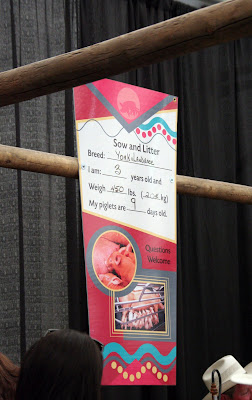 This is what surprised Adam and I the most, and isn't something you would likely see anywhere in an "educate the public" related event.
 A gilt and her piglets, in a farrowing crate. This display was packed with people, and clearly showed the pigs were all content in their crate. The mother had access to food and water, and her babies weren't getting squished. It showed hog farmers in a great light, as they should be represented.
 People swarmed to get a glimpse of the momma and baby pigs, and as a result were exposed to what a farrowing crate really looks like, and how and why farmer's use them. See that man siting on the far side of the picture, he was the hog farmer, and man was he popular with these people, who had questions and comments to discuss with him. Loved this!

Hello giant tent in the center of Calgary Stampede grounds, which is filled with live animals, a grain bin, computer programs about growing healthy crops, people in the industry to visit with you, posters, interactive activities and more, all with the intention of educating and showing people what Alberta agriculture is all about, why it's important, what they do to produce a safe food source, and countless other facts, figures and examples of ags importance to the country.One sheep producers that was working in the tent informed us there is a people counter at the entrances, and at or over 35,000 people a day go through this during the Calgary Stampede.
That's over half of Wyoming's population that walks through this educational tent over the course of the Stampede.
Wow! That's a lot of people not tied to agriculture getting a realistic, positive look at what ag is all about, and what the people involved in ag do to put food on their tables. I'm thinking we Americans should take a look at what they're doing, so I took pictures of some of the things in the tent to show you.
 There were educational charts that explained the value of agriculture produced foods, like beef, in a health diet. We use this same ZIP acronym here in America. There were also drawings for beef related prizes.
 Interactive activities taught people about their food, like this one that showed where different cuts of meat were located on the animal.The live animals were a huge hit with people of all ages. Here is the milk cow exhibit, which featured cows of different breeds, history of milk cows, differences between breeds, and other general information. At each animal station were producers to answer questions.
 Right next to the milk cows was a dairy area, fittingly enough. More positive facts and figures about milk and dairy in a healthy diet.
 Everything you can see had a purpose, and made a point about milk and dairy products. The tent was bursting with positive, truthful information, backed by facts, and made interesting to see and read about.
 You could also participate in interactive activities, like milking Bluebell. Based on the line, Bluebell got milked A LOT over the course of the Stampede, and was a huge hit!
 There were computer stations for kids, where they could learn about what it takes to grow healthy plants, and what Alberta farmers do to grow the food they eat.
 A grain bin was set up to show people how grains were harvested and stored.
 Lots of stuff for both kids and adults!
 Agriculture doesn't just feed you, and the Canadians covered other ways it benefits their country, like showing how oilseed crops are used to produce biodiesel.
 You could spin this plate around, and read different facts about Alberta lamb in the cut-out window.
 As I mentioned earlier, the animals were by far the biggest hit. Here is the sheep exhibit.
 No opportunity to share information was missed, and people were stopping to read it.
 We visited with this man for quite a while - he's who told us about the numbers of people that go through each day. He was there to tell people about sheep, and was happy to do so.
 This is what surprised Adam and I the most, and isn't something you would likely see anywhere in an "educate the public" related event.
 A gilt and her piglets, in a farrowing crate. This display was packed with people, and clearly showed the pigs were all content in their crate. The mother had access to food and water, and her babies weren't getting squished. It showed hog farmers in a great light, as they should be represented.
 People swarmed to get a glimpse of the momma and baby pigs, and as a result were exposed to what a farrowing crate really looks like, and how and why farmer's use them. See that man siting on the far side of the picture, he was the hog farmer, and man was he popular with these people, who had questions and comments to discuss with him. Loved this!
Also in the pig area were some weaner pigs, and a young boy (on the right) to tell people about them.
I was so impressed by this tent, and the huge impact it has in a just few days each year! I think it's an ingenious idea. As someone who lives in Wyoming, where another of the largest outdoor shows on earth (Cheyenne Frontier Days) occurs, and in one of the most agriculture-oriented states in our nation, I can't help but think of the potential to do something similar for tourists that attend our event. Great work Canadian agriculture!
Wednesday, March 30, 2011
Sassy's calf
Here is another cow of note for you. You can read about why I do these posts highlighting specific cows here.
This particular cow of mine makes the list for multiple reasons.
 I only kept this cow as a replacement heifer because she is out of my first cow/show heifer, Sassy (I will have to find a picture of Sassy and get it on here for you guys), and ended up being the last heifer calf Sassy had. While not the best looking cow, and a little lighter, narrower and ganglier than her counterparts, being out of Sassy was enough to tip the scale in her favor when selecting my replacement heifers.
What a great decision that turned out to be! She grew up to be a gangly, long, lighter weight cow than our average. She isn't a show stopper on looks by any means. But, this lightweight cow weaned the second heaviest calf in our herd last year (I did a happy dance when I this happened).
She also produces heifer calves that are more of the type, looks wise, that I prefer. All in all she has been a great asset to my cowherd.
Now, this shouldn't surprise me, as her mother was also a small cow, weighing in at about 950 pounds. To give you a comparison, our average cow probably weighed about 1,100 pounds during the time Sassy was young.
Before EPD's, and some of the other newer selection tools, one thing that ranchers weighed a cow's production on was the weight of the calf she weaned. If she wasn't weaning half her body weight each year, she wasn't doing a good enough job. Some people still go by this measurement of production.
Well, little 950 pound Sassy would consistently wean 550 pound calves, and they would continue to grow and gain to mature sizes far exceeding her small stature. This cow represents the last of my herd directly derived from Sassy, and she also posts impressive production records.
So, she is a cow of note because of her pedigree, and the outstanding calves she produces!

This particular cow of mine makes the list for multiple reasons.
 I only kept this cow as a replacement heifer because she is out of my first cow/show heifer, Sassy (I will have to find a picture of Sassy and get it on here for you guys), and ended up being the last heifer calf Sassy had. While not the best looking cow, and a little lighter, narrower and ganglier than her counterparts, being out of Sassy was enough to tip the scale in her favor when selecting my replacement heifers.
What a great decision that turned out to be! She grew up to be a gangly, long, lighter weight cow than our average. She isn't a show stopper on looks by any means. But, this lightweight cow weaned the second heaviest calf in our herd last year (I did a happy dance when I this happened).
She also produces heifer calves that are more of the type, looks wise, that I prefer. All in all she has been a great asset to my cowherd.
Now, this shouldn't surprise me, as her mother was also a small cow, weighing in at about 950 pounds. To give you a comparison, our average cow probably weighed about 1,100 pounds during the time Sassy was young.
Before EPD's, and some of the other newer selection tools, one thing that ranchers weighed a cow's production on was the weight of the calf she weaned. If she wasn't weaning half her body weight each year, she wasn't doing a good enough job. Some people still go by this measurement of production.
Well, little 950 pound Sassy would consistently wean 550 pound calves, and they would continue to grow and gain to mature sizes far exceeding her small stature. This cow represents the last of my herd directly derived from Sassy, and she also posts impressive production records.
So, she is a cow of note because of her pedigree, and the outstanding calves she produces!

Monday, January 24, 2011
Cows of Note: Astoundingly Athletic
Here is another "cow of note" for you. Number 4 over 18 (We will have to cover ear tags, soon), may look like just another black cow amongst the bunch.
 That's her in the middle.Watching me.
But, Number 18, as we refer to her, is definitely a cow of note. She is a nervous sort. The cow you will see with her head stuck up, always watching you. The one you've taken your rope down for as you watch her nervously move through the bunch, but one you don't have to rope, at least not now that she's a little older.
That's her in the middle.Watching me.
But, Number 18, as we refer to her, is definitely a cow of note. She is a nervous sort. The cow you will see with her head stuck up, always watching you. The one you've taken your rope down for as you watch her nervously move through the bunch, but one you don't have to rope, at least not now that she's a little older.
This doesn't mean we haven't had our issues. When she was a three-year old, I had to move her and the other cows her age from one end of the ranch to the other. Every chance she got she would take off at a dead run, attempting to get away. Now, on our operation you don't let a cow get away. This results in them knowing they can get away, and practicing the art every chance they get, and we don't put up with that.
Also, if I could rope well, I definitely would have stretched her out on this particular day.
But, I was alone, and had 40 other cows to move along with her, and potentially losing everyone else while attempting to rope one didn't sound like the best idea. So, every time she would do this little stunt, I would get a little more mad as I loped out and gathered her back up.
I finally decided that I would just air her out, and every time she so much as stuck her nose out of the bunch I would take her on a big, fast circle down across draws or up over rocky hills. She never faltered, or slowed down. I've never had a cow keep trying, at that speed, for that long.
By the time we reached the pasture, my horse, myself, and all the other pairs were aired out. The only thing not sucking major air was Number 18. She was feeling it, but not compared to everyone else involved in the situation.
Dang, she's athletic I thought. Fast too...
The next time we moved cows, my brother pulled up on his motorcycle toward the end of the move and commented, "Man, have you ever seen Number 18, she's fast. I had to air her out a couple times."
"Yep..."
However, these lessons (and quite possibly another one, involving a rope, that I didn't hear about) did prevent this "run off" issue in the future. She isn't dumb, but she maintained her nervous disposition, and is almost always in the lead when we're moving cows. She just goes the right way pretty much without issue these days.
She also gets a little tense when you're in the alley with her, and you don't want to put some idiot in there who will poke her a lot. Like I said at the beginning, she's the cow with her head up, watching you, making you think she's going to break for it, and keeping you on your toes.
She's never had a bad experience beyond my one spring morning of cardio, that I'm aware of. Just like people, cattle have different dispositions, and her's isn't a mellow one.
Another thing about our operation is that if cows are a little nervous, (and by this I don't mean the fence crawling, run your over variety, I just mean they aren't milk cow tame) we are willing to put up with them if they're good mothers, which is often the case.
We calve on the range, and our cows are expected to have a healthy calf without any help. Number 18 does this, and on that spring morning when I was making an example of her, she never lost her great big heifer calf for split second.
She's another one almost everyone can pick out almost immediately.

 That's her in the middle.Watching me.
This doesn't mean we haven't had our issues. When she was a three-year old, I had to move her and the other cows her age from one end of the ranch to the other. Every chance she got she would take off at a dead run, attempting to get away. Now, on our operation you don't let a cow get away. This results in them knowing they can get away, and practicing the art every chance they get, and we don't put up with that.
Also, if I could rope well, I definitely would have stretched her out on this particular day.
But, I was alone, and had 40 other cows to move along with her, and potentially losing everyone else while attempting to rope one didn't sound like the best idea. So, every time she would do this little stunt, I would get a little more mad as I loped out and gathered her back up.
I finally decided that I would just air her out, and every time she so much as stuck her nose out of the bunch I would take her on a big, fast circle down across draws or up over rocky hills. She never faltered, or slowed down. I've never had a cow keep trying, at that speed, for that long.
By the time we reached the pasture, my horse, myself, and all the other pairs were aired out. The only thing not sucking major air was Number 18. She was feeling it, but not compared to everyone else involved in the situation.
Dang, she's athletic I thought. Fast too...
The next time we moved cows, my brother pulled up on his motorcycle toward the end of the move and commented, "Man, have you ever seen Number 18, she's fast. I had to air her out a couple times."
"Yep..."
However, these lessons (and quite possibly another one, involving a rope, that I didn't hear about) did prevent this "run off" issue in the future. She isn't dumb, but she maintained her nervous disposition, and is almost always in the lead when we're moving cows. She just goes the right way pretty much without issue these days.
She also gets a little tense when you're in the alley with her, and you don't want to put some idiot in there who will poke her a lot. Like I said at the beginning, she's the cow with her head up, watching you, making you think she's going to break for it, and keeping you on your toes.
She's never had a bad experience beyond my one spring morning of cardio, that I'm aware of. Just like people, cattle have different dispositions, and her's isn't a mellow one.
Another thing about our operation is that if cows are a little nervous, (and by this I don't mean the fence crawling, run your over variety, I just mean they aren't milk cow tame) we are willing to put up with them if they're good mothers, which is often the case.
We calve on the range, and our cows are expected to have a healthy calf without any help. Number 18 does this, and on that spring morning when I was making an example of her, she never lost her great big heifer calf for split second.
She's another one almost everyone can pick out almost immediately.


Thursday, January 13, 2011
It must be so...
If you're a person who doesn't know about animal agriculture, you may search the Internet for information. That search may lead to places like the Humane Society of the United States, PETA, or other "pro-animal" (I use the term very loosely), a.k.a. anti-agriculture sites.
One of their most effective promotional tools are videos they post that show the alleged mistreatment of animals by farmers and ranchers. Well, I'm here to tell you those videos hit so far away from reality, you can't even see reality from them.
I've seen them. I couldn't finish a couple of them.
Let me put this in perspective for you.
Thinking that all farmers and ranchers treat their animals the way some videos portray things is like me searching for videos of dog owners, and coming across a vicious video of dog fighting, then assuming all dog owners must treat their "pets" in such a fashion. I mean, I saw the video, and this website told me that's what all dog owners in such and such location do. It must be true, right?
Wrong!
Does that make sense?
Those videos, and other information presented by those sites, is way off base, and represents such a small percentage of people with animals it would never show up statistically. If anyone in agriculture that I know saw treatment similar to that seen in those videos, they would put a stop to it on the spot.
I've also noticed in the ones I've watched that they're usually very old, and I have no idea where they got the footage, but it wasn't in America any time in recent history.
Whats more, those of us in production agriculture are possibly even more angered, upset, and hurt by those videos than people who don't own animals. We have animals ourselves, and we work hard every single day to prevent them from suffering any harm. The acts portrayed in those pieces of footage make us out to be something we're not, and that's a big concern to us.
Most dog owners are caring, compassionate people toward their pets. The same is true for people in agriculture. We also have to make a living off our animals, and that combined with our genuine care for them results in treatment that would never purposely cause harm or discomfort. Instead, we care for them in a way designed to make them happy, because happy animals perform better, and happy, high performing animals make for happy producers.
If you want to know more about animal agriculture, feel free to comment or email me at doublehphoto@live.com.
You can also check out a few accurate websites, including:
Real Ranchers
National Institute for Animal Agriculture
Life on a Kansas Cattle Ranch
Agriculture Proud
Extension Services
One of their most effective promotional tools are videos they post that show the alleged mistreatment of animals by farmers and ranchers. Well, I'm here to tell you those videos hit so far away from reality, you can't even see reality from them.
I've seen them. I couldn't finish a couple of them.
Let me put this in perspective for you.
Thinking that all farmers and ranchers treat their animals the way some videos portray things is like me searching for videos of dog owners, and coming across a vicious video of dog fighting, then assuming all dog owners must treat their "pets" in such a fashion. I mean, I saw the video, and this website told me that's what all dog owners in such and such location do. It must be true, right?
Wrong!
Does that make sense?
Those videos, and other information presented by those sites, is way off base, and represents such a small percentage of people with animals it would never show up statistically. If anyone in agriculture that I know saw treatment similar to that seen in those videos, they would put a stop to it on the spot.
I've also noticed in the ones I've watched that they're usually very old, and I have no idea where they got the footage, but it wasn't in America any time in recent history.
Whats more, those of us in production agriculture are possibly even more angered, upset, and hurt by those videos than people who don't own animals. We have animals ourselves, and we work hard every single day to prevent them from suffering any harm. The acts portrayed in those pieces of footage make us out to be something we're not, and that's a big concern to us.
Most dog owners are caring, compassionate people toward their pets. The same is true for people in agriculture. We also have to make a living off our animals, and that combined with our genuine care for them results in treatment that would never purposely cause harm or discomfort. Instead, we care for them in a way designed to make them happy, because happy animals perform better, and happy, high performing animals make for happy producers.
If you want to know more about animal agriculture, feel free to comment or email me at doublehphoto@live.com.
You can also check out a few accurate websites, including:
Real Ranchers
National Institute for Animal Agriculture
Life on a Kansas Cattle Ranch
Agriculture Proud
Extension Services
Tuesday, January 11, 2011
NWSS
This week I am at the National Western Stock Show (NWSS) in Denver, Colorado. I have been busy navigating slick and snow packed roads in the new Roundup vehicle (which makes me even more nervous about Denver traffic), sloshing through the muddy and icy yards, taking in the booths on the hill, and interviewing the person for our feature spot in this weeks paper.
Today I am attending the International Livestock Congress for the paper. Of everything I've attended in the last year for the Roundup, this is the one I found most educational and was most looking forward to attending again. It covers a number of international agriculture topics, and provides a great look into agriculture worldwide.
I am very excited about the topics being covered today.
For instance, I just learned that the top 10 in demand jobs in 2010 didn't exist in 2004, and that one out of 8 couples married last year met online, and that predictions are that by 2049 a $1,000 computer will exceed the intelligence of the entire human race.
These tidbits were listed to demonstrate that the agriculture industry's consumer demographic is changing, and we have to be proactive and aggressive to keep up with them.
I'm sure in the days and weeks to come I will cover a number of the topics presented at the Congress, and the NWSS.
Today I am attending the International Livestock Congress for the paper. Of everything I've attended in the last year for the Roundup, this is the one I found most educational and was most looking forward to attending again. It covers a number of international agriculture topics, and provides a great look into agriculture worldwide.
I am very excited about the topics being covered today.
For instance, I just learned that the top 10 in demand jobs in 2010 didn't exist in 2004, and that one out of 8 couples married last year met online, and that predictions are that by 2049 a $1,000 computer will exceed the intelligence of the entire human race.
These tidbits were listed to demonstrate that the agriculture industry's consumer demographic is changing, and we have to be proactive and aggressive to keep up with them.
I'm sure in the days and weeks to come I will cover a number of the topics presented at the Congress, and the NWSS.
Subscribe to:
Posts (Atom)